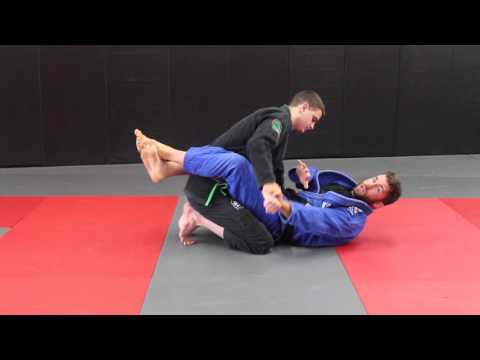
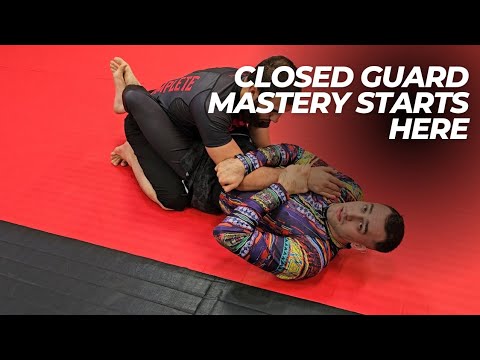
Easy to Use Entire Closed Guard System
0
Low Closed Guard·JonThomasBJJ
This video I go through in my opinion the most simple and effective closed guard system you can use. Often in BJJ new s…
Translation: low closed guard
The Low Closed Guard positions the guard player's legs around the opponent's waist at hip level, with ankles crossed below the small of the back. [1] The low guard is the standard, neutral closed guard position that provides a balance of control, sweep ability, and submission options. [1],[2] While the low guard provides less posture-breaking capability than the high guard, it is more secure against guard-opening attempts and provides a stable base for sweep attacks. [2],[3]
Low closed guard positions the legs around the opponent's waist, providing control of distance and hip movement. [1]
Low guard is the default closed guard position and the first guard taught in BJJ. [1]
Low closed guard is the most common closed guard variant in competition. [1]
No images yet for this technique.
Sign in to suggest an image.
This video I go through in my opinion the most simple and effective closed guard system you can use. Often in BJJ new s…
www.Chewjitsu.net In this video I show a kimura from closed guard. The kimura from closed guard is one of the essenti…
🔺 Welcome to IsakIvanovicjj - Your Gateway to BJJ Mastery! 🔺 📚 Today's Lesson: "Elevated Basics: The Ultimate No-Gi …
The low closed guard represents a foundational grappling position where the top player's posture is broken down and compressed toward the guard player's body. JonThomasBJJ emphasizes the critical importance of breaking the opponent's posture by pulling the knees to the chest and creating an off-balance crunch motion, then systematizing responses to four primary framing positions (both hands low, both hands high, one high/one low, and hands on chest). IsakIvanovicjj stresses that closed guard derives its power from leg strength rather than hand pulling, advocating for control of inside hand position and emphasizing the top lock—an elevated position where the legs wrap above the shoulder—as a fundamental offensive staging ground for armbars, triangles, and sweeps. Both instructors agree that isolating the opponent's elbow to the guard player's centerline is essential for technical execution. Chewjitsu focuses specifically on the Kimura setup from low closed guard, detailing the mechanics of breaking posture, targeting the wrist (not forearm) during the grip, maintaining an extended arm to prevent escape, and executing a hip escape shift before sitting up to the side to lock the figure-four. All three instructors converge on the principle that closed guard offense flows from posture disruption and systematic arm trapping, with transitions between submissions based on opponent resistance patterns.
Synthesized from 3 instructors
No instructional courses yet for this technique.
Sign in to suggest a course.
Risk of injury to the person this technique is applied to
Guard positions are defensive; injury risk comes from transitions, not the position itself
Skill level needed to execute this technique reliably
Whether this technique is allowed under major competition rule sets
Jiu-Jitsu University (Saulo Ribeiro, 2008)
Alias sources — [1] IBJJF Rules (2024) [2] Jiu-Jitsu University (Ribeiro, 2008) [3] The Guard (Moreira & Beneville, 2003)
Effectiveness sources — [1] Mastering Jujitsu (Gracie & Danaher, 2003)
Standard katakana transliteration of Western martial arts terminology (外来語) — used in Japanese MMA, boxing, and BJJ communities
Alias sources — [1] IBJJF Rules (2024) [2] Jiu-Jitsu University (Ribeiro, 2008) [3] The Guard (Moreira & Beneville, 2003)
Effectiveness sources — [1] Mastering Jujitsu (Gracie & Danaher, 2003)
hip flexibility, active legs, grip management
long legs for distance control and guard retention
hip flexors, adductors, quadriceps, core, grip
Isolate your opponent's arm by trapping it, then shrimp out to your side while blocking their bicep. This positioning makes it easier to bring your leg out for the triangle. Once you have the triangle locked, bridge your hips and push their arm across their body to prevent them from posturing, then adjust your leg position so their neck cuts in tightly like a nutcracker for maximum finishing power.
Use your knees and legs to pull your opponent in rather than relying only on your hands pulling—your legs and core are much stronger and what actually makes closed guard really strong. Isak Ivanovic emphasizes that closed guard is a battle for inside hand position, so work to keep your hands in the middle where you can control their head and set up submissions.
Pummel your arm underneath theirs and drop their elbows down, then quickly switch to grab a collar grip while pinning your elbow to their chest. Once you repummel underneath and pin the elbow, they cannot repummel back, giving you solid control for collar choke attacks.
Jon Thomas explains that no matter how good you are at one technique like an armbar, if your opponent is defending it and exposing a collar choke, you need to switch to the collar choke—it's how techniques connect together that matters most, not just the individual techniques themselves.
The Low Closed Guard positions the guard player's legs around the opponent's waist at hip level, with ankles crossed below the small of the back. The low guard is the standard, neutral closed guard position that provides a balance of control, sweep ability, and submission options.
The low closed guard is the default closed guard position taught to beginners, representing the most natural and intuitive way to lock the legs around an opponent. It has been the standard starting position for closed guard instruction since BJJ's earliest curriculum development.
IBJJF: legal — Legal — guard is fundamental to BJJ, sweeps from guard score 2 points; IJF: restricted — Guard pulling penalized as non-combativity — groundwork from guard permitted …; ADCC: legal — Legal, guard pull penalized -1 point in points portion; Unified MMA: legal — Legal — no penalty for playing guard; FIAS Sport Sambo: legal — Legal
Danger rating 2/10. Low — guard positions are defensive; injury risk comes from transitions, not the position itself
The standard setup chain: Achieve Guard Contact → Control Grips → Manage Distance → Threaten Submissions/Sweeps.
Standard counters include: Guard Pass — systematically work to clear the legs and establish a dominant position / Leg Pin — control one or both legs to neutralize guard retention / Pressure Passing — use heavy chest pressure to flatten and immobilize the guard player.
Common variants: High closed guard (legs high on the back for tighter control and more submis…); Low closed guard (ankles locked at the waist, controlling posture with grips); Body-lock closed guard (wrapping with both overhooks for tight breaking mechanics).
Low closed guard is the most common closed guard variant in competition.
Top errors to watch for: Staying exclusively in low guard without climbing to high guard when submissions are available — low guard is for swe… / Not using the hip bump sweep from low guard — the hip bump is the most effective sweep from the low lock position / Playing low guard without active grips — the grips create the attack opportunities / Keeping the legs locked loosely at the hips — maintain strong adductor squeeze.
The Low Closed Guard is also known as Rō Kurōzudo Gādo, Low Guard, Hip Guard, Low Full Guard.