Introduction to Closed Guard Fundamentals
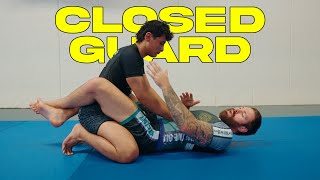
Closed guard functions as an inverted mount position, offering superior safety and control in Brazilian Jiu-Jitsu. The practitioner uses legs and hands against the opponent's upper body to establish site control and transition opportunities. Unlike most positions, closed guard severely limits high-percentage attacks from the bottom opponent, forcing them to stand and disengage.
The Role of Leg Engagement and Hand Positioning
Closed guard derives its strength from leg and core engagement rather than hand pulling alone. The battle for inside hand position determines offensive capability—hands in the middle enable head control, overhooks, and shoulder techniques. Preventing the opponent from establishing inside hand position on the legs is critical to maintaining pressure and preventing posturing.
Establishing the Top Lock Position
Once the opponent places hands in the armpits, the practitioner controls their four fingers and transitions to an elbow grip. The elbow must be pulled inside the hip to enable leg climbing for submissions. By swapping to a head control grip and placing the foot on the opponent's hip, the practitioner locks their legs above the opponent's shoulder in the top lock—a fundamental offensive platform.
Armbar Setup and Execution from Top Lock
From the top lock with maintained head control, the practitioner underhooks the leg and cuts the angle using the back of the knee and quadriceps. The leg slides directly over the opponent's head without a wide arc that enables escape. The practitioner secures back heel position on top of the head and can finish the armbar by grabbing the thumb and breaking it over the hip.
Triangle and Reverse Triangle Adjustments
If the opponent extracts their arm while the practitioner opens their legs, a triangle opportunity presents itself. Should the opponent hide their arm, the practitioner transitions to a reverse triangle by grabbing their shin and locking a full figure-four grip. This position sets up the kimura as the next offensive option.
Kimura Setup and Finishing Details
From the reverse triangle, the practitioner uses their fingers to peel the opponent's wrist away from their body. Once visible, they establish a kimura grip and drive the opponent's elbow toward the sternum before lifting. The submission's power derives from complete shoulder and head locking—requiring only millimeter-level adjustments rather than full arm displacement.
High Cross Sweep to Mount
The high cross sweep transitions from closed guard to mount by controlling the opponent's inside hand and positioning perpendicular to their body. The practitioner brings hands underneath and secures a head and thigh grip while helicoptering the legs to generate momentum. Leg scissors and pulling with the opposite arm complete the sweep, leading to mount consolidation with underhook control.
Shoulder Crunch Grip Setup for Back Take
The shoulder crunch represents the highest-percentage back take from closed guard in no-gi grappling. The practitioner establishes the position by feinting a hip bump to elicit the opponent's weight commitment, then switching direction explosively. A wrist-to-wrist grip with the elbow pinched tight against the head creates the tightest possible shoulder crunch and breaks the opponent's posture.
Elevated Basics: The Ultimate No-Gi Closed Guard Guide
Key Takeaways
- •Introduction to Closed Guard Fundamentals
- •The Role of Leg Engagement and Hand Positioning
- •Establishing the Top Lock Position
- •Armbar Setup and Execution from Top Lock
🔺 Welcome to IsakIvanovicjj - Your Gateway to BJJ Mastery! 🔺 📚 Today's Lesson: "Elevated Basics: The Ultimate No-Gi Closed Guard Guide" 🥋 Are you ready to transform your No-Gi Closed Guard game? Dive into our comprehensive guide, where we unravel the secrets and advanced fundamentals of No-Gi Closed Guard. 🌟 What You'll Learn: - The key elements that turn basic Closed Guard techniques into powerful tools. - In-depth breakdowns of high-efficiency moves and controls in the No-Gi setting. - Rare and highly effective details that elevate your ground game. 🔗 Stay Connected: - Follow on Instagram: @IsakIvanovicjj 🛒 Gear Up: Looking to upgrade your training gear? Check out our latest collection at [MatMerchants.com](http://www.matmerchants.com) for premium BJJ apparel and accessories. 📈 Enhance Your Skills: If you're finding this video helpful, please like, share with your training partners, and don't forget to subscribe for more in-depth guides and techniques. 🙏 Appreciate your support: Thank you for watching! Your journey to mastering BJJ is important to us. Keep training, keep improving, and see you on the mats! Remember, "Elevated Basics" aren't just techniques; they're the building blocks to mastering the art of Brazilian Jiu-Jitsu! 🥋
Related Techniques
Frequently Asked Questions
What does this video teach about low closed guard?
This video covers introduction to closed guard fundamentals, the role of leg engagement and hand positioning, establishing the top lock position. It provides detailed instruction from IsakIvanovicjj.
How long does it take to learn low closed guard?
The basic mechanics can be understood in a single session, but developing reliable execution requires consistent drilling over weeks of practice. This 8-part breakdown helps structure your training by isolating each phase of the technique.
What are the key details for finishing low closed guard?
The high cross sweep transitions from closed guard to mount by controlling the opponent's inside hand and positioning perpendicular to their body. The practitioner brings hands underneath and secures a head and thigh grip while helicoptering the legs to generate momentum. Leg scissors and pulling with the opposite arm complete the sweep, leading to mount consolidation with underhook control.
Related videos
Kimura From Closed Guard For White Belts (Small Details To Improve Success)
Chewjitsu
Easy to Use Entire Closed Guard System
JonThomasBJJ
How to do the Guillotine in Jiu Jitsu | Everything You Need to Know!
Matt Arroyo Jiu Jitsu
Elevated Basics: The Ultimate No-Gi Closed Guard Guide
IsakIvanovicjj
How to Create Angles in Closed Guard Like Gordon Ryan
Gordon Ryan