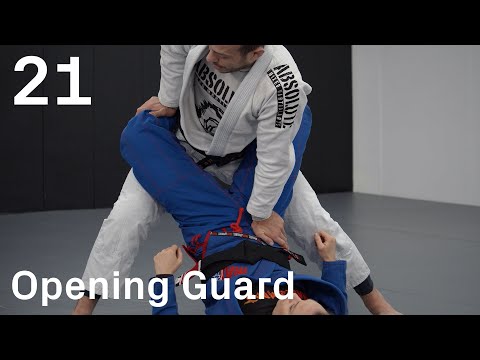
Opening The Closed Guard
0
Standard Closed Guard·Absolute MMA St Kilda - Melbourne
Full Course Playlist → https://youtube.com/playlist?list=PLDrQXekZsfYZfV1QZ4T5UkxLwFwQ12EbP Find the Introduction course…
Translation: standard closed guard
The Standard Closed Guard subfamily covers the basic closed guard configurations focused on maintaining the position, controlling distance, and managing the opponent's posture before setting up attacks. [1] Standard closed guard positions represent the neutral starting point from which the guard player works to establish attacking grips and off-balance the opponent. [1],[2] The standard closed guard includes high guard (legs high on the opponent's back) and low guard (legs around the waist), each providing different tactical options. [2],[3]
Closed guard is the most fundamental guard position in BJJ, emphasised by the Gracie family as a defensive and offensive platform. [1]
Closed guard is the most commonly played guard in BJJ competition at lower belt levels and remains effective at all levels. [1]
No images yet for this technique.
Sign in to suggest an image.
Full Course Playlist → https://youtube.com/playlist?list=PLDrQXekZsfYZfV1QZ4T5UkxLwFwQ12EbP Find the Introduction course…
No instructional courses yet for this technique.
Sign in to suggest a course.
Risk of injury to the person this technique is applied to
Guard positions are defensive; injury risk comes from transitions, not the position itself
Skill level needed to execute this technique reliably
Whether this technique is allowed under major competition rule sets
Drysdale, Robert. Opening Closed-Guard: The Origins of Jiu-Jitsu in Brazil (2020). ISBN: 979-8680602287
Drysdale's book title directly references the closed guard as central to BJJ's origins and development
Standard katakana transliteration of Western martial arts terminology (外来語) — used in Japanese MMA, boxing, and BJJ communities
Drysdale's book title directly references the closed guard as central to BJJ's origins and development
hip flexibility, active legs, grip management
long legs for distance control and guard retention
hip flexors, adductors, quadriceps, core, grip
Every move, in any martial art, shares a few universal traits. Mix and match below to pinpoint the right tool — or compare equivalents across styles.
The High Closed Guard positions the guard player's legs high on the opponent's back, with the ankles crossed near the shoulder blades rather than around the waist. [1] The high guard breaks the opponent's posture more effectively than the low guard because the elevated legs pull the opponent's upper body down, making it difficult for them to posture up. [1,2] The high closed guard is particularly effective for setting up armbar, triangle, and omoplata attacks because the legs are already in position near the opponent's shoulders. [2,3]
The Low Closed Guard positions the guard player's legs around the opponent's waist at hip level, with ankles crossed below the small of the back. [1] The low guard is the standard, neutral closed guard position that provides a balance of control, sweep ability, and submission options. [1,2] While the low guard provides less posture-breaking capability than the high guard, it is more secure against guard-opening attempts and provides a stable base for sweep attacks. [2,3]
Maintain good posture and stay square with your opponent. When your posture breaks down, your opponent can isolate your limbs and attack submissions like armbars or triangles. Keep both arms in front and ready to block rather than reaching underneath, which exposes you to arm isolation.
Stand up to create pressure, then push on the shin just below the knee and drop your weight to open the legs. Once open, pin the leg with your knee to prevent your opponent from re-closing the guard. This approach uses leverage effectively—trying to open the guard while staying low or using elbows won't work.
Place one hand high on the shoulders to prevent your posture from breaking and one hand low on the hips to stop your opponent from moving higher and isolating an arm. Keep your arms straight with elbows extended—bending your elbows weakens your control and allows your opponent to fold your arm.
Pushing the knee doesn't separate the feet and can actually keep them closer together. Instead, push on the shin just below the knee while dropping your weight—this creates the proper leverage to unlock the guard at the feet.
The Standard Closed Guard subfamily covers the basic closed guard configurations focused on maintaining the position, controlling distance, and managing the opponent's posture before setting up attacks. Standard closed guard positions represent the neutral starting point from which the guard player works to establish attacking grips and off-balance the opponent.
The standard closed guard represents the foundational guard position of BJJ, the first ground position most students learn and the starting point for all closed guard technique. It has been central to BJJ since the Gracie family's original development of the art.
IBJJF: legal — Legal — guard is fundamental to BJJ, sweeps from guard score 2 points; IJF: restricted — Guard pulling penalized as non-combativity — groundwork from guard permitted …; ADCC: legal — Legal, guard pull penalized -1 point in points portion; Unified MMA: legal — Legal — no penalty for playing guard; FIAS Sport Sambo: legal — Legal
Danger rating 2/10. Low — guard positions are defensive; injury risk comes from transitions, not the position itself
The standard setup chain: Achieve Guard Contact → Control Grips → Manage Distance → Threaten Submissions/Sweeps.
Standard counters include: Guard Pass — systematically work to clear the legs and establish a dominant position / Leg Pin — control one or both legs to neutralize guard retention / Pressure Passing — use heavy chest pressure to flatten and immobilize the guard player.
Common variants: High closed guard (legs high on the back for tighter control and more submis…); Low closed guard (ankles locked at the waist, controlling posture with grips); Body-lock closed guard (wrapping with both overhooks for tight breaking mechanics).
Closed guard is the most commonly played guard in BJJ competition at lower belt levels and remains effective at all levels.
Top errors to watch for: Lying flat on the back without angling the hips — the hips must move to create attack opportunities / Locking the ankles without squeezing — passive legs give the opponent freedom to posture and pass / Not controlling the opponent's posture as the first priority — break posture before anything else / Keeping the arms at the sides without gripping — establish controlling grips immediately.
The Standard Closed Guard is also known as Sutandādo Kurōzudo Gādo, Basic Closed Guard, Legs-Locked Guard, Full Guard.