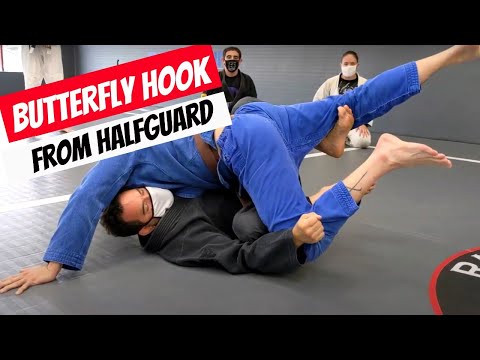
Use your Butterfly Hook from Half Guard
0
Single Butterfly Hook·Eduardo Fraga BJJ
Prof. Eduardo teaches how to use your shin hook from a poor position in half guard in order to recover to the full guard…
Translation: single butterfly hook
The Single Butterfly Hook subfamily covers positions where only one butterfly hook is inserted inside the opponent's thigh, with the other leg positioned differently — on the hip, on the mat, or in another guard configuration. [1] The single butterfly hook is a common transitional position and serves as an entry point to full butterfly guard, X-guard, and single leg X-guard. [1],[2] While providing less control than double hooks, the single butterfly hook offers more flexibility for transitions and can be combined with other guard elements. [2],[3]
The single butterfly hook position is recognised as both a transitional state and a guard position in its own right, used extensively in the butterfly guard system as an entry point to various attacks and transitions. [1] Its versatility as a gateway to multiple guard positions makes it a frequently encountered position in competition. [2],[3]
The single butterfly hook uses one hook inside the opponent's thigh, often as a transitional guard or half butterfly position. [1]
The single butterfly hook is a transitional and deliberate guard position in modern BJJ. [1]
The single butterfly hook is commonly used in BJJ competition as a guard recovery and sweep platform. [1]
No images yet for this technique.
Sign in to suggest an image.
Prof. Eduardo teaches how to use your shin hook from a poor position in half guard in order to recover to the full guard…
No instructional courses yet for this technique.
Sign in to suggest a course.
Risk of injury to the person this technique is applied to
Guard positions are defensive; injury risk comes from transitions, not the position itself
Skill level needed to execute this technique reliably
Whether this technique is allowed under major competition rule sets
Advanced Brazilian Jiu-Jitsu Techniques (Marcelo Garcia, 2011)
Alias sources — [1] Jiu-Jitsu University (Ribeiro, 2008) [2] The Guard (Moreira & Beneville, 2003) [3] Marcelo Garcia: Advanced BJJ Techniques (2011)
Effectiveness sources — [1] Jiu-Jitsu University (Ribeiro, 2008)
Standard katakana transliteration of Western martial arts terminology (外来語) — used in Japanese MMA, boxing, and BJJ communities
Alias sources — [1] Jiu-Jitsu University (Ribeiro, 2008) [2] The Guard (Moreira & Beneville, 2003) [3] Marcelo Garcia: Advanced BJJ Techniques (2011)
Effectiveness sources — [1] Jiu-Jitsu University (Ribeiro, 2008)
hip flexibility, active legs, grip management
long legs for distance control and guard retention
hip flexors, adductors, quadriceps, core, grip
Every move, in any martial art, shares a few universal traits. Mix and match below to pinpoint the right tool — or compare equivalents across styles.
Get a grip on your opponent's hip, hip out to create space, and lock your hook in. Eduardo Fraga emphasizes that you need to pull your opponent back heavily on your shoulder to control them before executing any sweep.
Driving their weight forward onto your hook is a huge mistake—the more pressure they apply, the easier the sweep becomes. Eduardo Fraga points out this weight distribution error makes the technique significantly more effective.
Keep the knee attached to your hook off the mat and think about pushing your foot out rather than focusing on the knee position, as your foot can get stuck otherwise. When transitioning to mount, you must move immediately rather than placing your knee down, or your opponent will trap your foot.
The Single Butterfly Hook subfamily covers positions where only one butterfly hook is inserted inside the opponent's thigh, with the other leg positioned differently — on the hip, on the mat, or in another guard configuration. The single butterfly hook is a common transitional position and serves as an entry point to full butterfly guard, X-guard, and single leg X-guard.
The single butterfly hook position is recognised as both a transitional state and a guard position in its own right, used extensively in the butterfly guard system as an entry point to various attacks and transitions. Its versatility as a gateway to multiple guard positions makes it a frequently encountered position in competition.
IBJJF: legal — Legal — guard is fundamental to BJJ, sweeps from guard score 2 points; IJF: restricted — Guard pulling penalized as non-combativity — groundwork from guard permitted …; ADCC: legal — Legal, guard pull penalized -1 point in points portion; Unified MMA: legal — Legal — no penalty for playing guard; FIAS Sport Sambo: legal — Legal
Danger rating 2/10. Low — guard positions are defensive; injury risk comes from transitions, not the position itself
The standard setup chain: Achieve Guard Contact → Control Grips → Manage Distance → Threaten Submissions/Sweeps.
Standard counters include: Guard Pass — systematically work to clear the legs and establish a dominant position / Leg Pin — control one or both legs to neutralize guard retention / Pressure Passing — use heavy chest pressure to flatten and immobilize the guard player.
Common variants: Standard butterfly guard (both feet hooked inside the opponent's thighs); Single butterfly hook (one hook in while the other leg posts or controls); Butterfly with overhook (combining the hooks with an overhook for sweep setups).
The single butterfly hook is commonly used in BJJ competition as a guard recovery and sweep platform.
Top errors to watch for: Treating the single hook as a stable position — it is transitional; work to improve immediately / Not using the free leg actively — the non-hooking leg should be framing, pushing, or threatening / Allowing the opponent to clear the single hook without resistance — maintain active pressure with the hook / Not transitioning to single-leg X when the opponent stands — this is the natural progression.
The Single Butterfly Hook is also known as Shinguru Batafurai Fukku, Half Butterfly, Single Hook Guard, One Butterfly Hook.