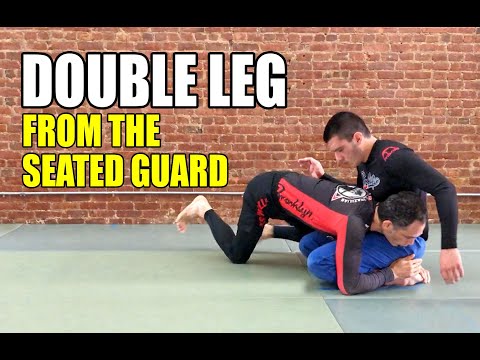
Double Leg from Seated Butterfly Guard (No Gi BJJ)
0
Seated Butterfly Guard·Brian Glick
Double Leg from the Seated Butterfly Guard: in jiu-jitsu, most people focus on using the butterfly guard either to sweep…
Translation: seated butterfly guard
The Seated Butterfly Guard subfamily covers the standard butterfly guard position where the guard player sits upright with both butterfly hooks inside the opponent's thighs, using the seated posture for maximum lifting leverage and transitional mobility. [1] The seated butterfly guard is the primary butterfly guard configuration, providing the strongest hook elevation for sweeps and the most options for transitions to other positions. [1],[2] The upright seated posture allows the guard player to use the full power of the hook lift combined with upper body pulling to execute sweeps. [2],[3]
Marcelo Garcia used the seated butterfly guard to win multiple ADCC titles. [1]
No images yet for this technique.
Sign in to suggest an image.
Double Leg from the Seated Butterfly Guard: in jiu-jitsu, most people focus on using the butterfly guard either to sweep…
No instructional courses yet for this technique.
Sign in to suggest a course.
Risk of injury to the person this technique is applied to
Guard positions are defensive; injury risk comes from transitions, not the position itself
Skill level needed to execute this technique reliably
Whether this technique is allowed under major competition rule sets
Advanced Brazilian Jiu-Jitsu Techniques (Marcelo Garcia, 2011)
Alias sources — [1] Jiu-Jitsu University (Ribeiro, 2008) [2] The Guard (Moreira & Beneville, 2003) [3] Marcelo Garcia: Advanced BJJ Techniques (2011)
Effectiveness sources — [1] Mastering Jujitsu (Gracie & Danaher, 2003) [2] Jiu-Jitsu University (Ribeiro, 2008)
Mixed Japanese-Western terminology — combines traditional Japanese terms with katakana loanwords
Alias sources — [1] Jiu-Jitsu University (Ribeiro, 2008) [2] The Guard (Moreira & Beneville, 2003) [3] Marcelo Garcia: Advanced BJJ Techniques (2011)
Effectiveness sources — [1] Mastering Jujitsu (Gracie & Danaher, 2003) [2] Jiu-Jitsu University (Ribeiro, 2008)
hip flexibility, active legs, grip management
long legs for distance control and guard retention
hip flexors, adductors, quadriceps, core, grip
Every move, in any martial art, shares a few universal traits. Mix and match below to pinpoint the right tool — or compare equivalents across styles.
Keep your arms controlled and reach around to control your partner's leg on the far side, making sure to control down low rather than up high. If you don't control down here, your partner will be able to sprawl and escape.
One hand should reach around behind the buttocks while the other hand controls your partner's leg on the far side, keeping both arms tight to prevent sprawl escapes.
The Seated Butterfly Guard subfamily covers the standard butterfly guard position where the guard player sits upright with both butterfly hooks inside the opponent's thighs, using the seated posture for maximum lifting leverage and transitional mobility. The seated butterfly guard is the primary butterfly guard configuration, providing the strongest hook elevation for sweeps and the most options for transitions to other positions.
The seated butterfly guard is the classic butterfly guard position, the foundation of the butterfly guard system made famous by Marcelo Garcia. It is the version most commonly taught and used in competition at all levels.
IBJJF: legal — Legal — guard is fundamental to BJJ, sweeps from guard score 2 points; IJF: restricted — Guard pulling penalized as non-combativity — groundwork from guard permitted …; ADCC: legal — Legal, guard pull penalized -1 point in points portion; Unified MMA: legal — Legal — no penalty for playing guard; FIAS Sport Sambo: legal — Legal
Danger rating 2/10. Low — guard positions are defensive; injury risk comes from transitions, not the position itself
The standard setup chain: Achieve Guard Contact → Control Grips → Manage Distance → Threaten Submissions/Sweeps.
Standard counters include: Guard Pass — systematically work to clear the legs and establish a dominant position / Leg Pin — control one or both legs to neutralize guard retention / Pressure Passing — use heavy chest pressure to flatten and immobilize the guard player.
Common variants: Standard butterfly guard (both feet hooked inside the opponent's thighs); Single butterfly hook (one hook in while the other leg posts or controls); Butterfly with overhook (combining the hooks with an overhook for sweep setups).
Marcelo Garcia used the seated butterfly guard to win multiple ADCC titles.
Top errors to watch for: Sitting with a rounded back — maintain an upright, athletic posture with chest up / Placing hooks without upper body control — the hooks and grips work as a system / Sitting too far from the opponent — the hooks need the opponent's weight on them to function / Keeping the head on the wrong side — the head goes to the underhook side for sweep leverage.
The Seated Butterfly Guard is also known as Suwari Batafurai Gādo, Upright Butterfly Guard, Sitting Butterfly, Butterfly Hook Guard.