How To Learn The Crab Ride - From Beginner To Advanced
0
Crab Ride·Brian Glick
Crab ride hooks provide a way to stay connected to your partner in scrambles and when you can't put hooks in from the ba…
Not yet documented
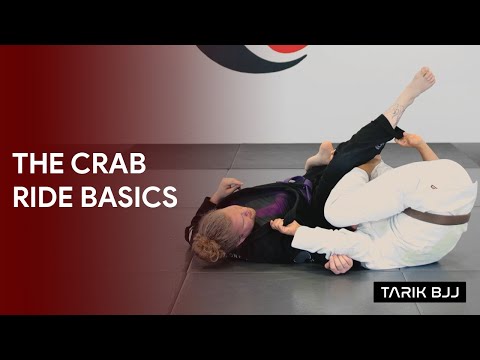
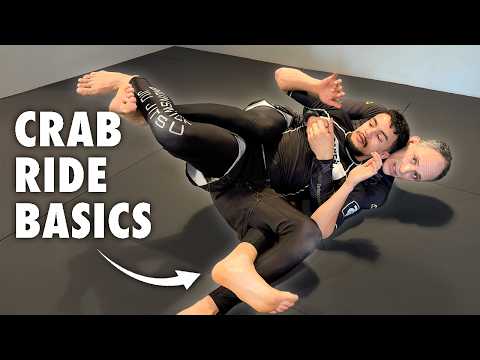
The Crab Ride is a back-taking transition where the attacker establishes control from behind the opponent by placing both feet on the opponent's inner thighs (like riding a crab), using this hook configuration to prevent the opponent from turning and to create entries for back control or leg lock positions. [1] The crab ride was popularised in modern BJJ competition as an alternative to traditional hooks-in back control. [1],[2]
Developed within the modern BJJ competition framework. [1]
Used in IBJJF, ADCC, and/or EBI competition. [1]
No images yet for this technique.
Sign in to suggest an image.
Crab ride hooks provide a way to stay connected to your partner in scrambles and when you can't put hooks in from the ba…
🔗 Links: Follow me on Instagram for more jiu-jitsu content: https://www.instagram.com/tarik_bjj/ Discover top-qualit…
No instructional courses yet for this technique.
Sign in to suggest a course.
Risk of injury to the person this technique is applied to
Varies based on the submissions accessible from this position
Skill level needed to execute this technique reliably
Whether this technique is allowed under major competition rule sets
Jiu-Jitsu University (Saulo Ribeiro, 2008)
Description sources — [1] Modern BJJ positional development [2] Competition evolution
Standard katakana transliteration of Western martial arts terminology (外来語) — used in Japanese MMA, boxing, and BJJ communities
Description sources — [1] Modern BJJ positional development [2] Competition evolution
positional awareness, body control, specific attribute for this position
core, hip flexors, legs
Every move, in any martial art, shares a few universal traits. Mix and match below to pinpoint the right tool — or compare equivalents across styles.
The crab ride is a back-control entry where the attacker hooks behind the opponent's knees from behind — resembling a crab. Used in wrestling as a riding position and adapted in modern BJJ as a back-take setup. (Wrestling coaching manuals)
Start in a familiar position with your partner seated and you controlling them with two hooks in, which gives you a stable foundation to build comfort before advancing to more dynamic scenarios.
Create two opposing forces: push your toes outward while simultaneously pinching your knees inward. This counter-pressure system prevents your opponent from easily bridging past your shoulders and escaping.
Tripod on your shoulder and head to push the opponent's knees inward as much as possible, which keeps them compressed and prevents them from opening their legs to create space for escape.
Yes—crab ride is useful in scrambles and can be applied from leg drag positions as an alternative to traditional back hooks, giving you flexibility in how you recover and maintain control.
The Crab Ride is a back-taking transition where the attacker establishes control from behind the opponent by placing both feet on the opponent's inner thighs (like riding a crab), using this hook configuration to prevent the opponent from turning and to create entries for back control or leg lock positions. The crab ride was popularised in modern BJJ competition as an alternative to traditional hooks-in back control.
This position developed within the modern BJJ/grappling positional framework as the art evolved.
IBJJF: legal — Legal — guard is fundamental to BJJ, sweeps from guard score 2 points; IJF: restricted — Guard pulling penalized as non-combativity — groundwork from guard permitted …; ADCC: legal — Legal, guard pull penalized -1 point in points portion; Unified MMA: legal — Legal — no penalty for playing guard; FIAS Sport Sambo: legal — Legal
Danger rating 5/10. Moderate — varies based on the submissions accessible from this position
The standard setup chain: Establish Entry Position → Transition to This Position → Consolidate Control → Attack or Transition → Maintain or Advance.
Standard counters include: Positional escape / Prevention (not allowing the position to be established) / Transition to a more advantageous position.
Common variants: Standard execution (the fundamental version); Modified variation (adapted for specific scenarios); Transitional version (used as a waypoint between positions).
Used in IBJJF, ADCC, and/or EBI competition.
Top errors to watch for: Entering without proper control / Not understanding the position's purpose / Staying too long without attacking / Not chaining with transitions to other positions.
The Crab Ride is also known as Crab Ride Position, Back Crab, Crab Control.