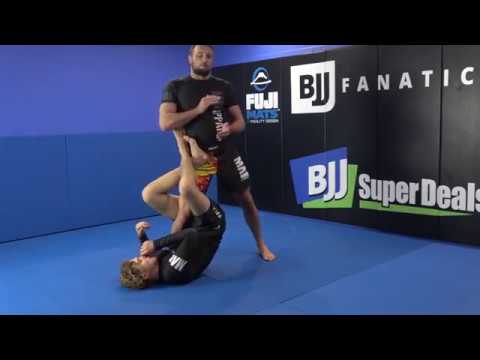
Crab Ride Back Take: CRAIG JONES BJJ Techniques
0
Standard Crab Ride·BJJ Fanatics·Added by Admin
CRAB RIDE BACK TAKE BY CRAIG JONES // In this BJJ Techniques video, Craig Jones demonstrates Crab Ride Back Take. Crai…
Translation: crab ride
The crab ride is a transitional control position where the attacker is face-up behind the opponent, hooking insteps behind the opponent's knees, used to expose the back or achieve top position. [1] First demonstrated at the highest level by Rafael Mendes at the 2012 IBJJF World Championships. Further developed by the Miyao Brothers, Gianni Grippo, and Mikey Musumeci as a key entry into berimbolo, truck, and back take sequences. [2]
Key transitional position in the berimbolo system. Used by multiple IBJJF World Champions for back takes and guard passes. [1]
Rafael Mendes (2012 IBJJF Worlds). Miyao Brothers, Gianni Grippo, Mikey Musumeci.
Rafael Mendes: multiple IBJJF World Champion. Miyao Brothers: multiple IBJJF medals. Mikey Musumeci: multiple IBJJF World Champion. All use crab ride as core transitional position.
No images yet for this technique.
Sign in to suggest an image.
CRAB RIDE BACK TAKE BY CRAIG JONES // In this BJJ Techniques video, Craig Jones demonstrates Crab Ride Back Take. Crai…
No instructional courses yet for this technique.
Sign in to suggest a course.
Risk of injury to the person this technique is applied to
Positional control with no direct submission threat
Skill level needed to execute this technique reliably
Whether this technique is allowed under major competition rule sets
Rafael Mendes — Art of Jiu-Jitsu berimbolo system
[1] Rafael Mendes — 2012 IBJJF Worlds demonstration
[2] Miyao Brothers and Musumeci — further development
Standard katakana transliteration of Western martial arts terminology (外来語) — used in Japanese MMA, boxing, and BJJ communities
[1] Rafael Mendes — 2012 IBJJF Worlds demonstration
[2] Miyao Brothers and Musumeci — further development
comfort with inversions, hip flexibility, precise hooking
hip flexors, core, hamstrings
Craig Jones emphasizes pulling your opponent's hips back to the floor, then converting your top foot into a shallow hook. Reach deep with your far-side hand to get a scoop grip on their legs, then use your secondary foot to help sit them up as you roll through to take the back.
Instead of keeping your opponent stacked and dropping your hips to the far side, you steer and pull their hips back to the floor, which makes it easier to convert your foot into a crab rack hook and complete the back take.
Craig Jones notes that your left foot (secondary foot) is a key detail to help sit your opponent up once you have the hook and have reached deep, enabling you to successfully roll through and take the back.
The crab ride is a transitional control position where the attacker is face-up behind the opponent, hooking insteps behind the opponent's knees, used to expose the back or achieve top position. First demonstrated at the highest level by Rafael Mendes at the 2012 IBJJF World Championships.
First demonstrated at elite level by Rafael Mendes at the 2012 IBJJF World Championships. Further developed by Miyao Brothers, Gianni Grippo, and Mikey Musumeci.
IBJJF: legal — Legal — guard is fundamental to BJJ, sweeps from guard score 2 points; IJF: restricted — Guard pulling penalized as non-combativity — groundwork from guard permitted …; ADCC: legal — Legal, guard pull penalized -1 point in points portion; Unified MMA: legal — Legal — no penalty for playing guard; FIAS Sport Sambo: legal — Legal
Danger rating 2/10. Low — positional control with no direct submission threat
The standard setup chain: Establish De La Riva or berimbolo entry → Invert underneath opponent → Hook insteps behind both knees → Establish crab ride control → Choose: back take, pass, or truck transition.
Standard counters include: Stand up before hooks are established / Sit back on the attacker to crush them / Grab ankles to prevent the hooks / Sprawl forward to deny the position.
Common variants: Crab ride to back take (spin underneath for back control); Crab ride pass (roll opponent to come up on top); Crab ride to truck (transition to truck position for twister or calf slicer); Crab ride to berimbolo (continue the inversion sequence).
Rafael Mendes: multiple IBJJF World Champion. Miyao Brothers: multiple IBJJF medals.
Top errors to watch for: Not hooking behind both knees — opponent can stand and escape / Staying too long without transitioning — must advance to back take, pass, or truck / Not maintaining the face-up position — rolling to the side loses the hooks / Attempting against a standing opponent — crab ride works best when opponent is on their knees.
The Standard Crab Ride is also known as Kurabu Raido, Crab Ride, Crab Ride Position, Baby Bolo Entry.