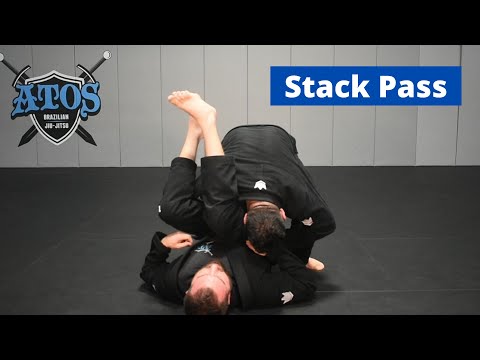
Fundamentals Lesson 1: Double Leg Stack Pass
0
Standard Stack Pass·ATOS Jiu-Jitsu Modesto·Added by Admin
Translation: stack pass
The stack pass is a fundamental pressure-based guard pass where the passer places the opponent's legs on their shoulders, rises onto their toes, and drives forward to fold the opponent in half — stacking their hips over their shoulders. [1] This creates extreme downward pressure as the opponent bears both their own inverted body weight and the passer's driving force simultaneously. One of the oldest guard passes in BJJ, it became widely associated with the Carlson Gracie lineage in the mid-1980s and remains a core technique from white belt through black belt. [2] Andre Galvao (6x IBJJF World Champion, 6x ADCC Champion) has produced the most comprehensive modern treatment of the system.
The stack pass originated in the early days of BJJ competition and became widely associated with the Carlson Gracie lineage in the mid-1980s, where stacking from closed guard was a core competitive strategy. [1] The Sao Paulo pass variant was created by Roberto Tozi, a judo and BJJ black belt. [2] In the modern era, Andre Galvao has produced the most comprehensive system.
One of the most fundamental and commonly used guard passes at all belt levels. Particularly effective for heavier and stronger grapplers who can generate crushing stacking pressure. Functions as a hub for the entire pressure passing game, chaining naturally with over-under, double under, and body lock variations. [1]
From the Carlson Gracie lineage (mid-1980s) through modern systematization by Andre Galvao. The Sao Paulo pass variant was developed by Roberto Tozi. One of the oldest passes in continuous competitive use.
Andre Galvao: 6x IBJJF World Champion, 6x ADCC Champion. Bernardo Faria: 5x IBJJF World Champion. Fabio Gurgel: 4x World Champion, Alliance founder. All used stack passing as a core element of their competitive guard passing systems.
No images yet for this technique.
Sign in to suggest an image.
No instructional courses yet for this technique.
Sign in to suggest a course.
Risk of injury to the person this technique is applied to
Moderate danger — primary risk is compressive force on the bottom player's cervical spine and neck when being folded; the bottom player must tap or communicate if neck pressure becomes dangerous
Skill level needed to execute this technique reliably
Whether this technique is allowed under major competition rule sets
The Stack Pass (Galvao, BJJ Fanatics) — Comprehensive Stack Passing System
System instructional — [1] The Stack Pass (Galvao, BJJ Fanatics) — 4-volume comprehensive system
Textbook — [2] Jiu-Jitsu University (Ribeiro, 2008) — brown belt guard passing chapter
Standard katakana transliteration of Western martial arts terminology (外来語) — used in Japanese MMA, boxing, and BJJ communities
System instructional — [1] The Stack Pass (Galvao, BJJ Fanatics) — 4-volume comprehensive system
Textbook — [2] Jiu-Jitsu University (Ribeiro, 2008) — brown belt guard passing chapter
upper body strength for lifting and stacking, balance, posture
heavier build for generating stacking pressure
shoulders, quadriceps, core stabilizers, neck muscles
Keep your elbows in tight to your body—never let them flare out. According to ATOS Jiu-Jitsu Modesto, hiding your elbows in is essential to the technique's foundation.
Most people try to use their upper body to throw the opponent's legs over, when the real key is driving intense pressure down on the legs to make it uncomfortable for the bottom person—especially restricting their breathing. ATOS Jiu-Jitsu Modesto emphasizes that this pressure, not upper body strength, is what makes the pass work.
Lift your opponent's hips slightly off the mat and walk underneath their body while driving their knees toward their face. This motion, combined with driving into your feet, creates the forward pressure needed to complete the pass.
The stack pass is a fundamental pressure-based guard pass where the passer places the opponent's legs on their shoulders, rises onto their toes, and drives forward to fold the opponent in half — stacking their hips over their shoulders. This creates extreme downward pressure as the opponent bears both their own inverted body weight and the passer's driving force simultaneously.
The stack pass originated in the early days of BJJ competition and became widely associated with the Carlson Gracie lineage in the mid-1980s, where stacking from closed guard was a core competitive strategy. The Sao Paulo pass variant was created by Roberto Tozi, a judo and BJJ black belt.
IBJJF: legal — Legal, guard pass scores 3 points; IJF: legal — Legal — transitioning past opponent's legs is part of newaza; ADCC: legal — Legal, guard pass scores 3 points; Unified MMA: legal — Legal; FIAS Sport Sambo: legal — Legal
Danger rating 3/10. Low-moderate danger — primary risk is compressive force on the bottom player's cervical spine and neck when being folded; the bottom player must tap or communicate if neck pressure becomes dangerous
The standard setup chain: Establish Posture in Guard → Break Open the Guard → Place Legs on Shoulders → Rise on Toes → Stack the Opponent → Angle and Slide Through.
Standard counters include: Triangle Choke — the primary counter; available when passer allows asymmetric arm position (one arm in, one arm out) / Kimura — attack the passer's arm when committed to controlling the legs / Omoplata — shoulder lock when passer's arm is isolated / Hip Escape — shrimp to prevent the stack from being fully established.
Common variants: Single stack pass (one arm under one leg, the other controlling the hip or p…); Double underhook stack pass (both arms under both legs, lifting hips and stacking for …); Sao Paulo pass (Tozi Pass) (created by Roberto Tozi, a crushing pressure variant effe…); Standing stack pass (posture up from standing, drive hips forward and stack be…); Knee-cut stack pass (incorporates stacking elements while using the knee to sl…).
Andre Galvao: 6x IBJJF World Champion, 6x ADCC Champion. Bernardo Faria: 5x IBJJF World Champion.
Top errors to watch for: Not stacking high enough — insufficient compression allows the guard player to retain hip mobility / Allowing one arm to be isolated — creates triangle choke opportunity / Not angling to finish — driving straight forward without angling to one side makes the pass harder / Head position too high — head should drive into opponent to maximize stacking compression.
The Standard Stack Pass is also known as Sutakku Pasu, Stack Pass, Stacking Pass, Stack Guard Pass, Folding Pass.