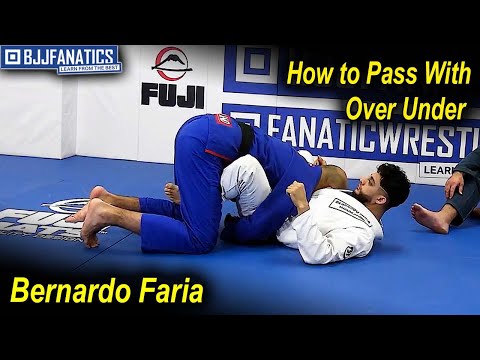
How to Pass With Over Under by Bernardo Faria
0
Standard Over-Under Pass·BJJ Fanatics·Added by Admin
HOW TO PASS WITH OVER UNDER https://bjjfanatics.com Bernardo Faria teaches How to Pass With Over Under in this Jiu Jits…
Translation: over-under pass
The over-under pass is a pressure-based guard pass where one arm goes under one of the opponent's legs (underhook) while the other arm comes over the opposite leg (overhook), creating an asymmetric leg-splitting configuration. [1] Developed by Renato Miragaia at Gracie Barra around 1993 together with his instructor Roberto 'Gordo' Correa, the technique became world-championship caliber through Bernardo Faria, who earned double gold (weight and absolute) at the 2015 IBJJF World Championships using this single pass as his primary weapon. [2] The passer's shoulder drives into the opponent's midsection, generating sustained crushing pressure while the legs are separated and immobilized.
The over-under pass was developed by Renato Miragaia at Gracie Barra around 1993 as a blue belt, working with his instructor Roberto 'Gordo' Correa (the creator of the modern half guard system). The position is sometimes called 'Miragaia Control' or 'Posicao Miragaia' in Portuguese. [1] Bernardo Faria later elevated it to world championship caliber, earning double gold at the 2015 IBJJF Mundials using it as his primary weapon. [2]
Bernardo Faria's over-under pass earned him double gold at the 2015 IBJJF Mundials (weight and absolute), demonstrating its effectiveness at the highest level. The technique works against virtually all guard variations: closed guard, open guard, spider guard, De La Riva, butterfly. [1] It remains one of the most utilized passing options by top-level competitors in both gi and no-gi.
Created by Renato Miragaia at Gracie Barra (~1993) with Roberto 'Gordo' Correa. Elevated to world championship level by Bernardo Faria (5x IBJJF World Champion, 2015 double gold). Murilo Santana (Unity BJJ) is another elite-level practitioner.
No images yet for this technique.
Sign in to suggest an image.
HOW TO PASS WITH OVER UNDER https://bjjfanatics.com Bernardo Faria teaches How to Pass With Over Under in this Jiu Jits…
No instructional courses yet for this technique.
Sign in to suggest a course.
Risk of injury to the person this technique is applied to
Moderate danger — generates significant pressure on the bottom player's torso and can cause rib discomfort, but does not involve dangerous joint manipulation or cervical spine compression unlike the double under stack
Skill level needed to execute this technique reliably
Whether this technique is allowed under major competition rule sets
Battle Tested Pressure Passing (Faria, BJJ Fanatics) — Over-Under System
Historical origin — [1] BJJ Heroes — The Miragaia Control (bjjheroes.com/techniques/miragaia)
Championship proof — [2] Bernardo Faria — 2015 IBJJF Mundials double gold
System instructional — Battle Tested Pressure Passing (Faria, BJJ Fanatics)
Standard katakana transliteration of Western martial arts terminology (外来語) — used in Japanese MMA, boxing, and BJJ communities
Historical origin — [1] BJJ Heroes — The Miragaia Control (bjjheroes.com/techniques/miragaia)
Championship proof — [2] Bernardo Faria — 2015 IBJJF Mundials double gold
System instructional — Battle Tested Pressure Passing (Faria, BJJ Fanatics)
understanding of weight distribution, patience, upper body endurance
larger body type for generating sustained pressure
shoulders, core stabilizers, hip flexors, pectorals
According to Bernardo Faria, a major mistake is opening up your arm and pushing the knee down, which leaves you completely vulnerable to a kimura. Instead, you should maintain control and angle properly to stretch the leg safely.
Bernardo Faria emphasizes staying on your toes and walking to the side to stretch the opponent's leg down, rather than letting their knees block your hip. You want to gradually walk to the opposite side while maintaining the stretch.
Your hand should not be too low and not too high—Bernardo Faria suggests going slightly higher rather than lower for better control and positioning.
Bernardo Faria breaks it down into three parts: first, approaching your opponent correctly; second, knowing how to actually pass; and third, establishing the pass once you've made progress.
The over-under pass is a pressure-based guard pass where one arm goes under one of the opponent's legs (underhook) while the other arm comes over the opposite leg (overhook), creating an asymmetric leg-splitting configuration. Developed by Renato Miragaia at Gracie Barra around 1993 together with his instructor Roberto 'Gordo' Correa, the technique became world-championship caliber through Bernardo Faria, who earned double gold (weight and absolute) at the 2015 IBJJF World Championships using this single pass as his primary weapon.
The over-under pass was developed by Renato Miragaia at Gracie Barra around 1993 as a blue belt, working with his instructor Roberto 'Gordo' Correa (the creator of the modern half guard system). The position is sometimes called 'Miragaia Control' or 'Posicao Miragaia' in Portuguese.
IBJJF: legal — Legal, guard pass scores 3 points; IJF: legal — Legal — transitioning past opponent's legs is part of newaza; ADCC: legal — Legal, guard pass scores 3 points; Unified MMA: legal — Legal; FIAS Sport Sambo: legal — Legal
Danger rating 3/10. Low-moderate danger — generates significant pressure on the bottom player's torso and can cause rib discomfort, but does not involve dangerous joint manipulation or cervical spine compression unlike the double under stack
The standard setup chain: Establish Top Position → Thread One Arm Under → Thread Opposite Arm Over → Drive Shoulder Into Midsection → Circle Toward Over Leg → Complete to Side Control.
Standard counters include: Kimura Attack — if the passer's over arm is not tight, attack with a kimura on that arm / Hip Escape — create distance before pressure is fully established, reguard to open guard / Frame and Reguard — use frames on passer's head and shoulder to create space for leg re-insertion / Underhook on the Over Side — fight for an underhook to prevent being flattened.
Common variants: Standard over-under (gi) (lapel and pant grip version with traditional shoulder pre…); No-gi over-under (deeper arm penetration without fabric grips, relies on bo…); Over-under from half guard (transitioning from deep half guard sweep directly into ov…); Over-under from double under (upgrading by switching one arm to the 'over' position for…); Miragaia control (original) (the original Gracie Barra version as developed by Renato …).
Bernardo Faria: 5x IBJJF World Champion, double gold (weight + absolute) at 2015 IBJJF Mundials using the over-under pass as primary weapon. Murilo Santana: multiple IBJJF medals with devastating over-under pressure.
Top errors to watch for: Not driving shoulder deep enough — insufficient pressure allows the guard player to create space and reguard / Hips too high — weight should be distributed low through the shoulder, not elevated / Not circling toward the 'over' leg — the finish requires lateral movement toward the overhook side / Allowing the bottom player to win an underhook — the opponent's underhook on the over side can prevent the pass.
The Standard Over-Under Pass is also known as Ōbā Andā Pasu, Over-Under Pass, Over/Under Pass, Barra Pass, Miragaia Control.