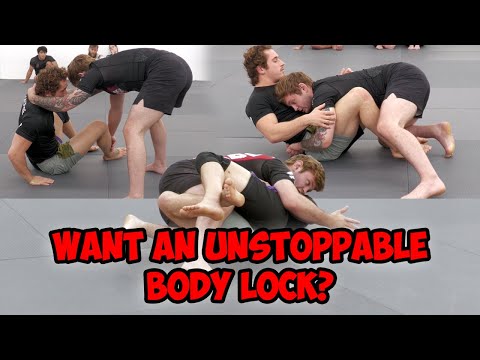
Nicky Ryan: Unstoppable Body Lock Pass Details | B-Team Technique
0
Standard Body Lock Pass·The B-Team·Added by Admin
https://bteamjj.myshopify.com Merch is now live! | Nicky Ryan shows you how to effectively enter the half guard to begin…
Translation: body lock pass
The body lock pass uses a gable grip or clasp around the opponent's waist or lower back, driving the chest into the opponent's torso to eliminate space, then incrementally clearing the legs to advance past the guard. [1] While the body lock is an ancient wrestling technique, its systematic application to BJJ guard passing was pioneered by Gordon Ryan (3x ADCC World Champion) and the Danaher Death Squad / New Wave Jiu-Jitsu system in the late 2010s. [2] Ryan identifies three completion methods: stuffing, shelving, or splitting the opponent's legs. Lachlan Giles developed a complementary 5-stage system. The body lock pass is considered one of the safest passes because the passer's legs stay far from the opponent's leg lock attacks.
Gordon Ryan's dominant ADCC and no-gi competition career is largely built on the body lock passing system. The technique is considered the safest and most methodical way to pass guard at the highest levels of no-gi grappling. [1]
Ancient wrestling body lock adapted for BJJ by Gordon Ryan and the Danaher system (late 2010s).
Gordon Ryan: 3x ADCC World Champion, IBJJF No-Gi World Champion — body lock as primary passing system.
No images yet for this technique.
Sign in to suggest an image.
https://bteamjj.myshopify.com Merch is now live! | Nicky Ryan shows you how to effectively enter the half guard to begin…
No instructional courses yet for this technique.
Sign in to suggest a course.
Risk of injury to the person this technique is applied to
Moderate — primarily pressure-based; considered one of the safest passes because passer's legs stay far from opponent's leg lock attacks
Skill level needed to execute this technique reliably
Whether this technique is allowed under major competition rule sets
Systematically Attacking the Guard: Body Lock Study (Ryan, BJJ Fanatics)
[1] Ryan — comprehensive body lock study (BJJ Fanatics)
[2] Giles — 5-stage body lock passing system
Systematically Attacking the Guard: Body Lock Study (Ryan, BJJ Fanatics) || The Body Lock Pass (Giles, BJJ Fanatics) || Evolve MMA — Types of Body Lock Passes (evolve-mma.com)
Standard katakana transliteration of Western martial arts terminology (外来語) — used in Japanese MMA, boxing, and BJJ communities
[1] Ryan — comprehensive body lock study (BJJ Fanatics)
[2] Giles — 5-stage body lock passing system
core strength, patience, sensitivity to weight distribution
core, shoulders, grip, pectorals
According to Nicky Ryan, you should never lock directly in the middle as this narrows your base and makes it easier for your opponent to escape or defend. Instead, always use one long arm and one short arm when locking to maintain a wider base and better elbow control.
Nicky Ryan recommends unlocking your hands and using a flicking motion with your elbow into their arm while simultaneously taking a near side under hook to continue advancing the position.
If your opponent successfully posts to prevent you from reaching three quarter mount, Nicky Ryan suggests swimming in another under hook to establish double unders, then switching your head across and using a butterfly hook to free your leg and secure inside control.
The body lock pass uses a gable grip or clasp around the opponent's waist or lower back, driving the chest into the opponent's torso to eliminate space, then incrementally clearing the legs to advance past the guard. While the body lock is an ancient wrestling technique, its systematic application to BJJ guard passing was pioneered by Gordon Ryan (3x ADCC World Champion) and the Danaher Death Squad / New Wave Jiu-Jitsu system in the late 2010s.
The body lock is an ancient wrestling technique. Its systematic application to BJJ guard passing was developed by Gordon Ryan and the Danaher Death Squad / New Wave Jiu-Jitsu in the late 2010s.
IBJJF: legal — Legal, guard pass scores 3 points; IJF: legal — Legal — transitioning past opponent's legs is part of newaza; ADCC: legal — Legal, guard pass scores 3 points; Unified MMA: legal — Legal; FIAS Sport Sambo: legal — Legal
Danger rating 3/10. Low-moderate — primarily pressure-based; considered one of the safest passes because passer's legs stay far from opponent's leg lock attacks
The standard setup chain: Break open the guard → Drive chest into opponent → Secure gable grip around waist → Begin incremental leg clearing (stuff, shelf, or split) → Advance past the guard → Establish side control or mount.
Standard counters include: Strong framing against face/neck — create distance before the lock is established / Inversion and hip flexibility — create space to reguard / Underhook pummeling — fight for underhooks to prevent the body lock / Granby roll escape — roll to create space.
Common variants: Standard body lock (waist grip) (classic gable grip around the waist); High body lock (mid-back/rib grip) (grip higher for more upper body control); High tripod pass (standing body lock popularized by Jozef Chen); Front body lock (driving forward with the body lock); Side body lock (angle to one side for passing); Body lock to mount (advance directly to mount rather than side control).
Gordon Ryan: 3x ADCC World Champion, IBJJF No-Gi World Champion — body lock as primary passing system.
Top errors to watch for: Not securing a tight gable grip — any space allows the guard player to frame / Trying to pass too quickly — the body lock is a patient, methodical pass / Not choosing a completion method — must commit to stuff, shelf, or split / Hips too high — weight must be distributed through the chest into the opponent.
The Standard Body Lock Pass is also known as Bodi Rokku Pasu, Body Lock Pass, Bear Hug Pass, Body Lock Guard Pass.