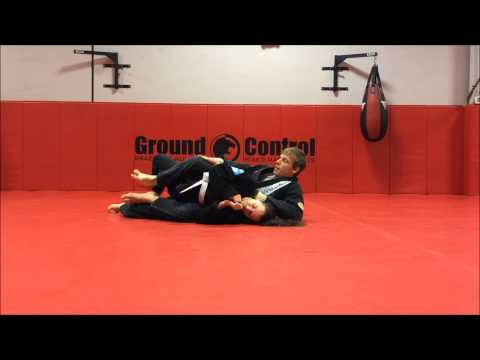
Back step pass series with Stephen Miller
0
Standard Backstep Pass·Simplicity Jiu Jitsu·Added by Admin
Ground Control Columbia Stephen Miller teaching a little back step from half guard series. Highly effective and basic te…
Translation: backstep pass
The backstep pass is a guard pass where the passer rotates their hips 180 degrees away from the opponent while maintaining weight on the trapped leg, converting a stalled knee-cut or half guard position into either a completed pass or leg lock entry. [1] The technique evolved organically from half guard and knee-cut passing exchanges in the late 1990s-2000s, with no single inventor credited. Lucas Lepri (multiple IBJJF World Champion) refined the backstep crossface series, and the technique gained further importance as leg lock entries from the backstep position became central to modern no-gi grappling. [2]
Evolved organically from half guard and knee-cut exchanges in the late 1990s-2000s. No single inventor. Lucas Lepri refined the crossface variant. [1]
Essential technique in the modern guard passer's toolkit, providing an alternative when direct forward passes are blocked. The dual threat of pass and leg lock entry makes it particularly dangerous. [1]
Evolved from knee-cut passing exchanges. Refined by Lucas Lepri. Leg lock applications developed by modern no-gi competitors.
Lucas Lepri: multiple IBJJF World Championship titles using backstep as core passing tool.
No images yet for this technique.
Sign in to suggest an image.
Ground Control Columbia Stephen Miller teaching a little back step from half guard series. Highly effective and basic te…
No instructional courses yet for this technique.
Sign in to suggest a course.
Risk of injury to the person this technique is applied to
Low danger for the pass itself; leg lock entries accessible from backstep can elevate risk
Skill level needed to execute this technique reliably
Whether this technique is allowed under major competition rule sets
Precise Half Guard Passing (Lepri, BJJ Fanatics)
[1] Lepri — refined backstep crossface series
[2] Grapplearts — backstep to leg lock entries
Standard katakana transliteration of Western martial arts terminology (外来語) — used in Japanese MMA, boxing, and BJJ communities
[1] Lepri — refined backstep crossface series
[2] Grapplearts — backstep to leg lock entries
hip mobility for 180-degree rotation, balance during transition
hip rotators, core, quadriceps
According to Simplicity Jiu Jitsu, it's important that you stay on top of your opponent and sit on them right away after the backstep spin. As long as you maintain control of the opponent's leg, you won't be in danger of your back being taken.
Simplicity Jiu Jitsu instructor Stephen Miller shows multiple options: you can establish an underhook with your right hand and hop back to slide into side control, or you can control the opponent's hip and transition to a back take by clearing your knee, getting underhook control, and using the belt and collar grips to establish hooks.
Stephen Miller emphasizes that if you drive the pressure down to the floor, you won't generate the pressure you need into your opponent's face. Instead, keep everything up—drive your shoulder and grip high while maintaining control of the top knee as you scoot your hips back.
Simplicity Jiu Jitsu's Stephen Miller describes a 'position within a position' where you can pause and reassess—controlling the top leg and shin while your knee is to the mat—before deciding whether to continue with a back take, calf slicer, or another finish.
The backstep pass is a guard pass where the passer rotates their hips 180 degrees away from the opponent while maintaining weight on the trapped leg, converting a stalled knee-cut or half guard position into either a completed pass or leg lock entry. The technique evolved organically from half guard and knee-cut passing exchanges in the late 1990s-2000s, with no single inventor credited.
Evolved organically from half guard and knee-cut exchanges in the late 1990s-2000s. No single inventor.
IBJJF: legal — Legal, guard pass scores 3 points; IJF: legal — Legal — transitioning past opponent's legs is part of newaza; ADCC: legal — Legal, guard pass scores 3 points; Unified MMA: legal — Legal; FIAS Sport Sambo: legal — Legal
Danger rating 3/10. Low danger for the pass itself; leg lock entries accessible from backstep can elevate risk
The standard setup chain: Establish knee-cut position → Opponent wins underhook → Rotate hips 180 degrees away → Maintain weight on trapped leg → Choose finish: complete pass to side control OR enter leg lock position.
Standard counters include: Underhook retention — maintain underhook and follow the rotation to take the back / Knee shield reinsertion — re-establish guard frames during the rotation / Inversion to leg entanglement — counter-attack with leg locks / Framing and re-guarding before rotation completes.
Common variants: Backstep to leg drag (rotate and drag the leg across); Backstep to saddle/inside sankaku (enter the leg lock position via hip rotation); Backstep to kneebar (directly attack the knee after rotation); Backstep with crossface (Lucas Lepri's signature, maintain crossface throughout ro…); Backstep to ninja roll (continue the rotation into a rolling back take).
Lucas Lepri: multiple IBJJF World Championship titles using backstep as core passing tool.
Top errors to watch for: Not maintaining weight on the trapped leg during rotation — allows opponent to recover guard / Rotating too slowly — the backstep must be decisive / Not choosing a finishing direction — must commit to either passing or leg lock entry / Leaving the head exposed — the opponent can attack the neck during rotation.
The Standard Backstep Pass is also known as Bakku Suteppu Pasu, Backstep Pass, Backstep Guard Pass, Hip Switch Pass.