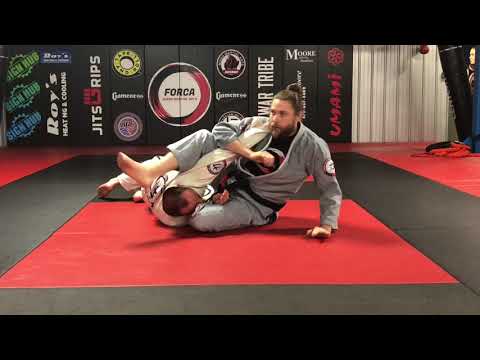
Standard Spider Sweep

Genus

スタンダードスパイダースイープ(Sutandādo Supaidā Suīpu)

Transliteration

Translation: standard spider sweep

Overview

The Standard Spider Sweep executes the fundamental spider guard sweep by controlling both sleeves, placing the feet on the biceps, then using an asymmetric push-pull with the legs to off-balance the opponent and sweep them to one side. [1] The guard player extends one leg to push the opponent's arm across while pulling the other arm inward, then uses the unbalanced position to kick the opponent over to the extended side. [1],[2] The sleeve control prevents the opponent from posting a hand to stop the sweep, making the spider sweep very effective once the grips are established. [2],[3]

Also known as
Basic Spider Sweep[1]Standard Lasso Sweep[2]

History & Origin

The standard spider sweep is the core technique of the spider guard system, part of the gi-based open guard play that became a staple of BJJ competition from the 1990s onward. [1] It remains one of the most commonly used open guard sweeps in gi tournaments. [2],[3]

Effectiveness

The spider guard sweep uses double sleeve grips with feet on the opponent's biceps to create powerful pushing and pulling leverage for sweeping. [1] It is one of the most effective open guard sweeps in gi competition, though it requires the gi for the sleeve grips. [1],[2]

Lineage

Spider guard sweeps were developed in competition BJJ in the 1990s and 2000s and became particularly associated with Brazilian competitors like Romulo Barral and Cobrinha. [1] The spider guard system was further developed as a comprehensive guard system with multiple sweeping angles. [2]

Competition Record

Romulo Barral won multiple IBJJF World Championship titles using the spider guard as his primary guard system. [1] Spider guard sweeps remain among the most commonly used sweeps in IBJJF competition. [2]

Images

No images yet for this technique.

Sign in to suggest an image.

Biomechanical Mechanism

Primary ActionBreaking the opponent's leg control to advance to a more dominant position
Joints InvolvedHips (posture and pressure), knees (opening the guard with knee-in or standing), hands (grip fighting)
Force VectorForward pressure (stack/smash) or backward posture (stand-up break) to open the closed guard
Passing MechanicOnce the guard is opened, speed passing, pressure passing, or toreando passing advances the position

Position & Entry

From bottom side controlCreate frames with the forearms against the opponent's neck and hip, hip escape (shrimp) to create space, insert the knee to recover guard
From underhook escapeSwim the near arm to an underhook, bridge into the opponent and come to knees or reverse
From opponent's transitionWhen the opponent moves to mount or north-south, use the movement to create space and escape

Variants

Standard sweepprimary off-balancing and reversal technique from the guard
Combination sweepchaining two sweep directions to catch the opponent's adjustment
Counter sweepsweeping as the opponent initiates a guard pass attempt
Competition sweepoptimised for point-scoring in tournament settings

Videos

1 video

Learn This Technique

No instructional courses yet for this technique.

Sign in to suggest a course.

Ratings

Danger Rating

Risk of injury to the person this technique is applied to

3
Moderate3/10

Sweeps reverse position from bottom; moderate impact on landing for top player

Difficulty

Skill level needed to execute this technique reliably

Intermediate
Competition Legality

Whether this technique is allowed under major competition rule sets

Training Notes

Standard spider sweep: double sleeve grips, both feet on biceps, extend one leg while pulling the opposite sleeve, and sweep the opponent to the extended-leg side (Romulo Barral, Spider Guard System, 2010s)
Step 1: from open guard, establish double sleeve grips — both hands control the opponent's cuffs
Step 2: place both feet on the opponent's biceps
Step 3: extend both legs to create maximum distance and off-balance the opponent
Step 4: pull one sleeve toward you while extending the opposite leg — this creates rotational force
Step 5: the push-pull sweeps the opponent over the extended-leg side — they fall to the side
Step 6: follow to top position while maintaining at least one sleeve grip for passing advantage
The push-pull coordination is the key: one side pushes (extends), the other side pulls (retracts)
The extended leg acts as a barrier — the opponent falls over it like falling over a hurdle
Drill with a partner standing: establish spider guard, sweep both directions — 10 reps per side

Common Mistakes

!Pulling both sleeves equally — the sweep requires asymmetric force: push one, pull the other
!Not extending the sweeping-side leg enough — the extension provides the barrier and the force
!Releasing a sleeve during the sweep — maintain at least one grip throughout
!Not following to top position — the sleeve grip gives immediate passing advantage on top
!Sweeping to the same side every time — alternate sides to be unpredictable
!Keeping the feet low on the arms instead of on the biceps — bicep placement gives maximum leverage
!Not threatening triangles or omoplatas between sweep attempts — the submission threats make the sweeps more effective

Related Techniques

Counter Techniques

Setup Chain

1Control Gripsestablish the controlling grips needed to load the sweep
2Off-Balanceshift the opponent's weight to the target direction
3Execute Sweepapply the sweeping mechanic to topple the opponent
4Follow to Topride the sweep momentum to establish top position

Sources & References

Primary Source

Jiu-Jitsu University (Saulo Ribeiro, 2008)

1BookThe Guard (Moreira & Beneville, 2008)

Alias sources — [1] Jiu-Jitsu University (Saulo Ribeiro, 2008) [2] Modern BJJ terminology

2BookJiu-Jitsu University (Ribeiro, 2008)

Effectiveness sources — [1] Jiu-Jitsu University (Saulo Ribeiro, 2008) [2] Brazilian Jiu-Jitsu: Theory and Technique (Renzo Gracie & Royler Gracie, 2001)

3OtherJapanese Combat Sports Katakana Convention

Standard katakana transliteration of Western martial arts terminology (外来語) — used in Japanese MMA, boxing, and BJJ communities

4CitationThe Guard (Moreira & Beneville, 2008)

Alias sources — [1] Jiu-Jitsu University (Saulo Ribeiro, 2008) [2] Modern BJJ terminology

5CitationJiu-Jitsu University (Ribeiro, 2008)

Effectiveness sources — [1] Jiu-Jitsu University (Saulo Ribeiro, 2008) [2] Brazilian Jiu-Jitsu: Theory and Technique (Renzo Gracie & Royler Gracie, 2001)

Community

Athletics

Requires

timing, hip power, off-balancing skill

Favours

strong hips and active legs for sweeping leverage

Key muscles

hip flexors, glutes, quadriceps, core rotators

Frequently Asked Questions

What should I do if my opponent puts their knee up to break my hook during the spider sweep?

According to Força Martial Arts & Fitness, when your opponent raises their knee to stay balanced or break the hook, you can adjust your positioning by scooting slightly sideways to reset and maintain control of the sweep.

How do I prevent my opponent from turtling out of the spider sweep?

Força Martial Arts & Fitness emphasizes that proper positioning and control make it significantly harder for your opponent to turtle, so focus on settling into a comfortable, controlling position before executing the sweep.

How does the Standard Spider Sweep work?

The Standard Spider Sweep executes the fundamental spider guard sweep by controlling both sleeves, placing the feet on the biceps, then using an asymmetric push-pull with the legs to off-balance the opponent and sweep them to one side. The guard player extends one leg to push the opponent's arm across while pulling the other arm inward, then uses the unbalanced position to kick the opponent over to the extended side.

Where does the Standard Spider Sweep come from?

The standard spider sweep is the core technique of the spider guard system, part of the gi-based open guard play that became a staple of BJJ competition from the 1990s onward. It remains one of the most commonly used open guard sweeps in gi tournaments.

Is the Standard Spider Sweep legal in competition?

Unified MMA: legal — Legal defensive/transitional technique; IBJJF: legal — Legal; IJF: legal — Legal; ADCC: legal — Legal; UWW: legal — Legal; FIAS Sport Sambo: legal — Legal

How dangerous is the Standard Spider Sweep?

Danger rating 3/10. Moderate — sweeps reverse position from bottom; moderate impact on landing for top player

How do I set up the Standard Spider Sweep?

The standard setup chain: Control Grips → Off-Balance → Execute Sweep → Follow to Top.

How do I defend against the Standard Spider Sweep?

Standard counters include: Base and Posture — maintain wide base and upright posture to resist the sweep / Grip Strip — break controlling grips before the sweep can be loaded / Back Step — retreat the leg being attacked to remove the sweep fulcrum.

What are the variants of the Standard Spider Sweep?

Common variants: Standard sweep (primary off-balancing and reversal technique from the guard); Combination sweep (chaining two sweep directions to catch the opponent's adj…); Counter sweep (sweeping as the opponent initiates a guard pass attempt); Competition sweep (optimised for point-scoring in tournament settings).

How effective is the Standard Spider Sweep in competition?

Romulo Barral won multiple IBJJF World Championship titles using the spider guard as his primary guard system. Spider guard sweeps remain among the most commonly used sweeps in IBJJF competition.

What are common mistakes when doing the Standard Spider Sweep?

Top errors to watch for: Pulling both sleeves equally — the sweep requires asymmetric force: push one, pull the other / Not extending the sweeping-side leg enough — the extension provides the barrier and the force / Releasing a sleeve during the sweep — maintain at least one grip throughout / Not following to top position — the sleeve grip gives immediate passing advantage on top.

What are other names for the Standard Spider Sweep?

The Standard Spider Sweep is also known as Sutandādo Supaidā Suīpu, Basic Spider Sweep, Standard Lasso Sweep.