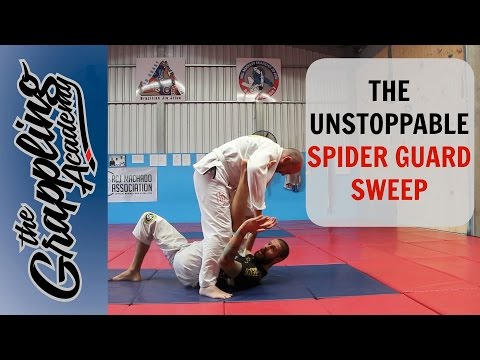
The UNSTOPPABLE Spider Guard SWEEP!
0
Spider Guard Sweep·The Grappling Academy
SALE SALE SALE OVER 50% OFF – BOX SET – ALL 4 COURSES 50% OFF CLICK HERE – https://bit.ly/2lAOHmp • The Blue Belt Sup…
Translation: spider guard sweep
The Spider Guard Sweep subfamily covers sweeps from the spider guard, where the guard player controls both of the opponent's sleeves and places the feet on the biceps, using the extended legs and sleeve grips as a web of control. [1] Spider guard sweeps use the unique leverage of feet-on-biceps to push, pull, and twist the opponent's upper body while controlling their ability to base with the hands. [1],[2] The spider guard is particularly effective in gi grappling because the sleeve grips are essential to maintaining the feet-on-biceps connection. [2],[3]
The spider guard was developed in BJJ as a sleeve-dependent gi guard system and became a major competition guard in the 1990s and 2000s. [1] Practitioners like Romulo Barral and Michael Langhi popularised spider guard as an elite competition system with highly effective sweeps and submissions. [2],[3]
Spider guard sweeps use feet-on-biceps control to off-balance and sweep the opponent. [1]
Spider guard sweeps were developed in gi BJJ competition. [1]
Spider guard sweeps are commonly scored in IBJJF competition. [1]
No images yet for this technique.
Sign in to suggest an image.
SALE SALE SALE OVER 50% OFF – BOX SET – ALL 4 COURSES 50% OFF CLICK HERE – https://bit.ly/2lAOHmp • The Blue Belt Sup…
No instructional courses yet for this technique.
Sign in to suggest a course.
Risk of injury to the person this technique is applied to
Sweeps reverse position from bottom; moderate impact on landing for top player
Skill level needed to execute this technique reliably
Whether this technique is allowed under major competition rule sets
The Guard (Joe Moreira & Ed Beneville, 2008)
Alias sources — [1] Jiu-Jitsu University (Saulo Ribeiro, 2008) [2] Modern BJJ terminology for lasso variation [3] Brazilian Jiu-Jitsu: Theory and Technique (Renzo Gracie & Royler Gracie, 2001)
Effectiveness sources — [1] Jiu-Jitsu University (Ribeiro, 2008)
Standard katakana transliteration of Western martial arts terminology (外来語) — used in Japanese MMA, boxing, and BJJ communities
Alias sources — [1] Jiu-Jitsu University (Saulo Ribeiro, 2008) [2] Modern BJJ terminology for lasso variation [3] Brazilian Jiu-Jitsu: Theory and Technique (Renzo Gracie & Royler Gracie, 2001)
Effectiveness sources — [1] Jiu-Jitsu University (Ribeiro, 2008)
timing, hip power, off-balancing skill
strong hips and active legs for sweeping leverage
hip flexors, glutes, quadriceps, core rotators
Every move, in any martial art, shares a few universal traits. Mix and match below to pinpoint the right tool — or compare equivalents across styles.
According to Coach Tom at The Grappling Academy, you land in a position that's ideal for going straight into a straight ankle lock, making it a great combination to flow directly into a foot lock.
Coach Tom notes that while the back sweep is his preferred option, you can also move into X guard or single leg X guard if you prefer those positions instead.
Coach Tom describes it as a mandatory movement pattern that every jiu-jitsuka should know, and it allows you to get easy points while also setting up foot lock submissions.
The Spider Guard Sweep subfamily covers sweeps from the spider guard, where the guard player controls both of the opponent's sleeves and places the feet on the biceps, using the extended legs and sleeve grips as a web of control. Spider guard sweeps use the unique leverage of feet-on-biceps to push, pull, and twist the opponent's upper body while controlling their ability to base with the hands.
The spider guard was developed in BJJ as a sleeve-dependent gi guard system and became a major competition guard in the 1990s and 2000s. Practitioners like Romulo Barral and Michael Langhi popularised spider guard as an elite competition system with highly effective sweeps and submissions.
Unified MMA: legal — Legal defensive technique; IBJJF: legal — Legal — escapes and sweeps are fundamental to BJJ, sweep from bottom scores 2…; IJF: legal — Legal; ADCC: legal — Legal, sweep scores 2 points (4 from mount/back); FIAS Sport Sambo: legal — Legal; FIAS Combat Sambo: legal — Legal
Danger rating 3/10. Moderate — sweeps reverse position from bottom; moderate impact on landing for top player
The standard setup chain: Control Grips → Off-Balance → Execute Sweep → Follow to Top.
Standard counters include: Base and Posture — maintain wide base and upright posture to resist the sweep / Grip Strip — break controlling grips before the sweep can be loaded / Back Step — retreat the leg being attacked to remove the sweep fulcrum.
Common variants: Standard sweep (primary off-balancing and reversal technique from the guard); Combination sweep (chaining two sweep directions to catch the opponent's adj…); Counter sweep (sweeping as the opponent initiates a guard pass attempt); Competition sweep (optimised for point-scoring in tournament settings).
Spider guard sweeps are commonly scored in IBJJF competition.
Top errors to watch for: Playing spider guard without double sleeve grips — both sleeves must be controlled / Not using the feet on the biceps — the feet provide the pushing force; without them, the sleeves alone are insufficient / Keeping the legs bent — extend the legs for maximum leverage and control / Only pushing with both legs — the sweep requires push-pull: push one side, pull the other.
The Spider Guard Sweep is also known as Supaidā Gādo Suīpu, Spider Guard, Lasso Sweep, Spider Web Sweep.