Learn The Waiter Sweep Tainan Dalpra Used To Win Pans
0
Waiter Sweep·Paragon Jiu-Jitsu Academy Austin
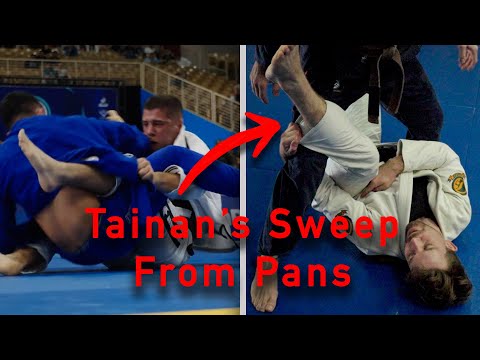
Tainan Dalpra beat Andy Murasaki at the 2025 IBJJF Pan Championships with a crafty variation of the old school waiter sw…
Translation: waiter sweep
The Waiter Sweep is a deep half guard sweep where the guard player hooks the opponent's far leg with the foot (holding it like a waiter holding a tray), then elevates and sweeps the opponent over by extending the hooking leg. [1] The guard player, deep under the opponent, reaches the free leg up and hooks behind the opponent's far knee or thigh, then extends the leg to lift and sweep the opponent over. [1],[2] The waiter sweep is one of the highest-percentage deep half guard finishes because the leg hook provides powerful leverage and the opponent's weight is already destabilised by the deep half position. [2],[3]
The waiter sweep is closely associated with Bernardo Faria's deep half guard system, though its origins trace to multiple grapplers who developed the deep half position. [1] Faria's use of the waiter sweep in world championship competition demonstrated its effectiveness at the highest level. [2],[3]
The waiter sweep was popularised by Bernardo Faria, five-time IBJJF World Champion, as a key technique in his deep half guard system. [1]
Bernardo Faria used the waiter sweep extensively in his competition career, including at the IBJJF World Championships where he won five gold medals in the ultra-heavyweight division. [1]
No images yet for this technique.
Sign in to suggest an image.
Tainan Dalpra beat Andy Murasaki at the 2025 IBJJF Pan Championships with a crafty variation of the old school waiter sw…
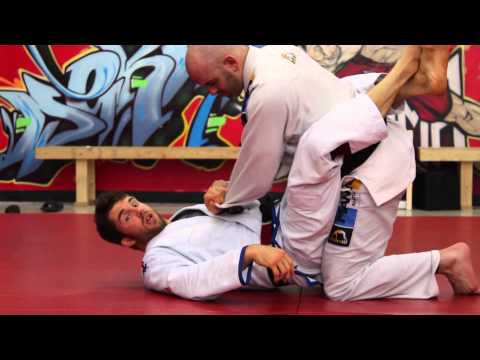
www.chewjitsu.net This is an effective full guard sweep against an opponent who stands up to break your guard. The wait…
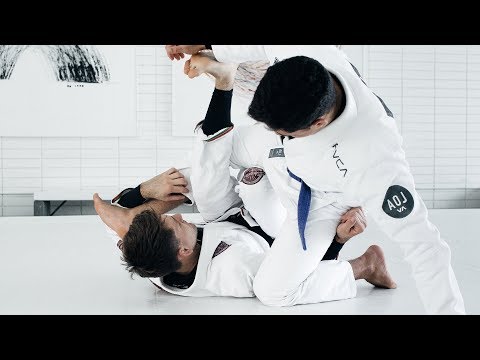
http://www.artofjiujitsu.com http://www.artofjiujitsu.com/seminars -- http://www.instagram.com/artofjiujitsu http://www.…
The waiter sweep is a guard reversal technique executed from half-guard or closed-guard positions when an opponent attempts to stand or pass. Named for its resemblance to a waiter holding a serving tray, the technique leverages underhooking and hip control to elevate and sweep the opponent. ART OF JIU JITSU's Rafael Mendes emphasizes the waiter sweep as a defensive response within deep half-guard, particularly when the opponent jumps over the leg—distinguishing it from pure deep half by maintaining the practicing player's knee as a protective shield. He details the progression from basic waiter positioning through hip-hooking and chest escape mechanics, culminating in a back-step entry to the back control. Paragon Jiu-Jitsu Academy Austin contextualizes the technique through Tainan Dalpra's 2025 IBJJF Pans performance, highlighting a sophisticated variation combining single-leg X entry with a daily-heave hook mechanism that traps the far leg using a self-pant grip, then executes the sweep via underhook, lapel control, and hip elevation. Chewjitsu presents a simpler closed-guard application from standing opponents, using cross-grip sleeve control and ankle underhooking with emphasis on hip timing and weight displacement to execute a side-rolling sweep into mount position. All three instructors agree on the core mechanics of underhooking the far leg and using hip pressure, though they differ in entry positions, grip details, and follow-up options.
Synthesized from 3 instructors
No instructional courses yet for this technique.
Sign in to suggest a course.
Risk of injury to the person this technique is applied to
Sweeps reverse position from bottom; moderate impact on landing for top player
Skill level needed to execute this technique reliably
Whether this technique is allowed under major competition rule sets
Jiu-Jitsu University (Saulo Ribeiro, 2008)
Alias sources — [1] Named for the foot-up position resembling a waiter holding a tray — modern BJJ terminology [2] Common alternative name in BJJ instructionals [3] Descriptive competition terminology
Effectiveness sources — [1] The Half Guard (Bernardo Faria, instructional series)
Standard katakana transliteration of Western martial arts terminology (外来語) — used in Japanese MMA, boxing, and BJJ communities
Alias sources — [1] Named for the foot-up position resembling a waiter holding a tray — modern BJJ terminology [2] Common alternative name in BJJ instructionals [3] Descriptive competition terminology
Effectiveness sources — [1] The Half Guard (Bernardo Faria, instructional series)
timing, hip power, off-balancing skill
strong hips and active legs for sweeping leverage
hip flexors, glutes, quadriceps, core rotators
Your knee acts as a shield to keep you safe while executing the technique. Rafael Mendes emphasizes positioning your knee to push away and protect yourself as the first step of the sweep.
Apply pressure on your opponent's knee to force them to give up their back. Once you have control, perform a chest escape, move your head away, and roll to take the back position, ideally using a seat belt grip according to Rafael Mendes.
Chewjitsu explains that opponents trap your arm to prevent you from hooking under their leg. The key is to push their hips off the foot to unload their weight, which makes it much easier to pull the leg and complete the sweep while keeping your guard locked.
No—according to Chewjitsu, go around to the side a little bit rather than sitting straight up, and maintain traction on the cross grip as you come up to establish your mount position cleanly.
The Waiter Sweep is a deep half guard sweep where the guard player hooks the opponent's far leg with the foot (holding it like a waiter holding a tray), then elevates and sweeps the opponent over by extending the hooking leg. The guard player, deep under the opponent, reaches the free leg up and hooks behind the opponent's far knee or thigh, then extends the leg to lift and sweep the opponent over.
The waiter sweep is closely associated with Bernardo Faria's deep half guard system, though its origins trace to multiple grapplers who developed the deep half position. Faria's use of the waiter sweep in world championship competition demonstrated its effectiveness at the highest level.
Unified MMA: legal — Legal defensive/transitional technique; IBJJF: legal — Legal; IJF: legal — Legal; ADCC: legal — Legal; UWW: legal — Legal; FIAS Sport Sambo: legal — Legal
Danger rating 3/10. Moderate — sweeps reverse position from bottom; moderate impact on landing for top player
The standard setup chain: Control Grips → Off-Balance → Execute Sweep → Follow to Top.
Standard counters include: Base and Posture — maintain wide base and upright posture to resist the sweep / Grip Strip — break controlling grips before the sweep can be loaded / Back Step — retreat the leg being attacked to remove the sweep fulcrum.
Common variants: Standard sweep (primary off-balancing and reversal technique from the guard); Combination sweep (chaining two sweep directions to catch the opponent's adj…); Counter sweep (sweeping as the opponent initiates a guard pass attempt); Competition sweep (optimised for point-scoring in tournament settings).
Bernardo Faria used the waiter sweep extensively in his competition career, including at the IBJJF World Championships where he won five gold medals in the ultra-heavyweight division.
Top errors to watch for: Not reaching deep enough under the far leg — the cup must be behind the knee or lower thigh / Cupping with fingers instead of the palm — palm-up cupping provides stable control / Not combining the cup with the shoulder position on the near leg — both legs must be controlled / Attempting the waiter from standard half guard without entering deep half — deep half positioning is required.
The Waiter Sweep is also known as Weitā Suīpu, Waiter, Tray Sweep, Foot Presentation Sweep.