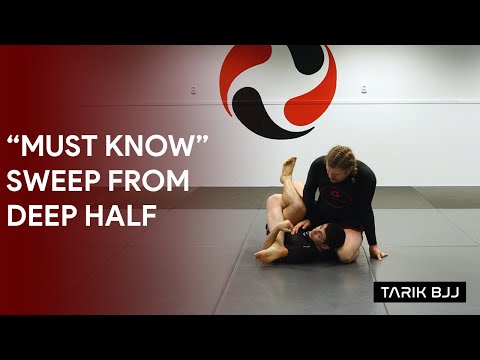
Waiter Sweep from Deep Half Guard
0
Deep Half Sweep·Tarik BJJ
🔗 Links: Follow me on Instagram for more jiu-jitsu content: https://www.instagram.com/tarik_bjj/ Discover top-qualit…
Translation: deep half sweep
The Deep Half Sweep subfamily covers sweeps from the deep half guard, an advanced half guard variation where the guard player dives deep underneath the opponent, positioning their body entirely beneath the opponent's hips. [1] Deep half guard provides extraordinary sweeping leverage because the guard player is directly under the opponent's centre of gravity, making it possible to off-balance and sweep with relatively little effort. [1],[2] Deep half sweeps include the waiter sweep (hooking the far leg with the foot), the Homer Simpson sweep (walking under to the other side), and direct elevations. [2],[3]
The deep half guard was developed by Jeff Glover and further systematised by Ryan Hall, Bernardo Faria, and other competitors who turned the ultra-deep under-the-body position into a complete sweeping system. [1] Bernardo Faria, a five-time world champion, made deep half guard his signature position and one of the most effective guard systems in competition history. [2],[3]
Deep half sweeps use the deep half guard position to off-balance the opponent by undermining their base. [1]
Deep half sweeps were developed in competitive BJJ. [1]
Used in BJJ competition. [1]
No images yet for this technique.
Sign in to suggest an image.
🔗 Links: Follow me on Instagram for more jiu-jitsu content: https://www.instagram.com/tarik_bjj/ Discover top-qualit…
No instructional courses yet for this technique.
Sign in to suggest a course.
Risk of injury to the person this technique is applied to
Sweeps reverse position from bottom; moderate impact on landing for top player
Skill level needed to execute this technique reliably
Whether this technique is allowed under major competition rule sets
Jiu-Jitsu University (Saulo Ribeiro, 2008)
Alias sources — [1] Half Guard (Jeff Glover & Ed Beneville, 2010) [2] Jiu-Jitsu University (Saulo Ribeiro, 2008)
Effectiveness sources — [1] Jiu-Jitsu University (Ribeiro, 2008)
Standard katakana transliteration of Western martial arts terminology (外来語) — used in Japanese MMA, boxing, and BJJ communities
Alias sources — [1] Half Guard (Jeff Glover & Ed Beneville, 2010) [2] Jiu-Jitsu University (Saulo Ribeiro, 2008)
Effectiveness sources — [1] Jiu-Jitsu University (Ribeiro, 2008)
timing, hip power, off-balancing skill
strong hips and active legs for sweeping leverage
hip flexors, glutes, quadriceps, core rotators
Every move, in any martial art, shares a few universal traits. Mix and match below to pinpoint the right tool — or compare equivalents across styles.
The backdoor sweep is a deep half guard sweep where, when the initial forward sweep is blocked, the guard player exits out the back by riding the opponent's resistance to rotate behind them and establish a single leg or top position. [1] Popularized by Jeff Glover (No-Gi World Champion, Paragon Academy), the technique uses the action-reaction principle — threaten a forward sweep, then use the opponent's defensive pull to rotate out the back. [2] The backdoor involves a karate-chop motion behind the opponent's knee with the forearm while using a lapel grip to prevent them from turning back.
The Homer Simpson sweep is a deep half guard sweep where the guard player hugs the opponent's knee tightly, pinches their own knees together to prevent leg extraction, and rolls backward toward the opponent to complete the sweep. [1] The rolling motion on the side resembles Homer Simpson running in circles on his side from The Simpsons — hence the name. Described as 'the most simple sweep from deep half.' [2] Without a proper knee pinch, the opponent can pull their leg free.
The Waiter Sweep is a deep half guard sweep where the guard player hooks the opponent's far leg with the foot (holding it like a waiter holding a tray), then elevates and sweeps the opponent over by extending the hooking leg. [1] The guard player, deep under the opponent, reaches the free leg up and hooks behind the opponent's far knee or thigh, then extends the leg to lift and sweep the opponent over. [1,2] The waiter sweep is one of the highest-percentage deep half guard finishes because the leg hook provides powerful leverage and the opponent's weight is already destabilised by the deep half position. [2,3]
According to Tarik BJJ, you need to actively fight to unbalance your opponent and force them to post their hand on the floor, which gives you the freedom to work with your legs and go for their foot.
Your foot should hook the back of your opponent's heel or right under their Achilles tendon, then bring the leg up toward you while crunching and bringing your knees toward your chest, according to Tarik BJJ.
Tarik BJJ explains that being on top of the knee makes it easier for your opponent to defend, so instead you want to square up and point your leg over their thigh to maintain control.
Tarik BJJ emphasizes keeping your arm punched in tight using your bicep for strength rather than stretching your arm out, which makes it easy for your opponent to escape the grip.
According to Tarik BJJ, don't sweep directly toward the leg they have base on; instead sweep behind their butt cheek toward the opposite side where they lack base.
The Deep Half Sweep subfamily covers sweeps from the deep half guard, an advanced half guard variation where the guard player dives deep underneath the opponent, positioning their body entirely beneath the opponent's hips. Deep half guard provides extraordinary sweeping leverage because the guard player is directly under the opponent's centre of gravity, making it possible to off-balance and sweep with relatively little effort.
The deep half guard was developed by Jeff Glover and further systematised by Ryan Hall, Bernardo Faria, and other competitors who turned the ultra-deep under-the-body position into a complete sweeping system. Bernardo Faria, a five-time world champion, made deep half guard his signature position and one of the most effective guard systems in competition history.
Unified MMA: legal — Legal defensive/transitional technique; IBJJF: legal — Legal; IJF: legal — Legal; ADCC: legal — Legal; UWW: legal — Legal; FIAS Sport Sambo: legal — Legal
Danger rating 3/10. Moderate — sweeps reverse position from bottom; moderate impact on landing for top player
The standard setup chain: Control Grips → Off-Balance → Execute Sweep → Follow to Top.
Standard counters include: Base and Posture — maintain wide base and upright posture to resist the sweep / Grip Strip — break controlling grips before the sweep can be loaded / Back Step — retreat the leg being attacked to remove the sweep fulcrum.
Common variants: Standard sweep (primary off-balancing and reversal technique from the guard); Combination sweep (chaining two sweep directions to catch the opponent's adj…); Counter sweep (sweeping as the opponent initiates a guard pass attempt); Competition sweep (optimised for point-scoring in tournament settings).
Used in BJJ competition.
Top errors to watch for: Entering deep half without securing the leg on the shoulder — the leg must be high on your shoulder for the sweep to … / Not controlling the far leg — the far-leg grip prevents the opponent from stepping over / Going flat under the opponent — maintain an angle in deep half for sweeping leverage / Not using the body extension to elevate — the sweep comes from extending your body to off-balance the opponent.
The Deep Half Sweep is also known as Dīpu Hāfu Suīpu, Deep Half Guard Sweep, Deep Underhook Half.