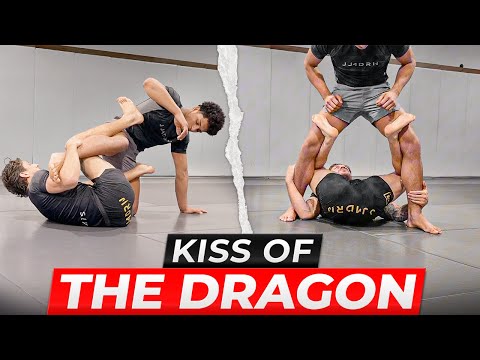
How To Hit The Kiss of The DRAGON
0
Kiss Of The Dragon·JIU JITSU MODERN
The Kiss of the Dragon is one of the most effective ways to take the back when your opponent is pressuring your Reverse …
Translation: kiss of the dragon
The Kiss Of The Dragon subfamily covers the specific berimbolo variation where the guard player inverts and threads through the opponent's legs from a reverse De La Riva position, emerging on the other side with back control. [1] Unlike the standard berimbolo which spins under the opponent, the Kiss of the Dragon threads between the legs, making it particularly effective when the opponent is standing with a wide base. [1],[2] The technique involves inverting, threading the head and shoulders between the opponent's legs, and emerging behind them with immediate back control. [2],[3]
The kiss of the dragon is a back-take transition from De La Riva guard that inverts between the opponent's legs. [1]
Developed in competitive BJJ as a dynamic back-take from DLR guard. [1]
Used in IBJJF competition by De La Riva guard specialists. [1]
No images yet for this technique.
Sign in to suggest an image.
The Kiss of the Dragon is one of the most effective ways to take the back when your opponent is pressuring your Reverse …
No instructional courses yet for this technique.
Sign in to suggest a course.
Risk of injury to the person this technique is applied to
Sweeps reverse position from bottom; moderate impact on landing for top player
Skill level needed to execute this technique reliably
Whether this technique is allowed under major competition rule sets
Advanced Brazilian Jiu-Jitsu Techniques (Marcelo Garcia, 2011)
Alias sources — [1] Popularised by Leandro Lo and Mendes Brothers [2] Modern competition BJJ terminology [3] Common abbreviation in BJJ community
Effectiveness sources — [1] IBJJF competition analysis
Standard katakana transliteration of Western martial arts terminology (外来語) — used in Japanese MMA, boxing, and BJJ communities
Alias sources — [1] Popularised by Leandro Lo and Mendes Brothers [2] Modern competition BJJ terminology [3] Common abbreviation in BJJ community
Effectiveness sources — [1] IBJJF competition analysis
hip escape (shrimping) speed, framing strength, timing
flexible hips and quick lateral movement
hip flexors, obliques, triceps (framing), core
Every move, in any martial art, shares a few universal traits. Mix and match below to pinpoint the right tool — or compare equivalents across styles.
According to Carlos Rosado from Jiu-Jitsu Modern, hook your partner's outside hip with the laces of your foot while your knee points toward theirs, then use your hand behind their knee to post and get weight off their lead leg. When they straighten their leg, keep the reverse De La Riva position active and re-hook when their knee bends again.
Carlos Rosado emphasizes not letting your leg slide down or opening up your arm, because your opponent will punch an underhook and start their passes. Instead, keep your elbow to the inside of your hip to maintain control.
According to Carlos Rosado, you need to switch from a heel grip to a scoop grip (hand elbow-deep between your hip and opponent's foot) to help you get up on your shoulders and invert. Position your opponent's leg in line with your hip to make the inversion easier.
Carlos Rosado teaches that you should 'hide' your leg by positioning yourself in front of them as they attempt the scoop, which prevents them from getting the grip they need to invert effectively.
The Kiss Of The Dragon subfamily covers the specific berimbolo variation where the guard player inverts and threads through the opponent's legs from a reverse De La Riva position, emerging on the other side with back control. Unlike the standard berimbolo which spins under the opponent, the Kiss of the Dragon threads between the legs, making it particularly effective when the opponent is standing with a wide base.
The Kiss of the Dragon was popularised by competitors in the modern berimbolo era, particularly associated with the Mendes brothers' guard systems. The technique represents an advanced berimbolo variation that expanded the back-taking options from inverted guard positions.
Unified MMA: legal — Legal defensive/transitional technique; IBJJF: legal — Legal; IJF: legal — Legal; ADCC: legal — Legal; UWW: legal — Legal; FIAS Sport Sambo: legal — Legal
Danger rating 3/10. Moderate — sweeps reverse position from bottom; moderate impact on landing for top player
The standard setup chain: Create Space → Disrupt Control → Execute Escape → Recover Position.
Standard counters include: Maintain Pressure — keep consistent weight distribution to limit escape space / Anticipate Direction — read escape attempt direction and block early / Transition — flow to a new position when the current one is threatened.
Common variants: Shrimp to guard (framing and hip-escaping to recover full guard or half guard); Underhook escape (winning the underhook and coming to knees or reversing); Bridge to knees (bridging into the opponent and transitioning to turtle or…); Ghost escape (inverting under the opponent to re-guard from the opposit…).
Used in IBJJF competition by De La Riva guard specialists.
Top errors to watch for: Attempting the Kiss of the Dragon when the opponent is standing tall — it works against kneeling or passing opponents / Inverting too late after the opponent has already consolidated the pass — the timing window is during the pass, not a… / Not maintaining the DLR hook during the spin — the hook is the anchor; losing it means losing the technique / Spinning too far and ending in front of the opponent — control the rotation to end behind them.
The Kiss Of The Dragon is also known as Kisu Obu Za Doragon, Kiss Of The Dragon, Reverse Berimbolo, KOTD.