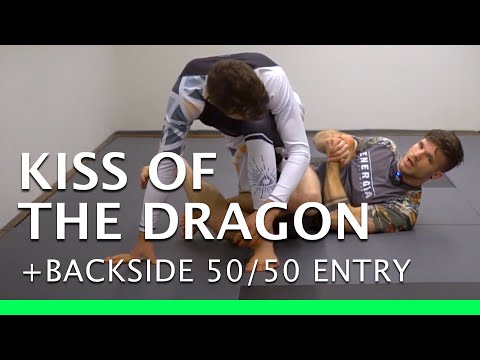
Kiss of the Dragon
0
Standard Kiss Of The Dragon·Energia Martial Arts·Added by Admin
Kiss of the Dragon In this video we cover the entry from reverse de la Riva to the kiss of the dragon back take. We also…
Translation: standard kiss of the dragon
The Standard Kiss Of The Dragon executes the fundamental version of this technique by establishing reverse De La Riva guard, inverting between the opponent's legs, and threading the head and shoulders through to emerge behind the opponent with back control. [1] The guard player hooks the reverse DLR, inverts by pulling the hips over the shoulders, and slides between the opponent's legs, using the hooking leg to maintain connection throughout the transition. [1],[2] As the player emerges behind the opponent, they immediately secure seat-belt control and establish hooks for full back control. [2],[3]
A modern BJJ back-take technique from DLR guard. [1]
Used in IBJJF competition. [1]
No images yet for this technique.
Sign in to suggest an image.
Kiss of the Dragon In this video we cover the entry from reverse de la Riva to the kiss of the dragon back take. We also…
No instructional courses yet for this technique.
Sign in to suggest a course.
Risk of injury to the person this technique is applied to
Sweeps reverse position from bottom; moderate impact on landing for top player
Skill level needed to execute this technique reliably
Whether this technique is allowed under major competition rule sets
Advanced Brazilian Jiu-Jitsu Techniques (Marcelo Garcia, 2011)
Alias sources — [1] Popularised by Leandro Lo and Mendes Brothers [2] Modern competition BJJ terminology
Effectiveness sources — [1] Art of Jiu-Jitsu Academy (Mendes Brothers) competition methodology [2] IBJJF competition analysis
Standard katakana transliteration of Western martial arts terminology (外来語) — used in Japanese MMA, boxing, and BJJ communities
Alias sources — [1] Popularised by Leandro Lo and Mendes Brothers [2] Modern competition BJJ terminology
Effectiveness sources — [1] Art of Jiu-Jitsu Academy (Mendes Brothers) competition methodology [2] IBJJF competition analysis
grip fighting ability, hip mobility for sliding to the mat, chin defence
strong hands for grip fighting, flexible hips
forearms (grip fighting), core, hip flexors, neck
You start from a reverse Dela Jiva position. Energia Martial Arts recommends checking out their basic reverse Dela Jiva video first to understand the foundational position.
Initially grip the opponent's heel from behind, then switch your grip to the inside backside of your hand and wrist as you invert. You'll push off with the backside of your hand and wrist against their ankle and shin to help you spin between their legs.
Shove your shoulders back slightly to prevent the opponent from falling on your face and chest, which helps them fall into your lap for the back take instead.
You can attack the opponent's leg with a backside 50/50 heel entry using a gable grip or reverse butterfly grip, keeping pressure with your hamstring to maintain control.
The Standard Kiss Of The Dragon executes the fundamental version of this technique by establishing reverse De La Riva guard, inverting between the opponent's legs, and threading the head and shoulders through to emerge behind the opponent with back control. The guard player hooks the reverse DLR, inverts by pulling the hips over the shoulders, and slides between the opponent's legs, using the hooking leg to maintain connection throughout the transition.
The standard Kiss of the Dragon represents the base version of this advanced berimbolo variation, developed within the broader inverted guard system that dominated lightweight BJJ competition. It remains a high-level technique primarily used by advanced competitors.
Unified MMA: legal — Legal defensive/transitional technique; IBJJF: legal — Legal; IJF: legal — Legal; ADCC: legal — Legal; UWW: legal — Legal; FIAS Sport Sambo: legal — Legal
Danger rating 3/10. Moderate — sweeps reverse position from bottom; moderate impact on landing for top player
The standard setup chain: Create Space → Disrupt Control → Execute Escape → Recover Position.
Standard counters include: Maintain Pressure — keep consistent weight distribution to limit escape space / Anticipate Direction — read escape attempt direction and block early / Transition — flow to a new position when the current one is threatened.
Common variants: Slide to side (choking-arm side) (fighting hands and sliding hips to the mat on the choking…); Peel-and-turn (stripping the seatbelt grip and turning into the opponent); Trap-arm escape (trapping one arm and rolling to pin the opponent's back); Body triangle escape (addressing the body triangle lock before escaping the hooks).
Used in IBJJF competition.
Top errors to watch for: Inverting before the opponent commits to the pass — you need their weight commitment for the spin to work / Losing the DLR hook during the inversion — the hook must stay deep throughout / Not gripping the far belt or ankle — the grip prevents the opponent from adjusting during your spin / Inverting to the wrong side — always invert under the passing knee, not away from it.
The Standard Kiss Of The Dragon is also known as Sutandādo Kisu Obu Za Doragon, Basic Kiss Of The Dragon, Standard KOTD.