Wallwork: Fighting Off of the Cage & MMA Clinch
0
Standard Wall Walk Standup·fightTIPS
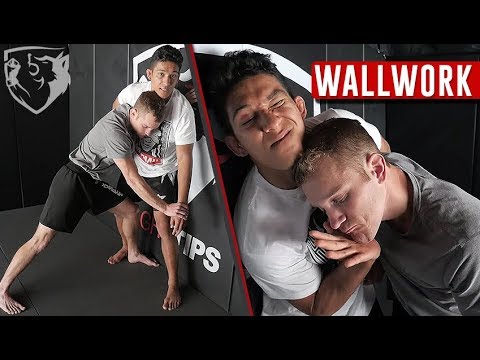
Fighting off the wall or cage is an art in itself, with very specific techniques that utilize leverage and control. 'The…
Translation: standard wall walk standup
The Standard Wall Walk Standup places the upper back against the cage fence, plants both feet underneath the body, and drives upward using the legs while the fence provides balance and prevents the opponent from driving the defender back down. [1] The defender maintains defensive framing against the opponent with one arm while using the other arm and the fence contact to push upward to standing. [1],[2] The standup must be performed with continuous upward pressure, as pausing at any point allows the opponent to reassert control. [2],[3]
The standard wall walk is the baseline cage-assisted standup. [1]
Developed in MMA cage fighting. [1]
Used in MMA competition. [1]
No images yet for this technique.
Sign in to suggest an image.
Fighting off the wall or cage is an art in itself, with very specific techniques that utilize leverage and control. 'The…
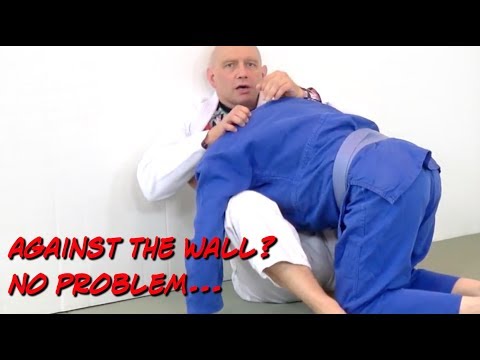
If you're doing BJJ for self defense or MMA fighting purposes then you have to know how to deal with obstructions like w…
Getting back to your feet is one of the most important skills in MMA - and most takedowns happen against the fence - so …
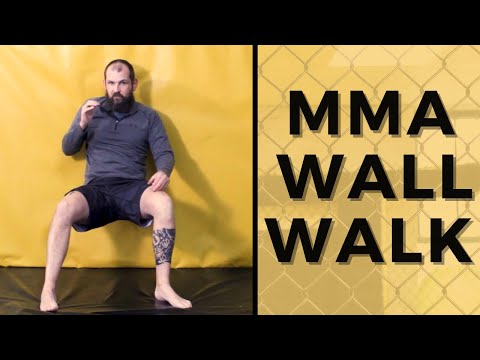
The standard wall walk standup is a technical method for escaping the bottom position and returning to the feet when pressed against a wall or cage, particularly in MMA and grappling contexts. Stephan Kesting emphasizes that head positioning is critical—the defender's head must be higher than the opponent's to execute the shoulder walk effectively, and lateral body angling of 20–30 degrees to the wall facilitates the movement. Predators MMA and BJJ Academy Manchester provides the most detailed progression, breaking the technique into three progressive drills: first, basic shoulder-to-shoulder alternation (pushing off one foot while driving the opposite shoulder into the wall to lift the hips); second, adding pummeling action simultaneously to fight for underhooks and arm positioning; third, executing the movement from a compromised bottom position, maintaining wall contact at hip, knee, and foot to prevent back control exposure. Both Kesting and Predators emphasize maintaining hand position for fighting rather than bracing on the floor. FightTIPS frames wall work within the broader defensive principle of controlling the opponent's head, hands, and hips, though their discussion focuses more on clinch control than standup recovery. All three instructors agree that the wall walk requires avoiding hand placement on the ground and maintaining constant wall contact; Predators and Kesting both stress the importance of proper body angles and foot-to-shoulder sequencing to generate upward momentum efficiently.
Synthesized from 3 instructors
No instructional courses yet for this technique.
Sign in to suggest a course.
Risk of injury to the person this technique is applied to
Standing escapes from clinch/holds; involves explosive disengagement
Skill level needed to execute this technique reliably
Whether this technique is allowed under major competition rule sets
Jiu-Jitsu University (Saulo Ribeiro, 2008)
Alias sources — [1] Wrestling Physical Conditioning Encyclopedia (John Jesse, 1974) [2] MMA coaching terminology
Effectiveness sources — [1] Wrestling for Fighting (Couture, 2007)
Standard katakana transliteration of Western martial arts terminology (外来語) — used in Japanese MMA, boxing, and BJJ communities
Alias sources — [1] Wrestling Physical Conditioning Encyclopedia (John Jesse, 1974) [2] MMA coaching terminology
Effectiveness sources — [1] Wrestling for Fighting (Couture, 2007)
grip fighting ability, hip mobility for sliding to the mat, chin defence
strong hands for grip fighting, flexible hips
forearms (grip fighting), core, hip flexors, neck
Keep your hip, knee, and foot all connected to the wall at all times to prevent your opponent from taking your back or creating space for hooks. According to Predators MMA and BJJ Academy Manchester, maintaining this connection allows you to use the wall to peel off an opponent if they attempt to control you from behind.
Try not to put your hands on the floor during a wall walk standup—keep yourself covered and switch your feet instead. Predators MMA and BJJ Academy Manchester emphasizes that putting your hands down opens you up to strikes or submissions, so rely on pushing your hips against the wall and bridging off your legs.
Pummel (fight for underhooks) as you move up the wall shoulder-to-shoulder, which allows you to prevent your opponent from controlling your legs. According to Predators MMA and BJJ Academy Manchester, pummeling during the movement keeps you fighting from position rather than just climbing passively and having to repeat the drill.
Push off one foot while driving your opposite shoulder into the wall, alternating side to side as you work your way up. Predators MMA and BJJ Academy Manchester describes this as a shoulder-to-shoulder movement, pushing from foot to foot to generate upward progress.
The Standard Wall Walk Standup places the upper back against the cage fence, plants both feet underneath the body, and drives upward using the legs while the fence provides balance and prevents the opponent from driving the defender back down. The defender maintains defensive framing against the opponent with one arm while using the other arm and the fence contact to push upward to standing.
The standard wall walk standup is one of the most commonly used ground-to-standing transitions in MMA, developed through the sport's cage fighting evolution. It is a standard component of MMA ground defence curricula taught at all training camps.
Unified MMA: legal — Legal defensive/transitional technique; IBJJF: legal — Legal; IJF: legal — Legal; ADCC: legal — Legal; UWW: legal — Legal, escape scores 1 point (freestyle), reversal scores 1 point; FIAS Sport Sambo: legal — Legal; NCAA Folkstyle: legal — Legal, escape scores 1 point, reversal scores 2 points
Danger rating 3/10. Moderate — standing escapes from clinch/holds; involves explosive disengagement
The standard setup chain: Create Space → Disrupt Control → Execute Escape → Recover Position.
Standard counters include: Maintain Pressure — keep consistent weight distribution to limit escape space / Anticipate Direction — read escape attempt direction and block early / Transition — flow to a new position when the current one is threatened.
Common variants: Slide to side (choking-arm side) (fighting hands and sliding hips to the mat on the choking…); Peel-and-turn (stripping the seatbelt grip and turning into the opponent); Trap-arm escape (trapping one arm and rolling to pin the opponent's back); Body triangle escape (addressing the body triangle lock before escaping the hooks).
Used in MMA competition.
Top errors to watch for: Walking the feet without pressing into the wall — the wall friction is what allows you to walk up; lean into it / Not maintaining the underhook throughout — losing the underhook means losing the escape / Walking up but not creating distance at the top — stand and immediately step away or transition / Taking too large of steps — small, incremental steps are more stable.
The Standard Wall Walk Standup is also known as Sutandādo Wōru Wōku Sutando Appu, Basic Wall Walk, Standard Cage Stand-Up.