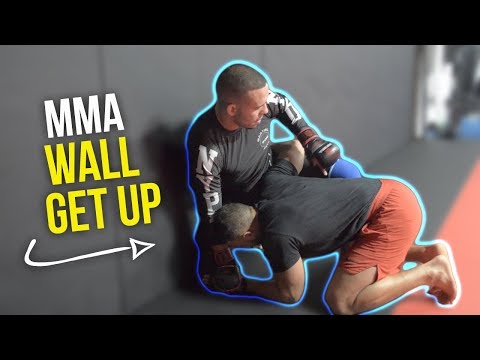
Wall Get Up (MMA)
0
Wall Walk Standup·Steven Strangles People
Escaping the bottom position in MMA is very difficult. It's even harder when you're pinned against the Wall(cage). Chec…
Translation: wall walk standup
The Wall Walk Standup subfamily covers standing techniques that use a wall or cage fence as support to rise from a downed position, using the vertical surface for balance and leverage. [1] The wall walk is the most common method of standing up in MMA when near the cage, as the fence provides a reliable support structure that compensates for the difficulty of standing under pressure. [1],[2] The technique involves placing the back against the cage and walking the feet underneath the body while using the fence for upward support. [2],[3]
The wall walk standup uses the cage or wall as support to rise from the ground while in the opponent's control. [1]
The wall walk was developed in MMA as a cage-specific standup technique. [1]
The wall walk is a common MMA escape technique. [1]
No images yet for this technique.
Sign in to suggest an image.
Escaping the bottom position in MMA is very difficult. It's even harder when you're pinned against the Wall(cage). Chec…
No instructional courses yet for this technique.
Sign in to suggest a course.
Risk of injury to the person this technique is applied to
Standing escapes from clinch/holds; involves explosive disengagement
Skill level needed to execute this technique reliably
Whether this technique is allowed under major competition rule sets
Jiu-Jitsu University (Saulo Ribeiro, 2008)
Alias sources — [1] MMA coaching terminology [2] Wrestling Physical Conditioning Encyclopedia (John Jesse, 1974) [3] UFC broadcast terminology
Effectiveness sources — [1] Wrestling for Fighting (Couture, 2007)
Standard katakana transliteration of Western martial arts terminology (外来語) — used in Japanese MMA, boxing, and BJJ communities
Alias sources — [1] MMA coaching terminology [2] Wrestling Physical Conditioning Encyclopedia (John Jesse, 1974) [3] UFC broadcast terminology
Effectiveness sources — [1] Wrestling for Fighting (Couture, 2007)
grip fighting ability, hip mobility for sliding to the mat, chin defence
strong hands for grip fighting, flexible hips
forearms (grip fighting), core, hip flexors, neck
Every move, in any martial art, shares a few universal traits. Mix and match below to pinpoint the right tool — or compare equivalents across styles.
Keep a strong pulse with your right hand to maintain control. When your opponent grabs your wrist—which they will—this actually gives you an opening to free up your right knee line, according to Steven Strangles People.
Rather than relying on explosive energy, Steven Strangles People suggests baiting your opponent into grabbing your wrist, which allows you to stay on the ground and work toward a dominant position instead of immediately standing up.
Once your opponent's head rises above their shoulder, it becomes nearly impossible for them to escape your right knee line. Keep your feet heavy on them to prevent this escape, per Steven Strangles People.
Get your elbow attached to your body and turn it inside of your opponent's shoulder. If they continue to build upward, they give you the underhook and shoulder dominance—place your shoulder under their armpit, grab the rotator cuff, and attach your knuckle to your temple to control their head, according to Steven Strangles People.
The Wall Walk Standup subfamily covers standing techniques that use a wall or cage fence as support to rise from a downed position, using the vertical surface for balance and leverage. The wall walk is the most common method of standing up in MMA when near the cage, as the fence provides a reliable support structure that compensates for the difficulty of standing under pressure.
The wall walk standup was developed specifically for MMA cage fighting, where the fence provides a unique structural support for returning to standing. It became a standard MMA technique as fighters recognised the fence's utility for ground-to-standing transitions.
Unified MMA: legal — Legal defensive/transitional technique; IBJJF: legal — Legal; IJF: legal — Legal; ADCC: legal — Legal; UWW: legal — Legal, escape scores 1 point (freestyle), reversal scores 1 point; FIAS Sport Sambo: legal — Legal; NCAA Folkstyle: legal — Legal, escape scores 1 point, reversal scores 2 points
Danger rating 3/10. Moderate — standing escapes from clinch/holds; involves explosive disengagement
The standard setup chain: Create Space → Disrupt Control → Execute Escape → Recover Position.
Standard counters include: Maintain Pressure — keep consistent weight distribution to limit escape space / Anticipate Direction — read escape attempt direction and block early / Transition — flow to a new position when the current one is threatened.
Common variants: Slide to side (choking-arm side) (fighting hands and sliding hips to the mat on the choking…); Peel-and-turn (stripping the seatbelt grip and turning into the opponent); Trap-arm escape (trapping one arm and rolling to pin the opponent's back); Body triangle escape (addressing the body triangle lock before escaping the hooks).
The wall walk is a common MMA escape technique.
Top errors to watch for: Attempting the wall walk without underhook control — the underhook prevents the opponent from pulling you back down / Walking the feet too far apart — a wide stance on the wall reduces the upward force; keep feet under your centre of g… / Not pressing the back firmly into the wall — the wall provides the friction and support; lean into it / Walking up too fast and losing balance — incremental steps are more reliable than one explosive push.
The Wall Walk Standup is also known as Wōru Wōku Sutando Appu, Cage Walk, Wall Stand-Up, Fence Walk.