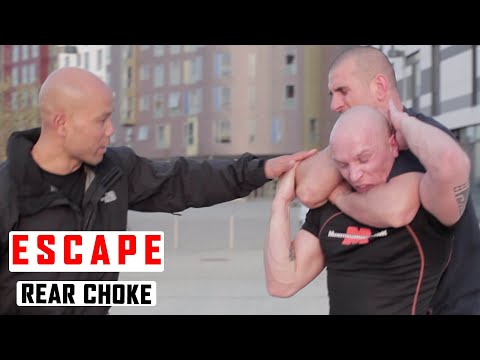
How to Escape a Standing Rear Choke ✅ Lesson 2
0
Standing Escape·Master Wong
How to Escape a Standing Rear Choke ✅ Lesson 2 For a FREE Wing Chun Programme, Click Here: https://bit.ly/3fulRKy Have y…
Translation: standing escape
The Standing Escape group encompasses all techniques for returning to a standing position from the ground, whether from bottom position, guard, or after being taken down. [1] Standing escapes are critical in MMA where the ground position may not be advantageous for a striker, and in self-defence where remaining on the ground creates additional vulnerability. [1],[2] This group includes technical stand-ups (systematic methods of standing safely), guard pulls (transitioning from standing to a specific guard position), and wrestle-ups (using wrestling techniques to return to standing from the bottom). [2],[3]
Standing escape techniques were developed across multiple martial arts traditions — wrestling's stand-up techniques, BJJ's technical stand-up, and MMA's cage-assisted stand-ups all contribute to the modern standing escape curriculum. [1] The importance of standing escapes increased dramatically with the growth of MMA, where the ability to choose the fighting range became a primary tactical consideration. [2],[3]
Standing up from bottom is a key MMA skill tracked by FightMetric. [1]
No images yet for this technique.
Sign in to suggest an image.
How to Escape a Standing Rear Choke ✅ Lesson 2 For a FREE Wing Chun Programme, Click Here: https://bit.ly/3fulRKy Have y…
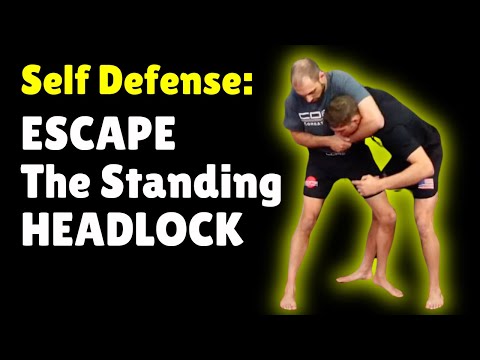
A standing headlock is a situation that frequently arises in untrained encounters for self defense and can be dangerous …
No instructional courses yet for this technique.
Sign in to suggest a course.
Risk of injury to the person this technique is applied to
Standing escapes from clinch/holds; involves explosive disengagement
Skill level needed to execute this technique reliably
Whether this technique is allowed under major competition rule sets
The Guard (Joe Moreira & Ed Beneville, 2008)
Alias sources — [1] Wrestling Physical Conditioning Encyclopedia (Welker, 2010) [2] Jiu-Jitsu University (Ribeiro, 2008) [3] Mastering Jujitsu (Gracie & Danaher, 2003)
Effectiveness sources — [1] Mastering Jujitsu (Gracie & Danaher, 2003) [2] Wrestling for Fighting (Couture, 2007)
Standard Japanese martial arts terminology (kanji/hiragana)
Established Japanese martial arts naming convention — native Japanese term (和語/漢語)
Alias sources — [1] Wrestling Physical Conditioning Encyclopedia (Welker, 2010) [2] Jiu-Jitsu University (Ribeiro, 2008) [3] Mastering Jujitsu (Gracie & Danaher, 2003)
Effectiveness sources — [1] Mastering Jujitsu (Gracie & Danaher, 2003) [2] Wrestling for Fighting (Couture, 2007)
hip mobility, explosive bridge/shrimp power, timing
flexible hips and strong glutes for escape movements
glutes, hip flexors, core, triceps (framing)
Every move, in any martial art, shares a few universal traits. Mix and match below to pinpoint the right tool — or compare equivalents across styles.
The Guard Pull family covers techniques for transitioning from standing to a seated or guard position on the ground, deliberately choosing to fight from the bottom guard rather than continuing to engage standing. [1] Guard pulling is a strategic decision used primarily in BJJ competition where the guard is considered an advantageous position with sweeps and submissions available. [1,2] Guard pulls include standard guard pulls (jumping to closed guard), sit guard pulls (sitting to the ground and establishing seated guard), and sport-specific variations designed for competition. [2,3]
The Technical Standup family covers systematic methods of returning to a standing position from the ground while maintaining defensive awareness and balance. [1] The technical standup is distinguished from simply standing up by its emphasis on maintaining a defensive posture throughout the rising motion — the fighter uses one hand posted behind them and keeps the opposite leg as a barrier while standing. [1,2] Technical standups include the standard technical standup (rising from a seated position) and wall walk standups (using the cage or wall for support). [2,3]
The Wrestle-Up family covers techniques for returning to a standing position by using wrestling-based movements — such as single-leg and double-leg entries — from the bottom position to stand up while simultaneously attacking. [1] The wrestle-up is an aggressive standing escape that combines the goal of returning to feet with an offensive wrestling attack, making it difficult for the opponent to defend both the standing attempt and the takedown threat. [1,2] Wrestle-ups are particularly effective from half guard, seated guard, and after creating space from bottom side control. [2,3]
Standing escapes — guard pulls, technical standups, and wrestle-ups — return the fighter to their feet from the ground. In MMA, the ability to stand up from bottom is often more important than guard sweeps, because standing negates the opponent's ground-and-pound. (MMA training manuals; Couture, Wrestling for Fighting)
Drop your chin down immediately to protect your neck and make it harder for them to lock the choke in properly. Master Wong emphasizes that dropping your chin down is the most important initial response to buy yourself time.
No—do not square your body. Instead, drop your body back slightly and keep your shoulders out properly, otherwise you risk getting choked. Master Wong stresses that improper body positioning in this situation can be dangerous.
Attack the choking hand straight away by peeling and pulling at it while maintaining control. Master Wong teaches that you must respond quickly to peel their hand off and control them before they can fully apply the choke.
Build your posture by bringing your hips in and your head up before your opponent's hands lock together. CorePRO BJJ notes that if you can establish good posture early, you can control their far arm and avoid the headlock entirely.
The Standing Escape group encompasses all techniques for returning to a standing position from the ground, whether from bottom position, guard, or after being taken down. Standing escapes are critical in MMA where the ground position may not be advantageous for a striker, and in self-defence where remaining on the ground creates additional vulnerability.
Standing escape techniques were developed across multiple martial arts traditions — wrestling's stand-up techniques, BJJ's technical stand-up, and MMA's cage-assisted stand-ups all contribute to the modern standing escape curriculum. The importance of standing escapes increased dramatically with the growth of MMA, where the ability to choose the fighting range became a primary tactical consideration.
Unified MMA: legal — Legal defensive/transitional technique; IBJJF: legal — Legal; IJF: legal — Legal; ADCC: legal — Legal; UWW: legal — Legal, escape scores 1 point (freestyle), reversal scores 1 point; FIAS Sport Sambo: legal — Legal; NCAA Folkstyle: legal — Legal, escape scores 1 point, reversal scores 2 points
Danger rating 3/10. Moderate — standing escapes from clinch/holds; involves explosive disengagement
The standard setup chain: Create Space → Disrupt Control → Execute Escape → Recover Position.
Standard counters include: Maintain Pressure — keep consistent weight distribution to limit escape space / Anticipate Direction — read escape attempt direction and block early / Transition — flow to a new position when the current one is threatened.
Common variants: Standard escape (primary escape mechanic using frames, bridges, or hip mov…); Combination escape (chaining two escape directions or methods); Counter escape (using the opponent's attack attempt to create the escape …); Competition variation (modified for rule-set optimisation).
Standing up from bottom is a key MMA skill tracked by FightMetric.
Top errors to watch for: Standing up without establishing frames first — you'll be immediately taken back down without frames and distance / Turning your back to stand — maintain visual contact with the opponent; the technical standup keeps you facing them / Standing up into the opponent's clinch — create distance with frames before attempting to stand / Not using the cage when available — in MMA, the cage is a structural advantage for standing escapes.
The Standing Escape is also known as Tachi-agari Nige, Standup, Get Up, Ground To Feet.