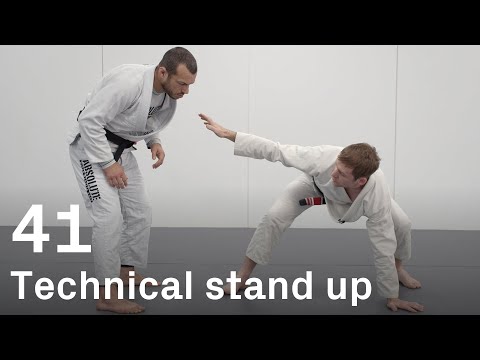
Technical Stand Up
0
Technical Standup·Absolute MMA St Kilda - Melbourne
Full Course Playlist → https://youtube.com/playlist?list=PLDrQXekZsfYZfV1QZ4T5UkxLwFwQ12EbP Find the Introduction course…
Translation: technical standup
The Technical Standup family covers systematic methods of returning to a standing position from the ground while maintaining defensive awareness and balance. [1] The technical standup is distinguished from simply standing up by its emphasis on maintaining a defensive posture throughout the rising motion — the fighter uses one hand posted behind them and keeps the opposite leg as a barrier while standing. [1],[2] Technical standups include the standard technical standup (rising from a seated position) and wall walk standups (using the cage or wall for support). [2],[3]
The technical standup was developed in BJJ and self-defence training as a safe method of returning to standing while maintaining readiness to defend against an advancing opponent. [1] It became essential in MMA where returning to standing safely is a critical skill for fighters who prefer to strike. [2],[3]
The technical standup is a core BJJ and MMA technique, emphasised in Gracie self-defence methodology. [1]
The technical standup is widely used in MMA competition for standing up from bottom. [1]
No images yet for this technique.
Sign in to suggest an image.
Full Course Playlist → https://youtube.com/playlist?list=PLDrQXekZsfYZfV1QZ4T5UkxLwFwQ12EbP Find the Introduction course…
No instructional courses yet for this technique.
Sign in to suggest a course.
Risk of injury to the person this technique is applied to
Standing escapes from clinch/holds; involves explosive disengagement
Skill level needed to execute this technique reliably
Whether this technique is allowed under major competition rule sets
Mastering Jujitsu (Renzo Gracie & John Danaher, 2003)
Alias sources — [1] Mastering Jujitsu (Gracie & Danaher, 2003) [2] Jiu-Jitsu University (Ribeiro, 2008)
Effectiveness sources — [1] Mastering Jujitsu (Gracie & Danaher, 2003) [2] Jiu-Jitsu University (Ribeiro, 2008)
Standard katakana transliteration of Western martial arts terminology (外来語) — used in Japanese MMA, boxing, and BJJ communities
Alias sources — [1] Mastering Jujitsu (Gracie & Danaher, 2003) [2] Jiu-Jitsu University (Ribeiro, 2008)
Effectiveness sources — [1] Mastering Jujitsu (Gracie & Danaher, 2003) [2] Jiu-Jitsu University (Ribeiro, 2008)
hip mobility, explosive bridge/shrimp power, timing
flexible hips and strong glutes for escape movements
glutes, hip flexors, core, triceps (framing)
Every move, in any martial art, shares a few universal traits. Mix and match below to pinpoint the right tool — or compare equivalents across styles.
The Standard Technical Standup subfamily covers the fundamental technique of rising from a seated or downed position while maintaining a defensive base and guard throughout the standing motion. [1] The technique uses a three-point base (two hands and one foot, or one hand, one foot, and one knee) to maintain stability while rising, keeping one leg extended as a barrier to prevent the opponent from closing distance. [1,2] The standard technical standup is considered the safest method of returning to feet because it keeps the defender balanced and protected at every stage. [2,3]
The Wall Walk Standup subfamily covers standing techniques that use a wall or cage fence as support to rise from a downed position, using the vertical surface for balance and leverage. [1] The wall walk is the most common method of standing up in MMA when near the cage, as the fence provides a reliable support structure that compensates for the difficulty of standing under pressure. [1,2] The technique involves placing the back against the cage and walking the feet underneath the body while using the fence for upward support. [2,3]
The technical standup uses a specific sequence — posting one hand behind, kicking the top leg forward, then rising to feet while maintaining guard — to safely return to standing from the ground. A fundamental MMA and self-defense movement that protects against being kicked while getting up. (MMA training manuals; Gracie self-defense curriculum)
If you sit up forwards naturally, you expose yourself to strikes to the head or face. The technical standup uses a different approach to protect yourself while rising.
Not keeping something between yourself and your opponent at all times. It's tempting to shortcut the technique by bringing your leg down or not having a hand in place, which exposes you to strikes or your opponent taking a superior position.
Use your feet to keep distance from your opponent—if they try to advance, push them back with your legs. As you rise onto your elbow and then hand, keep your arm between you and your opponent so you can grab and push them away if they come in.
Extending your arm completely gives you much more space to bring your leg out and stand up. If you only come up to your elbow, you'll tend to rise by coming to your knee first, which limits your movement and base stability.
The Technical Standup family covers systematic methods of returning to a standing position from the ground while maintaining defensive awareness and balance. The technical standup is distinguished from simply standing up by its emphasis on maintaining a defensive posture throughout the rising motion — the fighter uses one hand posted behind them and keeps the opposite leg as a barrier while standing.
The technical standup was developed in BJJ and self-defence training as a safe method of returning to standing while maintaining readiness to defend against an advancing opponent. It became essential in MMA where returning to standing safely is a critical skill for fighters who prefer to strike.
Unified MMA: legal — Legal defensive/transitional technique; IBJJF: legal — Legal; IJF: legal — Legal; ADCC: legal — Legal; UWW: legal — Legal, escape scores 1 point (freestyle), reversal scores 1 point; FIAS Sport Sambo: legal — Legal; NCAA Folkstyle: legal — Legal, escape scores 1 point, reversal scores 2 points
Danger rating 3/10. Moderate — standing escapes from clinch/holds; involves explosive disengagement
The standard setup chain: Create Space → Disrupt Control → Execute Escape → Recover Position.
Standard counters include: Maintain Pressure — keep consistent weight distribution to limit escape space / Anticipate Direction — read escape attempt direction and block early / Transition — flow to a new position when the current one is threatened.
Common variants: Standard escape (primary escape mechanic using frames, bridges, or hip mov…); Combination escape (chaining two escape directions or methods); Counter escape (using the opponent's attack attempt to create the escape …); Competition variation (modified for rule-set optimisation).
The technical standup is widely used in MMA competition for standing up from bottom.
Top errors to watch for: Standing up without posting the hand — the post provides the stability to rise in a controlled manner / Turning the back to the opponent while standing — the technical standup keeps you facing the threat / Not protecting with the lead hand — the hand should frame or guard as you rise / Standing up directly into the opponent's range — create distance as you stand with a retreating step.
The Technical Standup is also known as Tekunikaru Sutando Appu, Tech Standup, Base Up.