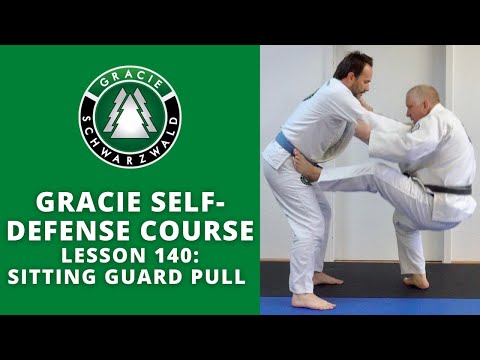
BJJ Self-Defense Course | Lesson 140: Sitting Guard Pull
0
Standard Sit Guard Pull·Gracie Schwarzwald Jiu-Jitsu·Added by Admin
Obviously, pulling guard is bad from a Self-Defense Perspective. But, I am teaching it so that students will learn how…
Translation: standard sit guard pull
The Standard Sit Guard Pull establishes a collar or sleeve grip, then sits directly to the ground while maintaining grip control, immediately establishing a seated guard position with the feet posted against the opponent's hips or legs. [1] The pull is executed by gripping the opponent's collar and sleeve (in gi) or wrist and collar tie (in no-gi), then sitting back while pulling the opponent forward to prevent them from simply backing away. [1],[2] The seated position immediately transitions to a specific guard system — butterfly, De La Riva, or shin-to-shin — depending on the practitioner's preference. [2],[3]
The standard sit guard pull is the baseline seated guard pull. [1]
A BJJ competition technique. [1]
Used in IBJJF competition. [1]
No images yet for this technique.
Sign in to suggest an image.
Obviously, pulling guard is bad from a Self-Defense Perspective. But, I am teaching it so that students will learn how…
No instructional courses yet for this technique.
Sign in to suggest a course.
Risk of injury to the person this technique is applied to
Standing escapes from clinch/holds; involves explosive disengagement
Skill level needed to execute this technique reliably
Whether this technique is allowed under major competition rule sets
Jiu-Jitsu University (Saulo Ribeiro, 2008)
Alias sources — [1] X-Guard (Marcelo Garcia, 2008) [2] Jiu-Jitsu University (Saulo Ribeiro, 2008)
Effectiveness sources — [1] Mastering Jujitsu (Gracie & Danaher, 2003)
Mixed Japanese-Western terminology — combines traditional Japanese terms with katakana loanwords
Alias sources — [1] X-Guard (Marcelo Garcia, 2008) [2] Jiu-Jitsu University (Saulo Ribeiro, 2008)
Effectiveness sources — [1] Mastering Jujitsu (Gracie & Danaher, 2003)
grip fighting ability, hip mobility for sliding to the mat, chin defence
strong hands for grip fighting, flexible hips
forearms (grip fighting), core, hip flexors, neck
You should sit and spin to land on your hip, not fall straight back. According to Gracie Schwarzwald Jiu-Jitsu, falling straight back allows your opponent to hop over your leg and attack, plus it risks hurting yourself and flattening your back—instead, sit, spin, and fall to your side with your leg extended out of reach.
Place your foot on your opponent's hip, and specifically the foot on the side of the arm you're controlling. Gracie Schwarzwald Jiu-Jitsu emphasizes keeping your leg extended and locked at about 99% capacity so your opponent cannot hop over it or access it.
Use a high grip on the collar, not a low grip. Gracie Schwarzwald Jiu-Jitsu notes that a high grip allows you to sit and pull your opponent while spinning, forcing him to step and preventing him from working on guard passes.
Once landed, pull hard with both grips, lift your hips, bend your knee, and clamp both legs high to secure the guard position. Gracie Schwarzwald Jiu-Jitsu also recommends creating frames between you and your opponent so they cannot jump out of the guard.
The Standard Sit Guard Pull establishes a collar or sleeve grip, then sits directly to the ground while maintaining grip control, immediately establishing a seated guard position with the feet posted against the opponent's hips or legs. The pull is executed by gripping the opponent's collar and sleeve (in gi) or wrist and collar tie (in no-gi), then sitting back while pulling the opponent forward to prevent them from simply backing away.
The standard sit guard pull became a common competition technique in modern sport BJJ, used by guard players who prefer to fight from seated open guard positions. It is now a standard skill taught in BJJ competition preparation.
Unified MMA: legal — Legal defensive technique; IBJJF: legal — Legal — escapes and sweeps are fundamental to BJJ, sweep from bottom scores 2…; IJF: legal — Legal; ADCC: legal — Legal, sweep scores 2 points (4 from mount/back); FIAS Sport Sambo: legal — Legal; FIAS Combat Sambo: legal — Legal
Danger rating 3/10. Moderate — standing escapes from clinch/holds; involves explosive disengagement
The standard setup chain: Create Space → Disrupt Control → Execute Escape → Recover Position.
Standard counters include: Maintain Pressure — keep consistent weight distribution to limit escape space / Anticipate Direction — read escape attempt direction and block early / Transition — flow to a new position when the current one is threatened.
Common variants: Slide to side (choking-arm side) (fighting hands and sliding hips to the mat on the choking…); Peel-and-turn (stripping the seatbelt grip and turning into the opponent); Trap-arm escape (trapping one arm and rolling to pin the opponent's back); Body triangle escape (addressing the body triangle lock before escaping the hooks).
Used in IBJJF competition.
Top errors to watch for: Sitting without grips — the opponent will simply walk around your guard / Falling backward instead of sitting controlled — the descent must be smooth and deliberate / Not inserting butterfly hooks as you sit — the hooks must be in place when you land / Sitting too far from the opponent — the grips should keep them within engagement range.
The Standard Sit Guard Pull is also known as Sutandādo Suwari Gādo Puru, Basic Sit Pull, Standard Butt Scoot.