Introduction and Context
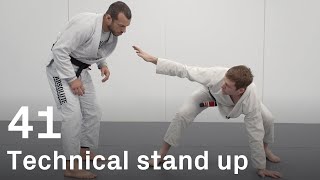
The sitting guard pull is taught within a self-defense curriculum to help students recognize and defend against this common technique. Understanding how skilled guard pullers execute this movement allows practitioners to either defend against it or perform it with proper intent and timing.
Initial Position and Grip Setup
The instructor begins from a standard collar tie position with both competitors gripping each other's collar. The grip should be high with three fingers finding the 'C' grip (the groove on the collar) to remove slack and establish control.
Reading the Opponent's Posture
The ideal moment to pull guard occurs when the opponent adopts a defensive stance with stiff arms and weight back—the 'jiu-jitsu fear stance.' This position indicates the opponent is focused on preventing takedowns rather than advancing forward, making it a vulnerable moment.
Hip Placement and Control
The instructor places his foot on the opponent's hip with the leg on the same side as the controlling arm. This foot placement is critical for controlling the opponent during the pull and prevents the opponent from passing over the leg.
The Sit and Spin Mechanics
Rather than falling straight back, the instructor sits to the side and spins, rotating his hips beneath the opponent. This rotation forces the opponent to step and adjust, preventing them from immediately working on a guard pass while the pulling leg remains protected.
Final Positioning and Leg Lock Mechanics
Upon landing, the instructor lands on his hip with his leg extended where the opponent cannot access it. The foot remains planted on the opponent's hip while both grips pull hard and the hips lift, allowing the guard to transition into a locked and ready attacking position.
Establishing Guard Control
The instructor lifts his hips while bending the knee of the pulling leg, clamping both legs high around the opponent's torso. This creates a tight guard position ready to execute sweeps and submissions rather than a loose, easily passable guard.
Defensive Considerations
If the opponent controls the instructor's arm, the foot placement becomes critical—the instructor uses the arm that is free (the one not being controlled) to defend against hip placement. The controlled arm cannot reach down to knock the leg away, which is why the foot placement on the controlled side is essential.
Complete Execution Summary
The sitting guard pull is executed by sitting to the side (not straight back), spinning the hips, pulling with both grips while lifting the hips, and clamping both legs tightly around the opponent. This method maintains control throughout the transition and positions the puller to immediately attack rather than defend.
Maintaining Frame and Practical Application
Throughout the pull, the instructor maintains frames between himself and the opponent to prevent a simple dismount. Though this technique is demonstrated within a self-defense course, it remains valuable for situations where the practitioner is injured or prefers to work from guard rather than pursue takedowns.
BJJ Self-Defense Course | Lesson 140: Sitting Guard Pull
Key Takeaways
- •Introduction and Context
- •Initial Position and Grip Setup
- •Reading the Opponent's Posture
- •Hip Placement and Control
Obviously, pulling guard is bad from a Self-Defense Perspective. But, I am teaching it so that students will learn how to defend it and how to perform it safely in training. Of course, we always encourage everyone to train takedowns every class and to start all sparring sessions from the feet with the goal of taking down your opponent We hope everyone is enjoying our Gracie Jiu-Jitsu Self-Defense Course. We are offering these lessons for free, but If you are enjoying what we are doing and want to support us, you can make a donation to PayPal at [email protected]. Please click Like, Subscribe, and hit the notification bell for updates on this course. Also, please spread the word about our course You can also Join my Patreon for more Content at: www.Patreon.com/RoyMarshJiuJitsu.com Or, check out my Video Instructionals at RoyMarsh.selz.com You can also read my Blog at: www.ConceptualJiuJitsu.Worpress.com My Websites: www.GracieSchwarzwald.com www.RoyMarshJiuJitsu.com www.Facebook.com/GracieSchwarzwald www.Instagram.com/GracieSchwarzwald
Frequently Asked Questions
What does this video teach about standard sit guard pull?
This video covers introduction and context, initial position and grip setup, reading the opponent's posture. It provides detailed instruction from Gracie Schwarzwald Jiu-Jitsu.
How long does it take to learn standard sit guard pull?
The basic mechanics can be understood in a single session, but developing reliable execution requires consistent drilling over weeks of practice. This 10-part breakdown helps structure your training by isolating each phase of the technique.
What are the key details for finishing standard sit guard pull?
The sitting guard pull is executed by sitting to the side (not straight back), spinning the hips, pulling with both grips while lifting the hips, and clamping both legs tightly around the opponent. This method maintains control throughout the transition and positions the puller to immediately attack rather than defend.