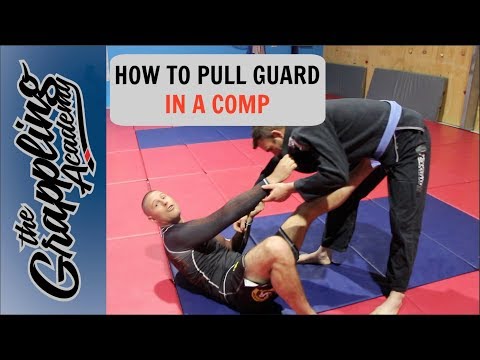
How To Pull Guard In A Competition
0
Guard Pull·The Grappling Academy
SALE SALE SALE OVER 50% OFF – BOX SET – ALL 4 COURSES 50% OFF CLICK HERE – https://bit.ly/2lAOHmp • The Blue Belt Sup…
Translation: guard pull
The Guard Pull family covers techniques for transitioning from standing to a seated or guard position on the ground, deliberately choosing to fight from the bottom guard rather than continuing to engage standing. [1] Guard pulling is a strategic decision used primarily in BJJ competition where the guard is considered an advantageous position with sweeps and submissions available. [1],[2] Guard pulls include standard guard pulls (jumping to closed guard), sit guard pulls (sitting to the ground and establishing seated guard), and sport-specific variations designed for competition. [2],[3]
Guard pulling evolved as a competitive BJJ strategy when practitioners recognised that their guard game was more effective than their standing takedown abilities. [1] The tactic became increasingly common in sport BJJ, though it remains controversial — some view it as a legitimate strategic choice, while others argue it undermines the martial aspect of grappling. [2],[3]
Guard pulling was developed in BJJ competition as a strategy for guard-focused fighters to avoid the standing phase. [1]
Guard pulling is a common tactic in IBJJF competition, though increasingly penalised in some rule sets. [1]
No images yet for this technique.
Sign in to suggest an image.
SALE SALE SALE OVER 50% OFF – BOX SET – ALL 4 COURSES 50% OFF CLICK HERE – https://bit.ly/2lAOHmp • The Blue Belt Sup…
No instructional courses yet for this technique.
Sign in to suggest a course.
Risk of injury to the person this technique is applied to
Standing escapes from clinch/holds; involves explosive disengagement
Skill level needed to execute this technique reliably
Whether this technique is allowed under major competition rule sets
Jiu-Jitsu University (Saulo Ribeiro, 2008)
Alias sources — [1] IBJJF Rules and Regulations [2] Jiu-Jitsu University (Ribeiro, 2008)
Effectiveness sources — [1] Mastering Jujitsu (Gracie & Danaher, 2003) [2] Jiu-Jitsu University (Ribeiro, 2008)
Standard katakana transliteration of Western martial arts terminology (外来語) — used in Japanese MMA, boxing, and BJJ communities
Alias sources — [1] IBJJF Rules and Regulations [2] Jiu-Jitsu University (Ribeiro, 2008)
Effectiveness sources — [1] Mastering Jujitsu (Gracie & Danaher, 2003) [2] Jiu-Jitsu University (Ribeiro, 2008)
timing, hip power, off-balancing skill
strong hips and active legs for sweeping leverage
hip flexors, glutes, quadriceps, core rotators
Every move, in any martial art, shares a few universal traits. Mix and match below to pinpoint the right tool — or compare equivalents across styles.
The Sit Guard Pull subfamily covers guard pulling techniques where the practitioner sits directly to the ground from standing, establishing a seated guard position. [1] The sit guard pull avoids the risks of jumping to closed guard (which can fail against a strong base) by simply sitting down and using grip control to prevent the opponent from immediately passing. [1,2] Sit guard pulls typically lead to butterfly guard, De La Riva guard, or other open guard positions that are effective from the seated position. [2,3]
The Standard Guard Pull subfamily covers the traditional guard pull where the practitioner jumps to closed guard by gripping the opponent's gi or body, pulling themselves up onto the opponent's hips, and closing the legs around the waist. [1] The standard guard pull aims to establish closed guard directly from standing, bypassing the standing phase entirely. [1,2] The technique requires timing and grip strength — the puller must maintain strong grips while jumping and wrapping the legs before the opponent can prevent the guard closure. [2,3]
The guard pull is controversial in competition BJJ — some view it as a legitimate strategy, others as an avoidance of standing. In IBJJF rules, pulling guard results in 0 points (neither scores) and an advantage to the opponent if done passively. In ADCC, guard pulling is penalized with a negative point. (IBJJF Rules v6.0; ADCC Rules)
When pulling closed guard, you place your first foot on the collar side of your opponent and must ensure that foot goes into the hip so your opponent can't block it. With open guard, your first foot goes into the hip on the same side as your grip arm, giving you more options like bellahiva or other open guard variations.
Throw your first leg quickly like a jab, but your second leg will be slower like a cross. After your first leg makes contact with the opponent's hip, drive your hips into them so your belt line touches theirs, then wrap your slower leg around.
Closed guard pulling is only legal at color belt level—blue belt and above. White belts must pull to open guard or use a different first leg positioning.
Having a solid judo or wrestling takedown game makes your guard pulls more effective because your opponent won't know if you're going to shoot or pull, so they can't prepare a defensive passing stance early. Coach Tom emphasizes not letting guard pulling hide your takedown skills.
The Guard Pull family covers techniques for transitioning from standing to a seated or guard position on the ground, deliberately choosing to fight from the bottom guard rather than continuing to engage standing. Guard pulling is a strategic decision used primarily in BJJ competition where the guard is considered an advantageous position with sweeps and submissions available.
Guard pulling evolved as a competitive BJJ strategy when practitioners recognised that their guard game was more effective than their standing takedown abilities. The tactic became increasingly common in sport BJJ, though it remains controversial — some view it as a legitimate strategic choice, while others argue it undermines the martial aspect of grappling.
Unified MMA: legal — Legal defensive technique; IBJJF: legal — Legal — escapes and sweeps are fundamental to BJJ, sweep from bottom scores 2…; IJF: legal — Legal; ADCC: legal — Legal, sweep scores 2 points (4 from mount/back); FIAS Sport Sambo: legal — Legal; FIAS Combat Sambo: legal — Legal
Danger rating 3/10. Moderate — standing escapes from clinch/holds; involves explosive disengagement
The standard setup chain: Create Space → Disrupt Control → Execute Escape → Recover Position.
Standard counters include: Maintain Pressure — keep consistent weight distribution to limit escape space / Anticipate Direction — read escape attempt direction and block early / Transition — flow to a new position when the current one is threatened.
Common variants: Standard sweep (primary off-balancing and reversal technique from the guard); Combination sweep (chaining two sweep directions to catch the opponent's adj…); Counter sweep (sweeping as the opponent initiates a guard pass attempt); Competition sweep (optimised for point-scoring in tournament settings).
Guard pulling is a common tactic in IBJJF competition, though increasingly penalised in some rule sets.
Top errors to watch for: Pulling guard without grips — an uncontrolled guard pull is a free pass for the opponent / Pulling to a flat back — pull to an active guard (closed, half, or open) with immediate offensive grips / Pulling guard in MMA without a specific plan — MMA guard pulls need a clear submission or sweep pathway / Pulling guard against a heavier, stronger opponent without technique — weight and strength advantages are amplified o….
The Guard Pull is also known as Gādo Puru, Pulling Guard, Sit To Guard.