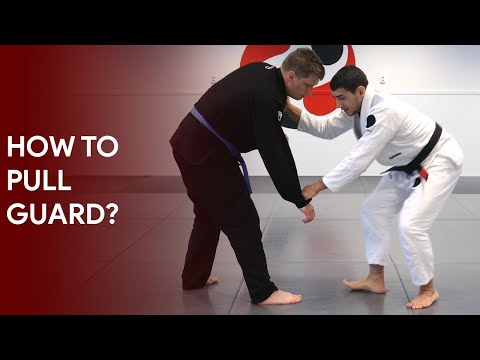
How to Pull Guard
0
Sit Guard Pull·Tarik BJJ
🔗 Links: Follow me on Instagram for more jiu-jitsu content: https://www.instagram.com/tarik_bjj/ Discover top-qualit…
Translation: sit guard pull
The Sit Guard Pull subfamily covers guard pulling techniques where the practitioner sits directly to the ground from standing, establishing a seated guard position. [1] The sit guard pull avoids the risks of jumping to closed guard (which can fail against a strong base) by simply sitting down and using grip control to prevent the opponent from immediately passing. [1],[2] Sit guard pulls typically lead to butterfly guard, De La Riva guard, or other open guard positions that are effective from the seated position. [2],[3]
The sit guard pull became popular in sport BJJ competition as an alternative to the jumping guard pull, particularly among lighter weight competitors who preferred open guard systems. [1] The Miyao brothers and other modern guard players helped popularise the seated guard pull as a competitive strategy. [2],[3]
The sit guard pull sits directly to the ground and engages guard from a seated position. [1]
Developed in competitive BJJ as a guard pull variation. [1]
Commonly used in IBJJF competition. [1]
No images yet for this technique.
Sign in to suggest an image.
🔗 Links: Follow me on Instagram for more jiu-jitsu content: https://www.instagram.com/tarik_bjj/ Discover top-qualit…
No instructional courses yet for this technique.
Sign in to suggest a course.
Risk of injury to the person this technique is applied to
Standing escapes from clinch/holds; involves explosive disengagement
Skill level needed to execute this technique reliably
Whether this technique is allowed under major competition rule sets
Advanced Brazilian Jiu-Jitsu Techniques (Marcelo Garcia, 2011)
Alias sources — [1] Jiu-Jitsu University (Saulo Ribeiro, 2008) [2] X-Guard (Marcelo Garcia, 2008) [3] IBJJF competition terminology
Effectiveness sources — [1] Mastering Jujitsu (Gracie & Danaher, 2003)
Mixed Japanese-Western terminology — combines traditional Japanese terms with katakana loanwords
Alias sources — [1] Jiu-Jitsu University (Saulo Ribeiro, 2008) [2] X-Guard (Marcelo Garcia, 2008) [3] IBJJF competition terminology
Effectiveness sources — [1] Mastering Jujitsu (Gracie & Danaher, 2003)
hip mobility, explosive bridge/shrimp power, timing
flexible hips and strong glutes for escape movements
glutes, hip flexors, core, triceps (framing)
Every move, in any martial art, shares a few universal traits. Mix and match below to pinpoint the right tool — or compare equivalents across styles.
If you sit straight down, your opponent can create pivoting power against your hips, which gives them an advantage. You need to make a deliberate movement rather than dropping straight down.
Yes, according to Tarik BJJ, there are many ways to pull guard and the approach depends on your weight division and the type of fight you have ahead.
The Sit Guard Pull subfamily covers guard pulling techniques where the practitioner sits directly to the ground from standing, establishing a seated guard position. The sit guard pull avoids the risks of jumping to closed guard (which can fail against a strong base) by simply sitting down and using grip control to prevent the opponent from immediately passing.
The sit guard pull became popular in sport BJJ competition as an alternative to the jumping guard pull, particularly among lighter weight competitors who preferred open guard systems. The Miyao brothers and other modern guard players helped popularise the seated guard pull as a competitive strategy.
Unified MMA: legal — Legal defensive technique; IBJJF: legal — Legal — escapes and sweeps are fundamental to BJJ, sweep from bottom scores 2…; IJF: legal — Legal; ADCC: legal — Legal, sweep scores 2 points (4 from mount/back); FIAS Sport Sambo: legal — Legal; FIAS Combat Sambo: legal — Legal
Danger rating 3/10. Moderate — standing escapes from clinch/holds; involves explosive disengagement
The standard setup chain: Create Space → Disrupt Control → Execute Escape → Recover Position.
Standard counters include: Maintain Pressure — keep consistent weight distribution to limit escape space / Anticipate Direction — read escape attempt direction and block early / Transition — flow to a new position when the current one is threatened.
Common variants: Standard escape (primary escape mechanic using frames, bridges, or hip mov…); Combination escape (chaining two escape directions or methods); Counter escape (using the opponent's attack attempt to create the escape …); Competition variation (modified for rule-set optimisation).
Commonly used in IBJJF competition.
Top errors to watch for: Sitting without grips — the opponent will simply walk around your guard without grips to control them / Sitting to a flat back instead of an active seated position — maintain the upright seated posture / Sitting too far from the opponent — the grips must keep the opponent within engagement range / Not immediately establishing butterfly hooks — the hooks control the opponent's base from the seated position.
The Sit Guard Pull is also known as Suwari Gādo Puru, Seated Guard Pull, Sit Pull, Butt Scoot.