PETERSON ROLL to Pin and Armlock
0
Peterson Roll·welcomematstevescott
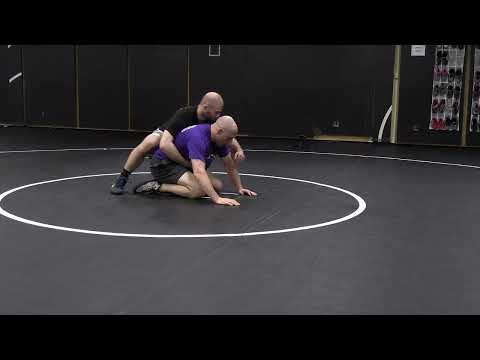
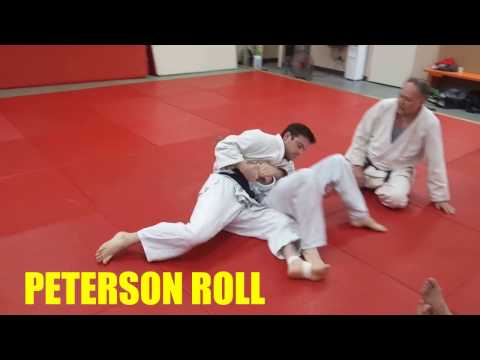
The Peterson Roll is an effective way to get out from the bottom when an opponent rides you. In this video Coach Steve S…
Translation: Peterson Roll (eponym — named after the American collegiate wrestler who popularised the technique; transliterated into Japanese for catch-wrestling and BJJ contexts)
The Peterson Roll is a wrestling reversal executed from the bottom referee's position (or any time the opponent has rear control with one or both arms across the body) where the bottom wrestler reaches back to grip the opponent's near-side arm or leg, then rolls forward and underneath the opponent in a controlled somersault to land in a top control position. [1] The mechanic uses the opponent's forward pressure as the rotation axis: by collapsing the near elbow and tucking the head, the bottom wrestler converts incoming weight into rotational momentum that spirals the opponent over their shoulder. [1],[2] Common in folkstyle and freestyle wrestling, the Peterson is one of the high-percentage escapes from the down position and can also score back-exposure points if the roll is finished cleanly into a side or back-control finish. [1]
The Peterson Roll is a folkstyle and freestyle wrestling reversal whose origin traces to American collegiate wrestling. [1],[2] It became a competition staple as wrestlers learned that it pairs with the switch as a complementary left/right reversal off the referee's position. [1] The technique is documented in standard wrestling pedagogy texts and is taught at the high-school level upward.
The Peterson Roll is one of the high-percentage reversals from the down position in folkstyle wrestling — when the opponent commits forward weight or reaches across the body, the Peterson converts that pressure into a 2-point reversal. [1] In the NCAA wrestling rule set, a successful Peterson scores a 2-point reversal and can score additional near-fall points if it lands the opponent in a back-exposure position. [1],[3] Crossover applications in MMA and no-gi grappling are well documented: in scrambles where one fighter has rear-control attempt or ride control, the Peterson is one of the standard turnover paths. [1],[2],[4] High-school and collegiate wrestling pedagogy treats it as one of the 'mandatory' reversals every wrestler should drill from referee's position.
American collegiate / folkstyle wrestling reversal tradition, codified mid-20th century. [1] Mainstream pedagogy via Iowa, Penn State, Oklahoma State, and Cornell wrestling programs. [1],[3] Crossover into BJJ and MMA in the late-1990s and 2000s as wrestlers like Mark Coleman, Randy Couture, and later Henry Cejudo brought the technique into MMA. The Peterson and Switch combination remains foundational at NCAA Division I, and continues to feature in MMA and grappling matches when wrestlers transition to combat sports. [2],[4]
Standard reversal in NCAA folkstyle wrestling — appears at every Division I tournament and is one of the most-reviewed bottom-position techniques in wrestling instructional literature. [1] Notable competitive uses include numerous NCAA finals and All-American performances over the past 50+ years; the Peterson regularly contributes points in close NCAA Championship matches. In freestyle (UWW), the technique is legal and applied at World Championships and Olympic Games. In MMA, the Peterson roll has been seen in turnover scenarios in the UFC and Bellator, applied by wrestlers transitioning from collegiate to MMA careers. [1],[2],[4]
No images yet for this technique.
Sign in to suggest an image.
The Peterson Roll is an effective way to get out from the bottom when an opponent rides you. In this video Coach Steve S…
Want to find wrestling tournaments near you? Check out: https://www.WrestlingTournaments.com/
No instructional courses yet for this technique.
Sign in to suggest a course.
Risk of injury to the person this technique is applied to
Standard reversal-level risk. Improper head positioning during the roll can compress the cervical spine; ensure chin tuck and shoulder-first contact
Skill level needed to execute this technique reliably
Whether this technique is allowed under major competition rule sets
John Smith — NCAA Wrestling: A Complete Guide for Coaches (Human Kinetics, 2010); Dan Gable — Coaching Wrestling Successfully (Human Kinetics, 1999)
Description sources — [1] Folkstyle wrestling pedagogy; [2] freestyle wrestling rule references for legality framing
Description sources — [1] Folkstyle wrestling pedagogy (Smith, Gable, Robinson); [2] freestyle wrestling rule references for legality framing; [3] NCAA Rules and Interpretations Book annual edition; [4] modern MMA / no-gi grappling crossover (BJJ Fanatics no-gi instructional content from former Division I wrestlers like Joel Bouzou, Bo Nickal)
Description sources — [1] Folkstyle wrestling pedagogy (Smith, Gable, Robinson); [2] freestyle wrestling rule references for legality framing; [3] NCAA Rules and Interpretations Book annual edition; [4] modern MMA / no-gi grappling crossover (BJJ Fanatics no-gi instructional content from former Division I wrestlers like Joel Bouzou, Bo Nickal)
explosive hip drive, head and neck flexibility for safe roll, grip strength for arm control
hip flexors (rotation), trapezius and rhomboids (head/shoulder protection during roll), forearms and biceps (arm grip)
The Peterson is named after the American collegiate wrestler who popularized it. Sources differ on which Peterson — multiple wrestlers by that surname coached and competed at NCAA level in the mid-20th century — but the technique is firmly in the folkstyle canon and pairs naturally with the Switch as a left/right reversal pair off the referee's position.
Reaching too far with your hand underneath instead of controlling the hip or leg—this compromises your position and control.
Grab and hold your opponent's wrist firmly, and never let go of it as you roll into position—this wrist control is essential throughout the technique.
Don't just sweep your leg over—trap your opponent's legs as you kick over to maintain control and prevent them from escaping.
Yes, you need to practice it on both sides since you never know which side your opponent will ride. The Peterson roll works in wrestling, judo, BJJ, and no-gi grappling.
The Peterson Roll is a wrestling reversal executed from the bottom referee's position (or any time the opponent has rear control with one or both arms across the body) where the bottom wrestler reaches back to grip the opponent's near-side arm or leg, then rolls forward and underneath the opponent in a controlled somersault to land in a top control position. The mechanic uses the opponent's forward pressure as the rotation axis: by collapsing the near elbow and tucking the head, the bottom wrestler converts incoming weight into rotational momentum that spirals the opponent over their shoulder.
The Peterson Roll is a folkstyle and freestyle wrestling reversal whose origin traces to American collegiate wrestling. It became a competition staple as wrestlers learned that it pairs with the switch as a complementary left/right reversal off the referee's position.
UWW: legal — Legal; NCAA Wrestling: legal — Legal (folkstyle); IBJJF: legal — Legal (no-gi); ADCC: legal — Legal; Unified MMA: legal — Legal
Danger rating 4/10. Moderate — standard reversal-level risk. Improper head positioning during the roll can compress the cervical spine; ensure chin tuck and shoulder-first contact
The standard setup chain: Establish Down Referee's Position → Detect Opponent's Forward Pressure → Reach Back and Secure Wrist or Arm → Drop Near Shoulder, Tuck Chin → Initiate Forward Roll → Land in Side Control or Top Half.
Standard counters include: Spread out forward pressure (don't lean) — the Peterson needs forward weight to rotate / Free the gripped arm before the roll initiates / Heavy hips — sit back to neutralize the rotational axis.
Common variants: Standard Peterson (wrist-grip entry from referee's position, classic shoulde…); High Peterson (taken when the opponent reaches deeper across the back; u…); Knee Peterson (reaches back to control the near knee instead of the arm,…).
Standard reversal in NCAA folkstyle wrestling — appears at every Division I tournament and is one of the most-reviewed bottom-position techniques in wrestling instructional literature. Notable competitive uses include numerous NCAA finals and All-American performances over the past 50+ years; the Peterson regularly contributes points in close NCAA Championship matches.
Top errors to watch for: Rolling without securing the arm grip first — the opponent simply rides through and the roll becomes a giveback / Not tucking the chin — exposes the cervical spine to compression as the roll initiates / Trying to power through instead of using the opponent's forward pressure — burns energy and signals the move / Releasing the arm grip mid-roll — loses the connection that makes the rotation work.
The Peterson Roll is also known as Pītāson Rōru, Peterson, Peterson Reversal, Roll Reversal Wrestling.