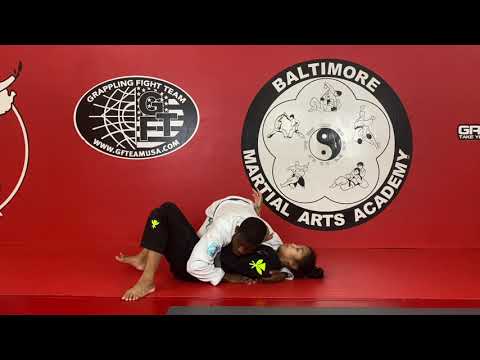
Learn how to shrimp escape side control and re-guard
0
Standard Shrimp Escape·Baltimore Martial Arts·Added by Admin
Professor Kristina Barlaan & Garcia Junior teach you how shrimp escape side control and re-guard. Adult Brazilian Jiu-J…
Translation: standard shrimp escape
The Standard Shrimp Escape from north-south frames against the opponent's hips, bridges to create space, then hip escapes to one side, turning the body to create enough angle to reinsert a knee and recover guard. [1] The frame must push the opponent's hips away first to relieve the chest pressure, then the shrimp creates the lateral displacement needed to thread the legs back between the fighters. [1],[2] The escape finishes with the defender establishing half guard or full guard on the escape side. [2],[3]
The standard shrimp escape is the baseline hip escape from north-south. [1]
A fundamental BJJ escape. [1]
Used in BJJ competition. [1]
No images yet for this technique.
Sign in to suggest an image.
Professor Kristina Barlaan & Garcia Junior teach you how shrimp escape side control and re-guard. Adult Brazilian Jiu-J…
No instructional courses yet for this technique.
Sign in to suggest a course.
Risk of injury to the person this technique is applied to
Bottom escapes from mount/side control; bridge and hip escape mechanics (Ribeiro 2008)
Skill level needed to execute this technique reliably
Whether this technique is allowed under major competition rule sets
Jiu-Jitsu University (Saulo Ribeiro, 2008)
Alias sources — [1] Jiu-Jitsu University (Saulo Ribeiro, 2008) [2] Brazilian Jiu-Jitsu: Theory and Technique (Renzo Gracie & Royler Gracie, 2001)
Effectiveness sources — [1] Jiu-Jitsu University (Ribeiro, 2008)
Mixed Japanese-Western terminology — combines traditional Japanese terms with katakana loanwords
Alias sources — [1] Jiu-Jitsu University (Saulo Ribeiro, 2008) [2] Brazilian Jiu-Jitsu: Theory and Technique (Renzo Gracie & Royler Gracie, 2001)
Effectiveness sources — [1] Jiu-Jitsu University (Ribeiro, 2008)
hip escape (shrimping) speed, framing strength, timing
flexible hips and quick lateral movement
hip flexors, obliques, triceps (framing), core
You need to establish your frames before your opponent locks in a solid side control, as it becomes much harder to create them after they've already settled into position. You should also keep one knee up to prevent your opponent from advancing to knee on belly or mount.
Bridge over your shoulder into your opponent rather than bridging straight up, and move your outside leg away to create room for your legs to work. This angled bridge generates the space you need to escape.
Hook onto your opponent's leg as you escape to trap their foot and prevent them from following you to the same side. You only need to trap the foot—you don't need to stretch them hard.
The Standard Shrimp Escape from north-south frames against the opponent's hips, bridges to create space, then hip escapes to one side, turning the body to create enough angle to reinsert a knee and recover guard. The frame must push the opponent's hips away first to relieve the chest pressure, then the shrimp creates the lateral displacement needed to thread the legs back between the fighters.
The standard shrimp escape from north-south is the fundamental escape technique for this position in BJJ, applying the art's most important movement — the hip escape — to the specific challenges of head-to-head control. It is the first north-south escape taught in most curricula.
Unified MMA: legal — Legal defensive technique; IBJJF: legal — Legal — escapes and sweeps are fundamental to BJJ, sweep from bottom scores 2…; IJF: legal — Legal; ADCC: legal — Legal, sweep scores 2 points (4 from mount/back); FIAS Sport Sambo: legal — Legal; FIAS Combat Sambo: legal — Legal
Danger rating 3/10. Moderate — bottom escapes from mount/side control; bridge and hip escape mechanics (Ribeiro 2008)
The standard setup chain: Frame on Hips → Hip Escape (Shrimp) → Insert Knee → Recover Guard.
Standard counters include: Heavy Hips — maintain low hip pressure and wide base to absorb the bridge / Grapevine — hook legs inside opponent's thighs to neutralize hip movement / Post Hand — post arm on the mat in the direction of the bridge to maintain balance.
Common variants: Shrimp to guard (framing and hip-escaping to recover full guard or half guard); Underhook escape (winning the underhook and coming to knees or reversing); Bridge to knees (bridging into the opponent and transitioning to turtle or…); Ghost escape (inverting under the opponent to re-guard from the opposit…).
Used in BJJ competition.
Top errors to watch for: Removing the frames during the shrimp — the frames must stay on the hips throughout / Shrimping without the correct hip movement — the shrimp is a lateral hip escape, not a scoot / Trying to thread both legs at once — get one leg through first, then the second / Not closing guard once the legs are through — an open guard from a recent escape is vulnerable.
The Standard Shrimp Escape is also known as Sutandādo Ebi Nige, Basic North-South Shrimp, N-S Hip Escape.