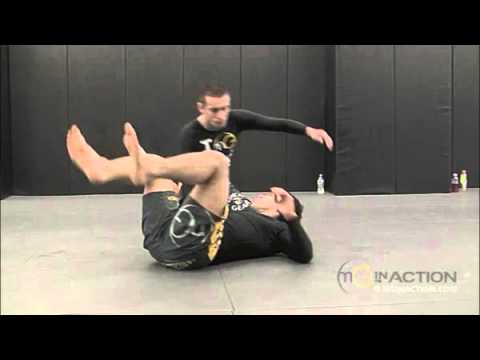
North South Escape, Elbow Push Escape vs Side Contro
0
Shrimp North-South Escape·Just Train
Translation: shrimp north-south escape
The Shrimp North-South Escape uses hip escape movement to create enough angle and distance to recover guard from the north-south position. [1] The shrimp from north-south is more challenging than from side control because the opponent's weight distribution pins the chest directly, making initial hip movement difficult. [1],[2] The escape requires creating initial space through framing and bridging, then executing the hip escape to create the angle needed to reinsert the legs for guard recovery. [2],[3]
The shrimp escape from north-south uses hip escape motion to create space and turn to face the opponent. [1]
A fundamental BJJ escape applied to the north-south position. [1]
Used in BJJ competition. [1]
No images yet for this technique.
Sign in to suggest an image.
No instructional courses yet for this technique.
Sign in to suggest a course.
Risk of injury to the person this technique is applied to
Bottom escapes from mount/side control; bridge and hip escape mechanics (Ribeiro 2008)
Skill level needed to execute this technique reliably
Whether this technique is allowed under major competition rule sets
Jiu-Jitsu University (Saulo Ribeiro, 2008)
Alias sources — [1] Jiu-Jitsu University (Saulo Ribeiro, 2008) [2] Kodokan Judo (Jigoro Kano, 1986)
Effectiveness sources — [1] Jiu-Jitsu University (Ribeiro, 2008)
Mixed Japanese-Western terminology — combines traditional Japanese terms with katakana loanwords
Alias sources — [1] Jiu-Jitsu University (Saulo Ribeiro, 2008) [2] Kodokan Judo (Jigoro Kano, 1986)
Effectiveness sources — [1] Jiu-Jitsu University (Ribeiro, 2008)
hip escape (shrimping) speed, framing strength, timing
flexible hips and quick lateral movement
hip flexors, obliques, triceps (framing), core
Every move, in any martial art, shares a few universal traits. Mix and match below to pinpoint the right tool — or compare equivalents across styles.
Hide the trapped arm from the opponent's face so they can't control it with the kimono grip. With your free arm, pass it under their body and out to the side to start your escape.
Once you've passed your arm under your opponent, reach their elbow and push it outward while keeping your arm extended and your head up. Rock your feet and sit up to create space as you push them over.
Keep your arm positioned away from the opponent's face and point your elbow downward—never turn it upward, as this prevents them from controlling you with the kimono grip.
Once you reach and extend their elbow, you've achieved a position where they cannot easily return to side control. If they try to grip your hand, pull their arm away to maintain control and continue your escape.
The Shrimp North-South Escape uses hip escape movement to create enough angle and distance to recover guard from the north-south position. The shrimp from north-south is more challenging than from side control because the opponent's weight distribution pins the chest directly, making initial hip movement difficult.
The shrimp from north-south is an adaptation of the fundamental hip escape applied to the unique challenges of the head-to-head position. It is taught as the primary north-south escape method in most BJJ curricula.
Unified MMA: legal — Legal defensive technique; IBJJF: legal — Legal — escapes and sweeps are fundamental to BJJ, sweep from bottom scores 2…; IJF: legal — Legal; ADCC: legal — Legal, sweep scores 2 points (4 from mount/back); FIAS Sport Sambo: legal — Legal; FIAS Combat Sambo: legal — Legal
Danger rating 3/10. Moderate — bottom escapes from mount/side control; bridge and hip escape mechanics (Ribeiro 2008)
The standard setup chain: Frame on Hips → Hip Escape (Shrimp) → Insert Knee → Recover Guard.
Standard counters include: Crossface — drive forearm across the face to prevent the hip escape / Underhook — thread arm under the far shoulder to control upper body rotation / Knee-on-Belly — transition to knee-on-belly to maintain pressure and mobility.
Common variants: Shrimp to guard (framing and hip-escaping to recover full guard or half guard); Underhook escape (winning the underhook and coming to knees or reversing); Bridge to knees (bridging into the opponent and transitioning to turtle or…); Ghost escape (inverting under the opponent to re-guard from the opposit…).
Used in BJJ competition.
Top errors to watch for: Shrimping without the hip frame — the frame creates the initial space that the shrimp expands / Only shrimping once — north-south escapes often require 3-5 shrimps to fully rotate to guard / Shrimping in the wrong direction (straight back) — shrimp to the side to create an angle / Not threading the legs through the created space — the legs must enter the gap between you and the opponent.
The Shrimp North-South Escape is also known as Ebi Nanboku Nige, North-South Hip Escape, Kami Shiho Shrimp.