Establishing Frames in Side Control
Before attempting the shrimp escape, the bottom player must establish defensive frames immediately upon losing guard position. The frames consist of one arm blocking the opponent's hip and the other framing at the neck. These frames must be in place before the opponent fully establishes side control, as adding them retroactively becomes significantly more difficult.
The High Knee Defense
The bottom player should keep one knee elevated to prevent the opponent from advancing to knee-on-belly or mount position. This defensive knee acts as a physical barrier that allows the bottom player to disrupt the opponent's leg before they can establish a more dominant position.
Creating Space with Hip Displacement
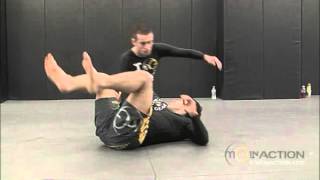
To execute the escape, the bottom player must create space for their legs by moving their outside leg further away from the opponent. Rather than bridging straight upward, the player bridges over their shoulder toward the opponent while simultaneously moving both feet outward, generating the necessary hip displacement.
Hip Bridge and Leg Insertion
As the player bridges into the opponent, the leg closest to the opponent slides through and turns across the opponent's body. The player maintains the hip frame throughout this movement while using their base to push themselves deeper into the escape position, with the knee now positioned on the far side of the opponent's body.
Foot Trap and Arm Control
Once bridged, the bottom player must locate the opponent's foot and trap it with their own leg to prevent the opponent from following and re-establishing side control. Simultaneously, the player traps the opponent's arm on the near side to prevent it from being used to push the recovering leg back through.
Hip Rotation and Guard Recovery
With both the opponent's foot and arm controlled, the bottom player rotates their hips to create space. The foot positioned in the middle can now either be stretched out to complete the leg recovery or the player can continue rotating their hips until achieving a closed guard position.
Full Sequence Integration
The complete shrimp escape combines all elements in continuous motion: frames in place, feet repositioned to the side, hips bridged into the opponent, foot trapped, arm controlled, and finally hip rotation into closed guard. The timing and sequencing of these actions is critical for efficient escape execution.
Individualization and Practice Progression
The shrimp escape requires customization based on body type and proportions. Larger players need more space for leg insertion while smaller players may require less. Practitioners should expect a learning curve before achieving consistent success, as transitioning from compromised positions to strong guard requires significant technical precision.
Learn how to shrimp escape side control and re-guard
Key Takeaways
- •Establishing Frames in Side Control
- •The High Knee Defense
- •Creating Space with Hip Displacement
- •Hip Bridge and Leg Insertion
Professor Kristina Barlaan & Garcia Junior teach you how shrimp escape side control and re-guard. Adult Brazilian Jiu-Jitsu Stay at Home 6 Week Introductory Course. Learn Brazilian Jiu-Jitsu from home with this complete introductory course. Learn the fundamentals and get coaching and support from our professional staff of instructors. Also get access to our member's portal with tons of pre-recorded videos and additional educational resources to assist your training. Also visit https://www.jitseasy.com for additional BJJ content. For more information about martial arts and/or fitness classes please visit https://www.baltimoremartialarts.com 6565 Baltimore National Pike, Catonsville, MD. 21228
Frequently Asked Questions
What does this video teach about standard shrimp escape?
This video covers establishing frames in side control, the high knee defense, creating space with hip displacement. It provides detailed instruction from Baltimore Martial Arts.
How long does it take to learn standard shrimp escape?
The basic mechanics can be understood in a single session, but developing reliable execution requires consistent drilling over weeks of practice. This 8-part breakdown helps structure your training by isolating each phase of the technique.
What are the key details for finishing standard shrimp escape?
The complete shrimp escape combines all elements in continuous motion: frames in place, feet repositioned to the side, hips bridged into the opponent, foot trapped, arm controlled, and finally hip rotation into closed guard. The timing and sequencing of these actions is critical for efficient escape execution.