Half Guard Upa
0
Half Upa·GracieGarage·Added by Admin
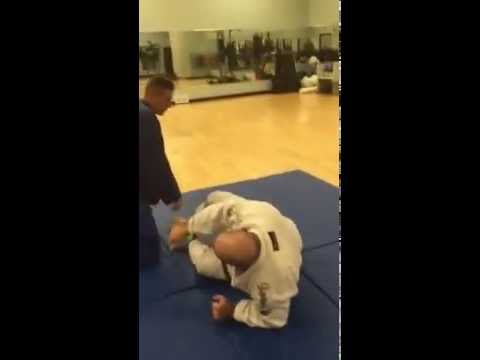
A bunch of upa from half guard
Translation: half upa
The Half Upa is a variation of the trap and roll where the defender traps only the opponent's arm (without trapping the foot) and bridges to create enough disruption to transition to a shrimp or reguard rather than completing a full roll reversal. [1] The half upa is used when the opponent protects their feet from being trapped, making a complete roll impossible — the bridge still disrupts the opponent's balance and creates the space needed for a secondary escape. [1],[2] The half upa demonstrates the principle of chaining escapes — using one technique to set up another. [2],[3]
The half upa developed as a practical modification of the traditional trap and roll for situations where the opponent defends against the full reversal. [1] It represents the BJJ principle of chaining techniques — when one technique is partially defended, it creates the opportunity for the next. [2],[3]
The half upa is a partial bridge escape from mount that creates enough space to recover half guard rather than fully reversing. [1]
A BJJ mount escape variant derived from the full upa/bridge and roll. [1]
Used in BJJ competition as a mount recovery technique. [1]
No images yet for this technique.
Sign in to suggest an image.
A bunch of upa from half guard
No instructional courses yet for this technique.
Sign in to suggest a course.
Risk of injury to the person this technique is applied to
Bottom escapes from mount/side control; bridge and hip escape mechanics (Ribeiro 2008)
Skill level needed to execute this technique reliably
Whether this technique is allowed under major competition rule sets
Jiu-Jitsu University (Saulo Ribeiro, 2008)
Alias sources — [1] Gracie Jiu-Jitsu (Gracie & Gracie, 2001) [2] Jiu-Jitsu University (Saulo Ribeiro, 2008) [3] Mastering Jujitsu (Renzo Gracie & John Danaher, 2003)
Effectiveness sources — [1] Jiu-Jitsu University (Ribeiro, 2008)
Mixed Japanese-Western terminology — combines traditional Japanese terms with katakana loanwords
Alias sources — [1] Gracie Jiu-Jitsu (Gracie & Gracie, 2001) [2] Jiu-Jitsu University (Saulo Ribeiro, 2008) [3] Mastering Jujitsu (Renzo Gracie & John Danaher, 2003)
Effectiveness sources — [1] Jiu-Jitsu University (Ribeiro, 2008)
explosive hip bridge power, shrimping ability, timing
strong glutes and hip extensors for powerful bridges
glutes, hip extensors, core, quadriceps
The Half Upa is a variation of the trap and roll where the defender traps only the opponent's arm (without trapping the foot) and bridges to create enough disruption to transition to a shrimp or reguard rather than completing a full roll reversal. The half upa is used when the opponent protects their feet from being trapped, making a complete roll impossible — the bridge still disrupts the opponent's balance and creates the space needed for a secondary escape.
The half upa developed as a practical modification of the traditional trap and roll for situations where the opponent defends against the full reversal. It represents the BJJ principle of chaining techniques — when one technique is partially defended, it creates the opportunity for the next.
Unified MMA: legal — Legal defensive/transitional technique; IBJJF: legal — Legal; IJF: legal — Legal; ADCC: legal — Legal; UWW: legal — Legal; FIAS Sport Sambo: legal — Legal
Danger rating 3/10. Moderate — bottom escapes from mount/side control; bridge and hip escape mechanics (Ribeiro 2008)
The standard setup chain: Frame Defence → Trap the Arm → Bridge Explosively → Roll to Top.
Standard counters include: Heavy Hips — maintain low hip pressure and wide base to absorb the bridge / Grapevine — hook legs inside opponent's thighs to neutralize hip movement / Post Hand — post arm on the mat in the direction of the bridge to maintain balance.
Common variants: Bridge and roll (upa) (explosive bridge trapping arm and leg to reverse position); Elbow-knee escape (framing and shrimping to recover guard); Foot drag escape (dragging the opponent's foot with the heel to create spac…); Combination escape (bridging to force a reaction, then shrimping when the opp…).
Used in BJJ competition as a mount recovery technique.
Top errors to watch for: Bridging without sufficient force — the half upa needs more explosive bridging than the full upa because there is no … / Not overhooking the arm tightly enough — the arm trap must be very secure since it is the only control point / Bridging straight up instead of over the trapped-arm shoulder — the directional bridge is essential / Expecting the same success rate as the full upa — the half upa is lower percentage; chain it with other escapes.
The Half Upa is also known as Han Ue-kaeshi, Half Bridge, Partial Upa, Bridge To Shrimp.