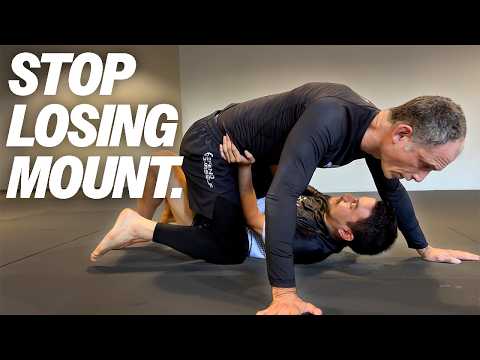
How To Shut Down The Kipping Escape
0
Standard Kipping Escape·Brian Glick·Added by Admin
The kipping escape punishes you for maintaining the mount. In this video we answer a common question: how do you keep to…
Translation: standard kipping escape
The Standard Kipping Escape executes a sharp upward hip thrust that launches the opponent momentarily off balance, then immediately follows with a shrimp or knee insertion to recover guard before the opponent resettles. [1] The kip is powered by planting both feet flat on the mat and driving the hips straight up with maximum force, creating an explosive upward jolt. [1],[2] The timing of the follow-up movement is critical — the kip creates only a brief window of opportunity that must be immediately exploited. [2],[3]
The standard kipping escape is the baseline version. [1]
A BJJ mount escape technique. [1]
Used in BJJ competition. [1]
No images yet for this technique.
Sign in to suggest an image.
The kipping escape punishes you for maintaining the mount. In this video we answer a common question: how do you keep to…
No instructional courses yet for this technique.
Sign in to suggest a course.
Risk of injury to the person this technique is applied to
Bottom escapes from mount/side control; bridge and hip escape mechanics (Ribeiro 2008)
Skill level needed to execute this technique reliably
Whether this technique is allowed under major competition rule sets
Jiu-Jitsu University (Saulo Ribeiro, 2008)
Alias sources — [1] Jiu-Jitsu University (Saulo Ribeiro, 2008) [2] Mastering Jujitsu (Renzo Gracie & John Danaher, 2003)
Effectiveness sources — [1] Jiu-Jitsu University (Ribeiro, 2008)
Standard katakana transliteration of Western martial arts terminology (外来語) — used in Japanese MMA, boxing, and BJJ communities
Alias sources — [1] Jiu-Jitsu University (Saulo Ribeiro, 2008) [2] Mastering Jujitsu (Renzo Gracie & John Danaher, 2003)
Effectiveness sources — [1] Jiu-Jitsu University (Ribeiro, 2008)
explosive hip bridge power, shrimping ability, timing
strong glutes and hip extensors for powerful bridges
glutes, hip extensors, core, quadriceps
According to Brian Glick, many people make the mistake of just doubling down on a cross face and posted arm, expecting to hold the position through hip pressure alone. This doesn't work because the more you hold on, the worse it gets for you as the follow-up attack becomes imminent.
No—Brian Glick emphasizes that instead of doubling down on your position, you may need to transition to something else when your partner goes to kip. While having a cross face and underhook is generally helpful, relying solely on grip pressure won't stop the escape.
Brian Glick recommends transitioning and being ready with counter options like ashi defense, rather than trying to out-grip the escape. Moving proactively is better than passively holding on, because the follow-up attack will be imminent once the kip begins.
The Standard Kipping Escape executes a sharp upward hip thrust that launches the opponent momentarily off balance, then immediately follows with a shrimp or knee insertion to recover guard before the opponent resettles. The kip is powered by planting both feet flat on the mat and driving the hips straight up with maximum force, creating an explosive upward jolt.
The standard kipping escape was developed as an explosive alternative to the more methodical shrimp and trap-and-roll mount escapes. It is taught as part of a comprehensive mount escape system in BJJ.
Unified MMA: legal — Legal defensive/transitional technique; IBJJF: legal — Legal; IJF: legal — Legal; ADCC: legal — Legal; UWW: legal — Legal; FIAS Sport Sambo: legal — Legal
Danger rating 3/10. Moderate — bottom escapes from mount/side control; bridge and hip escape mechanics (Ribeiro 2008)
The standard setup chain: Create Space → Disrupt Control → Execute Escape → Recover Position.
Standard counters include: Maintain Pressure — keep consistent weight distribution to limit escape space / Anticipate Direction — read escape attempt direction and block early / Transition — flow to a new position when the current one is threatened.
Common variants: Bridge and roll (upa) (explosive bridge trapping arm and leg to reverse position); Elbow-knee escape (framing and shrimping to recover guard); Foot drag escape (dragging the opponent's foot with the heel to create spac…); Combination escape (bridging to force a reaction, then shrimping when the opp…).
Used in BJJ competition.
Top errors to watch for: Thrusting the hips forward instead of straight up — the force must be vertical to displace the opponent / Inserting the knee too slowly after the kip — speed is critical; the window is fractions of a second / Not framing on the hips before kipping — without frames, the opponent can advance to high mount during your attempt / Planting the feet too wide — a moderate stance provides the best drive angle.
The Standard Kipping Escape is also known as Sutandādo Kippingu Esukēpu, Basic Kipping Escape, Standard Hip Buck.