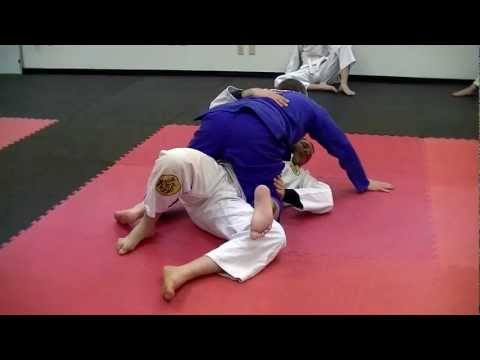
L12S5_Elbow Escape, Heel Drag
0
Standard Heel Drag·SundarJiuJitsu·Added by Admin
Elbow Escape, Heel Drag
Translation: standard heel drag
The Standard Heel Drag hooks one foot around the opponent's same-side ankle, drags it inward toward the centreline, and simultaneously inserts the knee through the space created to establish half guard. [1] The hooking foot catches the opponent's heel and pulls it toward the defender's midline while the opposite hip bridges slightly to create space for the knee insertion. [1],[2] Once the knee enters, the defender closes their legs around the trapped leg to secure half guard. [2],[3]
The heel drag escape is a high-percentage mount escape that uses the foot to hook and drag the opponent's ankle, creating space to insert the knee and recover half guard. [1] It is particularly effective against opponents who maintain a tight, low mount because it does not require the explosive bridging motion of the upa. [1],[2]
The standard heel drag is a fundamental mount escape. [1]
Used in BJJ competition. [1]
No images yet for this technique.
Sign in to suggest an image.
Elbow Escape, Heel Drag
No instructional courses yet for this technique.
Sign in to suggest a course.
Risk of injury to the person this technique is applied to
Bottom escapes from mount/side control; bridge and hip escape mechanics (Ribeiro 2008)
Skill level needed to execute this technique reliably
Whether this technique is allowed under major competition rule sets
Jiu-Jitsu University (Saulo Ribeiro, 2008)
Alias sources — [1] Jiu-Jitsu University (Saulo Ribeiro, 2008) [2] Gracie Jiu-Jitsu (Gracie & Gracie, 2001)
Effectiveness sources — [1] Jiu-Jitsu University (Saulo Ribeiro, 2008) [2] Mastering Jujitsu (Renzo Gracie & John Danaher, 2003)
Standard katakana transliteration of Western martial arts terminology (外来語) — used in Japanese MMA, boxing, and BJJ communities
Alias sources — [1] Jiu-Jitsu University (Saulo Ribeiro, 2008) [2] Gracie Jiu-Jitsu (Gracie & Gracie, 2001)
Effectiveness sources — [1] Jiu-Jitsu University (Saulo Ribeiro, 2008) [2] Mastering Jujitsu (Renzo Gracie & John Danaher, 2003)
explosive hip bridge power, shrimping ability, timing
strong glutes and hip extensors for powerful bridges
glutes, hip extensors, core, quadriceps
The heel drag occurs when you attempt an elbow escape and your opponent responds by keeping their knee on the ground to block you. You then place your knee under their shin to keep it elevated, bite down, square your hips, and shove the knee before finishing the escape.
You spin and face your hips to the side while looking away, turning out the back door rather than trying to lift your opponent. After squaring up and straightening your leg, you maintain control by keeping them in stage one.
Once you have the inside trap already set, connect your knee and elbow on that side and turn the knee up so your opponent cannot advance. You then finish the elbow escape using the standard technique you already know.
The Standard Heel Drag hooks one foot around the opponent's same-side ankle, drags it inward toward the centreline, and simultaneously inserts the knee through the space created to establish half guard. The hooking foot catches the opponent's heel and pulls it toward the defender's midline while the opposite hip bridges slightly to create space for the knee insertion.
The standard heel drag is a widely taught mount escape in BJJ, valued for its efficiency and reliability as a method of recovering half guard from the mounted position. It is commonly taught alongside the trap and roll and shrimp escapes as part of a complete mount escape system.
Unified MMA: legal — Legal defensive/transitional technique; IBJJF: legal — Legal; IJF: legal — Legal; ADCC: legal — Legal; UWW: legal — Legal; FIAS Sport Sambo: legal — Legal
Danger rating 3/10. Moderate — bottom escapes from mount/side control; bridge and hip escape mechanics (Ribeiro 2008)
The standard setup chain: Create Space → Disrupt Control → Execute Escape → Recover Position.
Standard counters include: Heavy Hips — maintain low hip pressure and wide base to absorb the bridge / Grapevine — hook legs inside opponent's thighs to neutralize hip movement / Post Hand — post arm on the mat in the direction of the bridge to maintain balance.
Common variants: Bridge and roll (upa) (explosive bridge trapping arm and leg to reverse position); Elbow-knee escape (framing and shrimping to recover guard); Foot drag escape (dragging the opponent's foot with the heel to create spac…); Combination escape (bridging to force a reaction, then shrimping when the opp…).
Used in BJJ competition.
Top errors to watch for: Reaching down with the hands to grab the foot — this exposes your arms; use the foot-to-foot hook / Not hooking deeply enough behind the ankle — a shallow hook slips off during the drag / Dragging without framing on the hips — the frames prevent the opponent from adjusting while you work the drag / Targeting the wrong foot — hook the foot on the same side as your hooking heel.
The Standard Heel Drag is also known as Sutandādo Hīru Doraggu, Basic Heel Drag, Foot Hook Mount Escape.