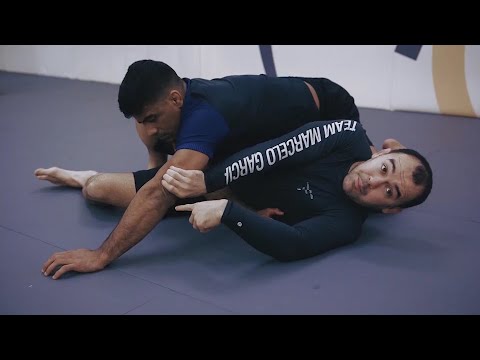
Standard Push Knee Reguard

Genus

スタンダード膝押しリガード(Sutandādo Hiza-oshi Rigādo)

Hybrid

Translation: standard push knee reguard

Overview

The Standard Push Knee Reguard grips the opponent's knee with both hands and pushes it off the body toward the mat, then immediately closes the legs around the opponent's body to establish closed guard or half guard. [1] The push is directed downward and sideways, displacing the knee from the belly while the defender simultaneously prepares the legs for reguarding. [1],[2] The reguard must be instantaneous — the moment the knee leaves the body, the legs must close around the opponent to prevent them from re-establishing the position. [2],[3]

Also known as
Basic Push Knee Escape[1]KOB Push And Guard[2]

History & Origin

The standard push knee reguard is a fundamental BJJ escape taught as a practical solution to the knee-on-belly position. [1] Its direct approach makes it one of the most commonly used KOB escapes in competition. [2],[3]

Effectiveness

The standard push knee reguard is the baseline version of this escape. [1]

Lineage

A fundamental BJJ escape. [1]

Competition Record

Used in BJJ competition. [1]

Images

No images yet for this technique.

Sign in to suggest an image.

Biomechanical Mechanism

Primary ActionBreaking the opponent's leg control to advance to a more dominant position
Joints InvolvedHips (posture and pressure), knees (opening the guard with knee-in or standing), hands (grip fighting)
Force VectorForward pressure (stack/smash) or backward posture (stand-up break) to open the closed guard
Passing MechanicOnce the guard is opened, speed passing, pressure passing, or toreando passing advances the position

Position & Entry

From bottom side controlCreate frames with the forearms against the opponent's neck and hip, hip escape (shrimp) to create space, insert the knee to recover guard
From underhook escapeSwim the near arm to an underhook, bridge into the opponent and come to knees or reverse
From opponent's transitionWhen the opponent moves to mount or north-south, use the movement to create space and escape

Variants

Shrimp to guardframing and hip-escaping to recover full guard or half guard
Underhook escapewinning the underhook and coming to knees or reversing
Bridge to kneesbridging into the opponent and transitioning to turtle or single-leg
Ghost escapeinverting under the opponent to re-guard from the opposite side

Videos

Marcelo Garcia: Elbow Push & Sit Up Escape vs Side Control

0
Standard Push Knee Reguard·Marcelo Garcia Jiu-Jitsu·Added by Admin

Marcelo escapes Side Control after his frames collapse or get deflected: If your opponent wriggles his or her shoulders

1 video

Learn This Technique

No instructional courses yet for this technique.

Sign in to suggest a course.

Ratings

Danger Rating

Risk of injury to the person this technique is applied to

3
Moderate3/10

Bottom escapes from mount/side control; bridge and hip escape mechanics (Ribeiro 2008)

Difficulty

Skill level needed to execute this technique reliably

Beginner
Competition Legality

Whether this technique is allowed under major competition rule sets

Unified MMA — Legal defensive technique
Unified Rules of MMA, August 2025PDF
IBJJF — Legal — escapes and sweeps are fundamental to BJJ...
IBJJF Rules Book v6.0, June 2024PDF
FIAS Sport Sambo — Legal
FIAS International Sambo Competition RulesPDF
FIAS Combat Sambo — Legal
FIAS Combat Sambo RulesPDF

Training Notes

Standard push-knee-reguard execution: place both hands on the opponent's knee, push it across their body toward their opposite leg, shrimp away, and insert guard (Saulo Ribeiro, Jiu-Jitsu University, 2008)
Step 1: grip the opponent's knee with both hands — one on top, one on the side
Step 2: push the knee diagonally across the opponent's body
Step 3: as the knee displaces, shrimp your hips away in the opposite direction
Step 4: insert your near-side knee or shin as a shield
Step 5: recover full guard and establish controlling grips
The two-handed push provides enough force to displace even a heavy opponent's knee
The diagonal push direction is key — it uses the opponent's own body geometry to make the displacement easier
Drill in combination with the frame-and-shrimp: attempt one, if it fails, immediately try the other

Common Mistakes

!Pushing vertically instead of diagonally — the diagonal push is mechanically stronger against KOB
!Grip slipping off the knee — use a firm, cupping grip on the kneecap
!Pushing with extended arms — keep the elbows close for power; extended arms are weak and expose submission entries
!Not shrimping simultaneously with the push — the escape requires both; either alone is insufficient
!Hesitating after the push — the window is 1-2 seconds; insert guard immediately
!Not drilling both KOB escape variants — the push-knee and frame-and-shrimp should be chained together
!Training against a static KOB only — drill against opponents who are actively transitioning to increase realism

Related Techniques

Counter Techniques

Setup Chain

1Create Spaceuse frames, hip movement, or leverage to generate room to move
2Disrupt Controlbreak or weaken the opponent's grips and weight placement
3Execute Escapeapply the specific escape mechanic with timing and commitment
4Recover Positionestablish a safe position (guard, standing, or top)

Sources & References

Primary Source

Jiu-Jitsu University (Saulo Ribeiro, 2008)

1BookJiu-Jitsu University (Ribeiro, 2008)

Alias sources — [1] Jiu-Jitsu University (Saulo Ribeiro, 2008) [2] Brazilian Jiu-Jitsu: Theory and Technique (Renzo Gracie & Royler Gracie, 2001)

2BookMastering Jujitsu (Gracie & Danaher, 2003)

Effectiveness sources — [1] Jiu-Jitsu University (Ribeiro, 2008)

3OtherJapanese Martial Arts Hybrid Terminology

Mixed Japanese-Western terminology — combines traditional Japanese terms with katakana loanwords

4CitationJiu-Jitsu University (Ribeiro, 2008)

Alias sources — [1] Jiu-Jitsu University (Saulo Ribeiro, 2008) [2] Brazilian Jiu-Jitsu: Theory and Technique (Renzo Gracie & Royler Gracie, 2001)

5CitationMastering Jujitsu (Gracie & Danaher, 2003)

Effectiveness sources — [1] Jiu-Jitsu University (Ribeiro, 2008)

Community

Athletics

Requires

hip escape (shrimping) speed, framing strength, timing

Favours

flexible hips and quick lateral movement

Key muscles

hip flexors, obliques, triceps (framing), core

Frequently Asked Questions

Why is it important to stay sit up during the push knee reguard escape?

Staying sit up is critical because if you lie back, your opponent will pin you and jump to pass your guard again, resetting their position and forcing you to restart your escape.

How does the Standard Push Knee Reguard work?

The Standard Push Knee Reguard grips the opponent's knee with both hands and pushes it off the body toward the mat, then immediately closes the legs around the opponent's body to establish closed guard or half guard. The push is directed downward and sideways, displacing the knee from the belly while the defender simultaneously prepares the legs for reguarding.

Where does the Standard Push Knee Reguard come from?

The standard push knee reguard is a fundamental BJJ escape taught as a practical solution to the knee-on-belly position. Its direct approach makes it one of the most commonly used KOB escapes in competition.

Is the Standard Push Knee Reguard legal in competition?

Unified MMA: legal — Legal defensive technique; IBJJF: legal — Legal — escapes and sweeps are fundamental to BJJ, sweep from bottom scores 2…; IJF: legal — Legal; ADCC: legal — Legal, sweep scores 2 points (4 from mount/back); FIAS Sport Sambo: legal — Legal; FIAS Combat Sambo: legal — Legal

How dangerous is the Standard Push Knee Reguard?

Danger rating 3/10. Moderate — bottom escapes from mount/side control; bridge and hip escape mechanics (Ribeiro 2008)

How do I set up the Standard Push Knee Reguard?

The standard setup chain: Create Space → Disrupt Control → Execute Escape → Recover Position.

How do I defend against the Standard Push Knee Reguard?

Standard counters include: Maintain Pressure — keep consistent weight distribution to limit escape space / Anticipate Direction — read escape attempt direction and block early / Transition — flow to a new position when the current one is threatened.

What are the variants of the Standard Push Knee Reguard?

Common variants: Shrimp to guard (framing and hip-escaping to recover full guard or half guard); Underhook escape (winning the underhook and coming to knees or reversing); Bridge to knees (bridging into the opponent and transitioning to turtle or…); Ghost escape (inverting under the opponent to re-guard from the opposit…).

How effective is the Standard Push Knee Reguard in competition?

Used in BJJ competition.

What are common mistakes when doing the Standard Push Knee Reguard?

Top errors to watch for: Pushing vertically instead of diagonally — the diagonal push is mechanically stronger against KOB / Grip slipping off the knee — use a firm, cupping grip on the kneecap / Pushing with extended arms — keep the elbows close for power; extended arms are weak and expose submission entries / Not shrimping simultaneously with the push — the escape requires both; either alone is insufficient.

What are other names for the Standard Push Knee Reguard?

The Standard Push Knee Reguard is also known as Sutandādo Hiza-oshi Rigādo, Basic Push Knee Escape, KOB Push And Guard.