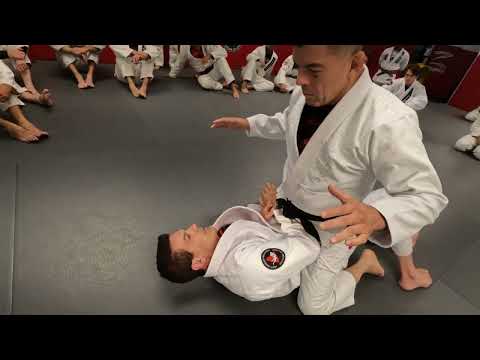
The tried and true head-to-knee mount escape
0
Push Knee And Reguard·JeanJacquesMachado
#escapes #jeanjacquesmachado #bjj ----- One of the pioneers of the art of Brazilian Jiu-Jitsu and one of its greates…
Translation: push knee and reguard
The Push Knee And Reguard subfamily covers knee-on-belly escapes where the defender pushes the pressing knee off the body directly, then immediately reinserts the legs to establish guard before the opponent can transition to another control position. [1] This escape addresses the knee directly — rather than shrimping away, the defender uses both hands to push the knee off the torso and down to the mat, then quickly closes guard or establishes half guard. [1],[2] The speed of the reguard is critical, as the opponent will immediately attempt to re-establish knee-on-belly or transition to mount. [2],[3]
Push knee and reguard uses a push on the opponent's knee to create space for guard recovery. [1]
A fundamental BJJ escape technique. [1]
Used in BJJ competition. [1]
No images yet for this technique.
Sign in to suggest an image.
#escapes #jeanjacquesmachado #bjj ----- One of the pioneers of the art of Brazilian Jiu-Jitsu and one of its greates…
No instructional courses yet for this technique.
Sign in to suggest a course.
Risk of injury to the person this technique is applied to
Bottom escapes from mount/side control; bridge and hip escape mechanics (Ribeiro 2008)
Skill level needed to execute this technique reliably
Whether this technique is allowed under major competition rule sets
Jiu-Jitsu University (Saulo Ribeiro, 2008)
Alias sources — [1] Jiu-Jitsu University (Saulo Ribeiro, 2008) [2] Mastering Jujitsu (Renzo Gracie & John Danaher, 2003)
Effectiveness sources — [1] Jiu-Jitsu University (Ribeiro, 2008)
Mixed Japanese-Western terminology — combines traditional Japanese terms with katakana loanwords
Alias sources — [1] Jiu-Jitsu University (Saulo Ribeiro, 2008) [2] Mastering Jujitsu (Renzo Gracie & John Danaher, 2003)
Effectiveness sources — [1] Jiu-Jitsu University (Ribeiro, 2008)
explosive hip bridge power, shrimping ability, timing
strong glutes and hip extensors for powerful bridges
glutes, hip extensors, core, quadriceps
Every move, in any martial art, shares a few universal traits. Mix and match below to pinpoint the right tool — or compare equivalents across styles.
According to Jean Jacques Machado, you need to keep your elbows in tight like a knife and get at least one leg in the center of your opponent's head, with your forehead touching your own knee to consolidate your frame.
Jean Jacques Machado explains that once your weight is consolidated and your opponent is committed forward, pushing back with your hips will split their knees apart, allowing you to get your knee inside as a shield.
Choose a side, stretch your leg between your opponent's feet, place your elbow on the ground between their knee and your body (not outward), and keep applying cross-face pressure while driving forward to escape.
The Push Knee And Reguard subfamily covers knee-on-belly escapes where the defender pushes the pressing knee off the body directly, then immediately reinserts the legs to establish guard before the opponent can transition to another control position. This escape addresses the knee directly — rather than shrimping away, the defender uses both hands to push the knee off the torso and down to the mat, then quickly closes guard or establishes half guard.
The push knee and reguard is a direct and efficient knee-on-belly escape taught in BJJ as an alternative to the frame-and-shrimp approach. Its simplicity makes it effective under the pressure and discomfort of the knee-on-belly position.
Unified MMA: legal — Legal defensive technique; IBJJF: legal — Legal — escapes and sweeps are fundamental to BJJ, sweep from bottom scores 2…; IJF: legal — Legal; ADCC: legal — Legal, sweep scores 2 points (4 from mount/back); FIAS Sport Sambo: legal — Legal; FIAS Combat Sambo: legal — Legal
Danger rating 3/10. Moderate — bottom escapes from mount/side control; bridge and hip escape mechanics (Ribeiro 2008)
The standard setup chain: Create Space → Disrupt Control → Execute Escape → Recover Position.
Standard counters include: Maintain Pressure — keep consistent weight distribution to limit escape space / Anticipate Direction — read escape attempt direction and block early / Transition — flow to a new position when the current one is threatened.
Common variants: Bridge and roll (upa) (explosive bridge trapping arm and leg to reverse position); Elbow-knee escape (framing and shrimping to recover guard); Foot drag escape (dragging the opponent's foot with the heel to create spac…); Combination escape (bridging to force a reaction, then shrimping when the opp…).
Used in BJJ competition.
Top errors to watch for: Pushing the knee straight up — push across (toward the opponent's other leg) for the correct displacement angle / Using one hand instead of two — the two-handed push generates much more force / Pushing without shrimping — the push creates the opening, but the shrimp creates the distance for re-guarding / Not immediately inserting guard after pushing — the opponent will return to KOB within 1-2 seconds.
The Push Knee And Reguard is also known as Hiza-oshi Rigādo, Knee Push Escape, Push And Recover Guard.