Your Second Martial Arts Lesson...Front Kicks, High Blocks, and Knife hand Strikes!
0
Two On One Hand Fighting·Tiger Rock North Louisiana·Added by Admin
Translation: two-on-one hand fighting
The Two On One Hand Fighting escape uses both hands to control the attacker's choking arm, creating a two-against-one advantage on the most dangerous arm while working to clear hooks and turn. [1] The defender secures the attacker's choking wrist with both hands, pulling it below the chin line while simultaneously working the hips to clear the bottom hook. [1],[2] The two-on-one control provides the strongest possible defence against the choke while the hip movement creates the escape angle. [2],[3]
Two-on-one hand fighting uses both hands to control one of the opponent's arms, preventing choke entries from back control. [1]
Two-on-one control from back mount draws from wrestling's two-on-one grip system. [1]
Critical defensive technique in MMA back control situations. [1]
No images yet for this technique.
Sign in to suggest an image.
This video I breakdown a few tips for handfighting to get the 2 on 1 control that I like to use when I'm playing guard. …
When you first start Jiu Jitsu, you're gonna be getting stuck in the bottom of mount. A lot. Even by people who aren't v…
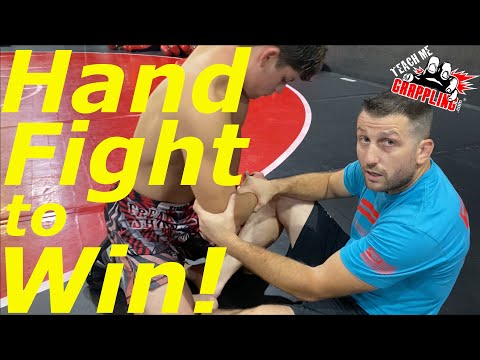
Two-on-one hand fighting is a grappling control technique where one fighter secures both the opponent's wrist and elbow on the same arm, creating a dominant grip for position development and attack sequencing. TeachMeGrappling Coach Brian emphasizes the mechanical foundation: the controlling hand grabs the wrist with palm facing inward, while the second hand controls the elbow from the side using thumb and middle finger around the back, creating what he calls 'elbow control.' The grip is secured by pinning the opponent's arm against the controller's thigh (the 'pocket'), making it resistant to escape attempts. Coach Brian details multiple entry methods when facing resistant opponents: transitioning from wrist control alone, combining head control with a wrist grab to exploit the opponent's defensive push, using double-wrist control as an intermediate step, and exploiting momentum from two-arm shoves. He contrasts this with an inferior grip variation (what he terms the 'ice cream cone' grip) that lacks the same control density. The technique enables subsequent attacks including back takes, butterfly guard transitions, leg lock entries, and sweeps depending on the opponent's positional response. Coach Brian stresses that against skilled opponents, obtaining the two-on-one requires layered hand-fighting strategy rather than direct application. While High Blocks' and Brandon McCaghren's transcripts address general hand fighting and mount escapes respectively, they do not specifically cover two-on-one mechanics, making Coach Brian's instruction the primary detailed source for this technique.
Synthesized from 3 instructors
No instructional courses yet for this technique.
Sign in to suggest a course.
Risk of injury to the person this technique is applied to
Back escapes must address choke threat while escaping; urgency increases injury risk
Skill level needed to execute this technique reliably
Whether this technique is allowed under major competition rule sets
Jiu-Jitsu University (Saulo Ribeiro, 2008)
Alias sources — [1] Back Attacks: Enter the System (John Danaher, 2018) [2] Jiu-Jitsu University (Saulo Ribeiro, 2008) [3] Mastering Jujitsu (Renzo Gracie & John Danaher, 2003)
Effectiveness sources — [1] Mastering Jujitsu (Gracie & Danaher, 2003)
Mixed Japanese-Western terminology — combines traditional Japanese terms with katakana loanwords
Alias sources — [1] Back Attacks: Enter the System (John Danaher, 2018) [2] Jiu-Jitsu University (Saulo Ribeiro, 2008) [3] Mastering Jujitsu (Renzo Gracie & John Danaher, 2003)
Effectiveness sources — [1] Mastering Jujitsu (Gracie & Danaher, 2003)
explosive hip bridge power, shrimping ability, timing
strong glutes and hip extensors for powerful bridges
glutes, hip extensors, core, quadriceps
Coach Brian from TeachMeGrappling recommends pinning the arm against your thigh in your pocket for maximum control once you've secured the grip.
If the two-on-one isn't available because your opponent is playing defensively, grab both wrists instead, and look for opportunities to transition into the two-on-one when your opponent tries to break your grip.
Coach Brian emphasizes that you want elbow and wrist control together for really good control; a grip with just the wrist can be broken more easily by your opponent.
The Two On One Hand Fighting escape uses both hands to control the attacker's choking arm, creating a two-against-one advantage on the most dangerous arm while working to clear hooks and turn. The defender secures the attacker's choking wrist with both hands, pulling it below the chin line while simultaneously working the hips to clear the bottom hook.
Two-on-one hand fighting for back escape is one of the most fundamental defensive techniques in BJJ, taught as the primary method of managing the choke threat from back control. It represents the defensive principle of concentrating resources against the most dangerous threat.
Unified MMA: legal — Legal defensive/transitional technique; IBJJF: legal — Legal; IJF: legal — Legal; ADCC: legal — Legal; UWW: legal — Legal; FIAS Sport Sambo: legal — Legal
Danger rating 4/10. Moderate — back escapes must address choke threat while escaping; urgency increases injury risk
The standard setup chain: Create Space → Disrupt Control → Execute Escape → Recover Position.
Standard counters include: Maintain Pressure — keep consistent weight distribution to limit escape space / Anticipate Direction — read escape attempt direction and block early / Transition — flow to a new position when the current one is threatened.
Common variants: Bridge and roll (upa) (explosive bridge trapping arm and leg to reverse position); Elbow-knee escape (framing and shrimping to recover guard); Foot drag escape (dragging the opponent's foot with the heel to create spac…); Combination escape (bridging to force a reaction, then shrimping when the opp…).
Critical defensive technique in MMA back control situations.
Top errors to watch for: Maintaining the two-on-one without escaping — the two-on-one buys time; use that time to move your hips and escape / Controlling the forearm instead of the wrist — wrist control is tighter and more effective for the two-on-one / Not switching the two-on-one when the opponent changes the choking hand — late switches allow the choke to advance / Pulling the hand straight away from the neck — peel circularly toward the thumb; linear pulling is less effective.
The Two On One Hand Fighting is also known as Ni-tai-Ichi Hando Faitingu, Two-On-One Grip Defense, 2-on-1 Hand Fight, Double Wrist Control Escape.