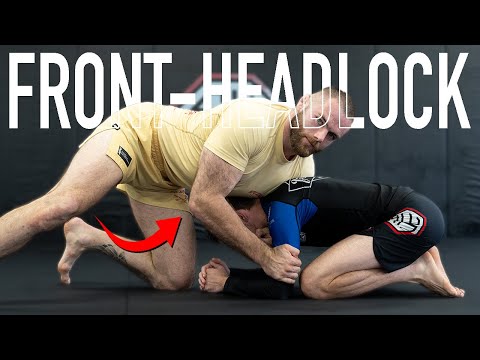
Front Headlock Attack System Your Coach Wont Show You
0
Standard Front Headlock·Josh Saunders
✅ 31 Ways In 31 Days to get better faster: https://hpucoaching.aweb.page/p/6f685b31-b49d-44c5-acbe-25c700054224 ✅Systemi…
Translation: standard front headlock
The Standard Front Headlock subfamily covers the basic front headlock position where the attacker wraps one arm around the opponent's neck from the front while the other hand controls the opponent's near arm or wrist, maintaining the bent-over posture. [1] The standard front headlock is characterised by the attacker's hip-to-hip positioning with the opponent's head trapped underneath the attacker's torso, creating a dominant control where the opponent cannot posture up. [1],[2] This position serves as a hub for multiple attack chains in both wrestling and submission grappling. [2],[3]
The standard front headlock secures the opponent's head and one arm, providing control for snap-downs, go-behinds, and choke entries. [1]
A core wrestling position used across all styles. [1]
The standard front headlock is a dominant control position in wrestling and MMA, used at every level of competition to control and attack a downed opponent. [1]
No images yet for this technique.
Sign in to suggest an image.
✅ 31 Ways In 31 Days to get better faster: https://hpucoaching.aweb.page/p/6f685b31-b49d-44c5-acbe-25c700054224 ✅Systemi…
Earn Your Gold Academy: https://earnyourgoldmedal.teachable.com/
The standard front headlock represents a methodical, control-oriented attack system originating from clinch positions in both wrestling and grappling contexts. Unlike explosive takedowns that rely on speed and force, this family emphasizes deliberate positioning, pressure distribution, and systematic escapeproofing. Earn Your Gold Medal highlights the football grip front headlock employed by two-time NCAA champion Austin O'Connor, characterizing it as a slow, methodical attack (often 20–35 seconds) that succeeds primarily through patient hand-fighting and response to opponent defensive postures—particularly exploiting overties and thumb blocks through head positioning adjustments. Josh Saunders frames the front headlock as a complete attack ecosystem, emphasizing that control depends on elbow placement (positioned high toward the hip rather than low across the chin), weight distribution, and preemptive counters to common escapes (drags, arm spins, four-point breakouts). Both instructors prioritize preventing defensive transitions: O'Connor pairs front headlock attempts with alternative attacks (double-leg, arm drag, throw-by) based on opponent stance height, while Saunders develops systematic follow-ups including turtle position control, hip-pinning sequences, and finishing holds (arming guillotine from grappling contexts). The unified principle across variants is that the front headlock serves not as a rapid forcing technique but as a position that yields multiple scoring and control pathways when opponents attempt escape, making it valuable across both wrestling and submission-oriented grappling.
Synthesized from 2 instructors
No instructional courses yet for this technique.
Sign in to suggest a course.
Risk of injury to the person this technique is applied to
Head/neck control positions create cervical strain; Muay Thai plum is primary striking platform
Skill level needed to execute this technique reliably
Whether this technique is allowed under major competition rule sets
Freestyle Wrestling: A Complete Guide for Coaches and Wrestlers (Petrov, 1977)
Alias sources — [1] Wrestling Physical Conditioning Encyclopedia (Welker, 2010) [2] Clinch Fighting for MMA (Couture, 2011) [3] Kodokan Judo (Kano, 1986)
Effectiveness sources — [1] Wrestling Physical Conditioning Encyclopedia (Petrov, 1977)
Standard katakana transliteration of Western martial arts terminology (外来語) — used in Japanese MMA, boxing, and BJJ communities
Alias sources — [1] Wrestling Physical Conditioning Encyclopedia (Welker, 2010) [2] Clinch Fighting for MMA (Couture, 2011) [3] Kodokan Judo (Kano, 1986)
Effectiveness sources — [1] Wrestling Physical Conditioning Encyclopedia (Petrov, 1977)
downward pressure, grip strength, sprawl endurance
strong upper body, heavy chest for top pressure
deltoids, biceps, pectorals, core, hip extensors
Every move, in any martial art, shares a few universal traits. Mix and match below to pinpoint the right tool — or compare equivalents across styles.
The front headlock is described in multiple MMA and grappling manuals as the 'hub' position for chokes — guillotine, D'Arce, Anaconda, and Japanese necktie all launch from here. (Mastering Jujitsu, Gracie & Danaher; The Ultimate MMA Training Guide)
According to Josh Saunders, you want to position your chin strap and shoulder with your front delt somewhere between your opponent's shoulder blades, while maintaining consistent pressure through your shoulder blades in an athletic position.
Josh Saunders emphasizes positioning your right hip to contact the floor first with your left leg extended toward the ceiling to block the cartwheel, while ensuring the opponent's head drives toward the mat with your elbow and rib line covering each ear.
Josh Saunders notes that many practitioners reach for the back too quickly and go too deep, which gives the opponent more defensive opportunities rather than improving your attack position.
You need to cover the hips and keep them positioned correctly—if you leave them extended in the wrong direction, your opponent can sit to guard on the far side, putting you too far behind to finish effectively.
The Standard Front Headlock subfamily covers the basic front headlock position where the attacker wraps one arm around the opponent's neck from the front while the other hand controls the opponent's near arm or wrist, maintaining the bent-over posture. The standard front headlock is characterised by the attacker's hip-to-hip positioning with the opponent's head trapped underneath the attacker's torso, creating a dominant control where the opponent cannot posture up.
The standard front headlock is a foundational wrestling control position that has been part of the sport's curriculum for well over a century. The position's importance grew significantly with the development of front headlock submission systems in BJJ and MMA.
Unified MMA: legal — Legal — clinching is integral to MMA; IJF: legal — Legal — kumi-kata (grip fighting) is fundamental to judo; IBJJF: legal — Legal — standing grip fighting and clinch work permitted; IFMA: legal — Legal — the clinch is a core element of Muay Thai, clinch dominance is highly…; WBC/Boxing: restricted — Holding is technically a foul — referee breaks clinch, excessive holding resu…; K: restricted — 1/GLORY — One attack from clinch allowed, then referee breaks; WAKO: restricted — Clinch generally broken by referee — limited or no clinch fighting in most fo…; UWW: legal — Legal — clinch is fundamental to wrestling, the primary position in Greco-Roman
Danger rating 5/10. High — head/neck control positions create cervical strain; Muay Thai plum is primary striking platform
The standard setup chain: Close Distance → Establish Primary Grip → Position the Hips → Apply Pressure.
Standard counters include: Pummeling — fight for inside position by swimming arms under opponent's grips / Frame and Push — create distance using forearm frames against the chest or neck / Hand Fight — strip grips by peeling fingers or pushing the wrist away / Level Change — change levels to break the collar tie angle and attack the legs.
Common variants: Standard front headlock (arm wrapped around the head from the front); Front headlock with arm (controlling the head and one arm (head-and-arm position)); Short choke front headlock (tight headlock seeking a guillotine or snap-down).
The standard front headlock is a dominant control position in wrestling and MMA, used at every level of competition to control and attack a downed opponent.
Top errors to watch for: Wrapping the head loosely — the bicep-forearm squeeze on both sides of the neck must be tight / Not sprawling the hips back — upright posture gives the opponent room to stand up and escape / Keeping your weight on your own feet instead of on the opponent — drive your chest into their head/neck / Clasping hands without a purpose — the hand position should set up a specific attack (choke, go-behind).
The Standard Front Headlock is also known as Sutandādo Furonto Heddo Rokku, Standard Front Chancery, Basic Front Headlock, Mae-Kubi-Gatame.