Underhook to Front Headlock Attacks
0
Front Headlock·RuizCombatGrappling
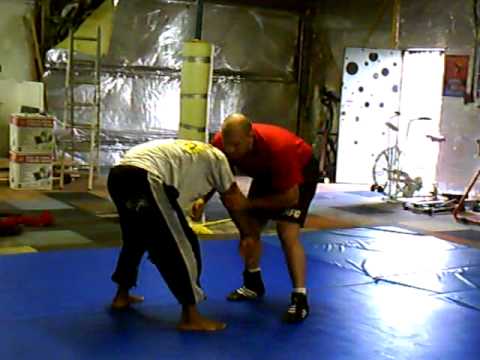
Underhook entry with multiple options for attacks from the front headlock or head down position. These attacks will help…
Translation: front headlock
The Front Headlock family covers clinch positions where the attacker controls the opponent's head from the front, wrapping one arm around the head and neck while the opponent is in a bent-forward posture. [1] The front headlock is one of the most versatile clinch positions in combat sports — it serves as a control position, a platform for submissions (guillotine, anaconda, D'arce chokes), and a setup for go-behinds and takedowns. [1],[2] Front headlocks typically occur when an opponent's shot is sprawled on, when snap-downs drive the opponent's head down, or when the opponent is broken down in the clinch. [2],[3]
The front headlock has been a fundamental wrestling control position for over a century, used primarily as a platform for go-behinds and scoring nearfalls. [1] The position gained dramatically more importance with the rise of submission grappling and MMA, where the front headlock became the primary setup for some of the sport's most effective choke submissions. [2],[3]
The front headlock is one of the highest-percentage control positions in wrestling and MMA, offering immediate access to chokes (guillotine, anaconda, D'arce), go-behinds, and snap-down attacks. [1] Couture describes it as a 'Swiss army knife' position — once secured, the attacker has numerous offensive options while the defender must work urgently to escape. [1] Welker notes that in collegiate wrestling, the front headlock is the single most common position from which turns and near-falls are scored after a sprawl defence. [2]
Front headlock submissions are among the most common finishes in MMA. [1]
No images yet for this technique.
Sign in to suggest an image.
Underhook entry with multiple options for attacks from the front headlock or head down position. These attacks will help…
No instructional courses yet for this technique.
Sign in to suggest a course.
Risk of injury to the person this technique is applied to
Head/neck control positions create cervical strain; Muay Thai plum is primary striking platform
Skill level needed to execute this technique reliably
Whether this technique is allowed under major competition rule sets
Freestyle Wrestling: A Complete Guide for Coaches and Wrestlers (Petrov, 1977)
Alias sources — [1] Wrestling Physical Conditioning Encyclopedia (Welker, 2010) [2] NCAA Wrestling Rules and Interpretations [3] Championship Fighting (Dempsey, 1950)
Effectiveness sources — [1] Clinch Fighting for MMA (Couture, 2011) [2] Wrestling Physical Conditioning Encyclopedia (Welker, 2010)
Standard katakana transliteration of Western martial arts terminology (外来語) — used in Japanese MMA, boxing, and BJJ communities
Alias sources — [1] Wrestling Physical Conditioning Encyclopedia (Welker, 2010) [2] NCAA Wrestling Rules and Interpretations [3] Championship Fighting (Dempsey, 1950)
Effectiveness sources — [1] Clinch Fighting for MMA (Couture, 2011) [2] Wrestling Physical Conditioning Encyclopedia (Welker, 2010)
downward pressure, grip strength, sprawl endurance
strong upper body, heavy chest for top pressure
deltoids, biceps, pectorals, core, hip extensors
Every move, in any martial art, shares a few universal traits. Mix and match below to pinpoint the right tool — or compare equivalents across styles.
The Sprawl Front Headlock subfamily covers the front headlock position established after sprawling on an opponent's takedown attempt, where the attacker has driven their hips back and down to stuff the shot and ended up with the opponent's head trapped under the armpit. [1] The sprawl creates a powerful top position where the attacker's weight is distributed forward onto the opponent, and the headlock provides direct head and neck control. [1,2] From the sprawl headlock, the attacker can transition to go-behinds, snap the opponent to the mat, or set up front headlock submissions. [2,3]
The Standard Front Headlock subfamily covers the basic front headlock position where the attacker wraps one arm around the opponent's neck from the front while the other hand controls the opponent's near arm or wrist, maintaining the bent-over posture. [1] The standard front headlock is characterised by the attacker's hip-to-hip positioning with the opponent's head trapped underneath the attacker's torso, creating a dominant control where the opponent cannot posture up. [1,2] This position serves as a hub for multiple attack chains in both wrestling and submission grappling. [2,3]
The front headlock appears in 105 passages across 12 books. The hub position for multiple high-percentage submissions — guillotine, D'Arce, Anaconda, and Japanese necktie all launch from front headlock control. In MMA, it is one of the most dangerous transitional positions. (12 books; Mastering Jujitsu, Gracie & Danaher)
If your opponent pulls back and resists instead of going down, follow their movement by passing and dropping your level to continue the attack. You can choose to either stay on your feet or drop to a knee depending on the situation.
If your opponent pulls their head up, you have a throw-by attack available. Alternatively, you can release the head grip while keeping your elbow tight and transition to an arm drag by stepping deep, wrapping the hip, and taking them down from there.
Keep your back half of your body moving as a unit while pulling your opponent's head, and maintain consistent pressure by walking toward their head and keeping them hopped down. Make sure your front control is locked in throughout the position.
The Front Headlock family covers clinch positions where the attacker controls the opponent's head from the front, wrapping one arm around the head and neck while the opponent is in a bent-forward posture. The front headlock is one of the most versatile clinch positions in combat sports — it serves as a control position, a platform for submissions (guillotine, anaconda, D'arce chokes), and a setup for go-behinds and takedowns.
The front headlock has been a fundamental wrestling control position for over a century, used primarily as a platform for go-behinds and scoring nearfalls. The position gained dramatically more importance with the rise of submission grappling and MMA, where the front headlock became the primary setup for some of the sport's most effective choke submissions.
Unified MMA: legal — Legal — clinching is integral to MMA; IJF: legal — Legal — kumi-kata (grip fighting) is fundamental to judo; IBJJF: legal — Legal — standing grip fighting and clinch work permitted; IFMA: legal — Legal — the clinch is a core element of Muay Thai, clinch dominance is highly…; WBC/Boxing: restricted — Holding is technically a foul — referee breaks clinch, excessive holding resu…; K: restricted — 1/GLORY — One attack from clinch allowed, then referee breaks; WAKO: restricted — Clinch generally broken by referee — limited or no clinch fighting in most fo…; UWW: legal — Legal — clinch is fundamental to wrestling, the primary position in Greco-Roman
Danger rating 5/10. High — head/neck control positions create cervical strain; Muay Thai plum is primary striking platform
The standard setup chain: Close Distance → Establish Primary Grip → Position the Hips → Apply Pressure.
Standard counters include: Pummeling — fight for inside position by swimming arms under opponent's grips / Frame and Push — create distance using forearm frames against the chest or neck / Hand Fight — strip grips by peeling fingers or pushing the wrist away / Level Change — change levels to break the collar tie angle and attack the legs.
Common variants: Standard front headlock (arm wrapped around the head from the front); Front headlock with arm (controlling the head and one arm (head-and-arm position)); Short choke front headlock (tight headlock seeking a guillotine or snap-down).
Front headlock submissions are among the most common finishes in MMA.
Top errors to watch for: Holding the front headlock without applying chest pressure — your weight must be on the opponent's head and neck / Wrapping only the head without controlling the near arm — the arm control prevents the opponent from rolling out / Standing upright in the front headlock — sprawl your hips back and drive your weight down / Squeezing only the head without a specific attack plan — the headlock is a position, not a submission (unless you're ….
The Front Headlock is also known as Furonto Heddo Rokku, Front Head And Arm, Snap Down Position, Front Chancery.