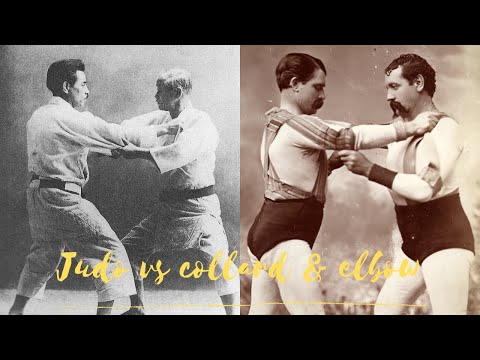
Judo VS Irish collar and elbow
0
Irish Collar Tie·Chadi
Support me on Patreon: https://www.patreon.com/chadijudo The hero with a thousand holds: https://www.youtube.com/c/TheH…
Not yet documented
The Irish Collar Tie is a clinch position where one hand controls the back of the opponent's neck (collar tie) while the other hand controls their wrist on the same side — creating a diagonal control configuration used in wrestling and MMA for snap-downs, level changes, and arm drag setups. [1] The 'Irish' variation specifically refers to the wrist control addition to the standard collar tie. [1],[2]
Developed within the parent martial arts tradition. [1]
Used in relevant competition formats. [1]
No images yet for this technique.
Sign in to suggest an image.
Support me on Patreon: https://www.patreon.com/chadijudo The hero with a thousand holds: https://www.youtube.com/c/TheH…
No instructional courses yet for this technique.
Sign in to suggest a course.
Risk of injury to the person this technique is applied to
Standard technique-level risk appropriate to the category
Skill level needed to execute this technique reliably
Whether this technique is allowed under major competition rule sets
Jiu-Jitsu University (Saulo Ribeiro, 2008)
Description sources — [1] Martial arts curriculum [2] Competition analysis
Standard katakana transliteration of Western martial arts terminology (外来語) — used in Japanese MMA, boxing, and BJJ communities
Description sources — [1] Martial arts curriculum [2] Competition analysis
technique-specific physical attributes
technique-dependent
Every move, in any martial art, shares a few universal traits. Mix and match below to pinpoint the right tool — or compare equivalents across styles.
According to Chadi, learning stable grips through techniques like the Irish collar tie is very important for young practitioners growing up, as it teaches foundational grip control and how to dominate with your grips.
Chadi emphasizes that just as technical heritage is important in judo, it is equally important in other cultures around the world, and he advocates for preserving traditional wrestling disciplines like Irish collar and elbow alongside modern martial arts.
The Irish Collar Tie is a clinch position where one hand controls the back of the opponent's neck (collar tie) while the other hand controls their wrist on the same side — creating a diagonal control configuration used in wrestling and MMA for snap-downs, level changes, and arm drag setups. The 'Irish' variation specifically refers to the wrist control addition to the standard collar tie.
This technique developed within its parent martial arts tradition and has been refined through competition.
Unified MMA: legal — Legal — clinching is integral to MMA; IJF: legal — Legal — kumi-kata (grip fighting) is fundamental to judo; IBJJF: legal — Legal — standing grip fighting and clinch work permitted; IFMA: legal — Legal — the clinch is a core element of Muay Thai, clinch dominance is highly…; WBC/Boxing: restricted — Holding is technically a foul — referee breaks clinch, excessive holding resu…; K: restricted — 1/GLORY — One attack from clinch allowed, then referee breaks; WAKO: restricted — Clinch generally broken by referee — limited or no clinch fighting in most fo…; UWW: legal — Legal — clinch is fundamental to wrestling, the primary position in Greco-Roman
Danger rating 4/10. Moderate — standard technique-level risk appropriate to the category
The standard setup chain: Establish Entry Position → Set Up the Technique → Execute → Follow Through → Consolidate or Transition.
Standard counters include: Defensive techniques against this specific technique / Prevention of the entry position.
Common variants: Standard execution (the fundamental version); Modified variation (adapted for specific scenarios).
Used in relevant competition formats.
Top errors to watch for: Poor entry positioning / Incomplete execution / Not chaining with follow-up techniques / Attempting without proper setup.
The Irish Collar Tie is also known as Irish Whip, Collar Tie Snap, Head Snap.