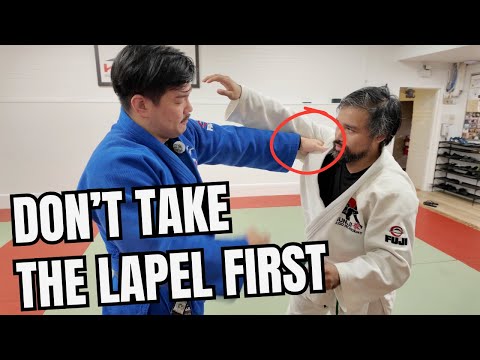
Use the Armpit Grip to Dominate Ai-Yotsu and Hit Strong Uchi Mata & Osoto
0
Standard Kenka-Yotsu·KENJUDO_nyc·Added by Admin
🥋 The Armpit Grip Secret: How Japanese Judoka Dominate Ai-Yotsu Most people think that in ai-yotsu (same stance), you …
Translation: standard opposite-side grip
The Standard Kenka-Yotsu positions two fighters in opposite stances, with each gripping the other's collar and sleeve in a mirror-image configuration. [1] In this position, the lapel grip is relatively easy to establish (both fighters' lead hands can reach the collar naturally), but the sleeve grip requires reaching across the opponent's body. [1],[2] The standard kenka-yotsu position creates a dynamic where both fighters contest the dominant grip on the far sleeve, and throws that exploit the open angle between the fighters — such as kouchi gari, ouchi gari, and tai otoshi — are particularly effective. [2],[3]
Standard kenka-yotsu has been a primary competitive scenario in judo since the art's establishment, with specific strategies and counter-strategies developed over generations of competition. [1] Many of judo's most famous rivalries have featured kenka-yotsu matchups that drove tactical innovation. [2],[3]
The standard kenka-yotsu position has one fighter in right stance and the other in left, creating cross-body grip dynamics. [1]
Kenka-yotsu is taught in all judo programmes as one of the two fundamental grip orientations. [1]
No images yet for this technique.
Sign in to suggest an image.
🥋 The Armpit Grip Secret: How Japanese Judoka Dominate Ai-Yotsu Most people think that in ai-yotsu (same stance), you …
No instructional courses yet for this technique.
Sign in to suggest a course.
Risk of injury to the person this technique is applied to
Grip fighting is primarily positional; finger/wrist strain risk
Skill level needed to execute this technique reliably
Whether this technique is allowed under major competition rule sets
Kodokan Judo (Jigoro Kano, 1986)
Alias sources — [1] Kodokan Judo (Kano, 1986) [2] Best Judo (Inokuma & Sato, 1979) [3] Kodokan New Japanese-English Dictionary of Judo (IJF, 2000)
Effectiveness sources — [1] Kodokan Judo (Kano, 1986)
Official Kodokan ground technique classification system
Mixed Japanese-Western terminology — combines traditional Japanese terms with katakana loanwords
Alias sources — [1] Kodokan Judo (Kano, 1986) [2] Best Judo (Inokuma & Sato, 1979) [3] Kodokan New Japanese-English Dictionary of Judo (IJF, 2000)
Effectiveness sources — [1] Kodokan Judo (Kano, 1986)
grip strength, upper body endurance, balance under pressure
strong arms and shoulders, stable base
forearms, deltoids, core, hip muscles
The armpit grip prevents your opponent from posting their arm to block or escape, which is especially useful against opponents with long arms. This grip also makes it difficult for them to reach and defend effectively.
By controlling the opponent's arm with the armpit grip, you eliminate their ability to post and stabilize themselves, creating an unstable position that makes it easier to extend into powerful hip and leg throws.
The Standard Kenka-Yotsu positions two fighters in opposite stances, with each gripping the other's collar and sleeve in a mirror-image configuration. In this position, the lapel grip is relatively easy to establish (both fighters' lead hands can reach the collar naturally), but the sleeve grip requires reaching across the opponent's body.
Standard kenka-yotsu has been a primary competitive scenario in judo since the art's establishment, with specific strategies and counter-strategies developed over generations of competition. Many of judo's most famous rivalries have featured kenka-yotsu matchups that drove tactical innovation.
Unified MMA: legal — Legal — clinching is integral to MMA; IJF: legal — Legal — kumi-kata (grip fighting) is fundamental to judo; IBJJF: legal — Legal — standing grip fighting and clinch work permitted; IFMA: legal — Legal — the clinch is a core element of Muay Thai, clinch dominance is highly…; WBC/Boxing: restricted — Holding is technically a foul — referee breaks clinch, excessive holding resu…; K: restricted — 1/GLORY — One attack from clinch allowed, then referee breaks; WAKO: restricted — Clinch generally broken by referee — limited or no clinch fighting in most fo…; UWW: legal — Legal — clinch is fundamental to wrestling, the primary position in Greco-Roman
Danger rating 2/10. Low — grip fighting is primarily positional; finger/wrist strain risk
The standard setup chain: Close Distance → Establish Primary Grip → Position the Hips → Apply Pressure.
Standard counters include: Pummeling — fight for inside position by swimming arms under opponent's grips / Frame and Push — create distance using forearm frames against the chest or neck / Grip Break — systematically strip the opponent's controlling grips / Posture Up — straighten the spine and drive the hips forward to break clinch control.
Common variants: Standard variation (primary clinch configuration from the most common entry); Gi variation (adapted with collar and sleeve grips for gi-based grappling); No-gi / MMA variation (modified for no-gi or cage fighting conditions); Offensive variation (configured to set up strikes, takedowns, or submissions f…).
Kenka-yotsu (asymmetrical grip, one left and one right) creates a different tactical dynamic in judo competition, favouring techniques like osoto-gari and uchi-mata to the opposite side. It occurs in roughly half of judo matches at international level.
Top errors to watch for: Not recognising the open angle and its implications — in kenka yotsu, both fighters have an exposed side / Fighting for the same grips you'd use in ai yotsu — the asymmetric position rewards different grip configurations / Allowing the opponent to rotate you toward your open side — use footwork and grip fighting to protect it / Standing statically and waiting for the opponent to create the action — kenka yotsu rewards the first mover.
The Standard Kenka-Yotsu is also known as Sutandādo Kenka-yotsu, Basic Kenka-Yotsu, Standard Opposite Grip, Fundamental Opposite-Side Kumi-Kata.