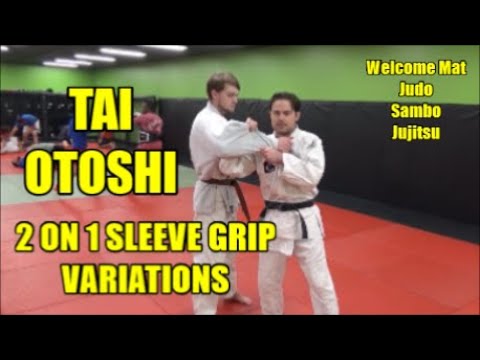
TAI OTOSHI: 2 ON 1 SLEEVE GRIP VARIATIONS
0
Collar-Sleeve Grip·welcomematstevescott
Tai Otoshi (Body Drop) is an effective and popular throwing technique. IN this video, we show several different methods …
Translation: collar-sleeve grip
The Collar-Sleeve Grip family covers the classical judo and BJJ gripping configuration where one hand grips the opponent's collar (lapel) and the other grips the sleeve, establishing the standard bilateral control used for most gi-based throwing and sweeping techniques. [1] The collar grip controls the opponent's posture and head position, while the sleeve grip controls the arm and creates rotational opportunities — together they form the most versatile grip configuration in gi grappling. [1],[2] The relative positioning of these grips (same-side or opposite-side) creates fundamentally different tactical dynamics known in judo as ai-yotsu (same-side) and kenka-yotsu (opposite-side). [2],[3]
The collar-and-sleeve grip is the foundational gripping system in judo, established since Jigoro Kano's systematisation of the art in the 1880s. [1] The classical hon-kumi (standard grip) — right hand on the collar, left hand on the sleeve — has been the default starting position for judo training for over 140 years. [2] The development of ai-yotsu and kenka-yotsu strategies has been one of the most sophisticated tactical evolutions in judo competition history. [2],[3]
The collar-sleeve grip (kumi-kata) is the fundamental gripping configuration in judo, providing the basis for the vast majority of judo throws. [1] Kano identified proper grip fighting as essential to judo success, noting that the fighter who establishes their preferred grip first typically controls the exchange. [1] Inokuma and Sato describe the collar-sleeve grip as the 'starting point for all throwing technique' in judo. [2]
The collar-sleeve grip was formalised as part of Jigoro Kano's Kodokan Judo curriculum from the 1880s onward. [1] The specific terminology and training methodology for grip fighting (kumi-kata) has been transmitted through the Kodokan system and its worldwide federation affiliates (IJF) for over 140 years. [1]
Collar-sleeve gripping is the standard grip exchange in judo competition. [1]
No images yet for this technique.
Sign in to suggest an image.
Tai Otoshi (Body Drop) is an effective and popular throwing technique. IN this video, we show several different methods …
No instructional courses yet for this technique.
Sign in to suggest a course.
Risk of injury to the person this technique is applied to
Grip fighting is primarily positional; finger/wrist strain risk
Skill level needed to execute this technique reliably
Whether this technique is allowed under major competition rule sets
Kodokan Judo (Jigoro Kano, 1986)
Alias sources — [1] Kodokan Judo (Kano, 1986) [2] Kodokan Judo (Kano, 1986) [3] Kodokan Judo (Kano, 1986)
Effectiveness sources — [1] Kodokan Judo (Kano, 1986) [2] Best Judo (Inokuma & Sato, 1979)
Official Kodokan ground technique classification system
Established Japanese martial arts naming convention — native Japanese term (和語/漢語)
Alias sources — [1] Kodokan Judo (Kano, 1986) [2] Kodokan Judo (Kano, 1986) [3] Kodokan Judo (Kano, 1986)
Effectiveness sources — [1] Kodokan Judo (Kano, 1986) [2] Best Judo (Inokuma & Sato, 1979)
grip strength, upper body endurance, balance under pressure
strong arms and shoulders, stable base
forearms, deltoids, core, hip muscles
Every move, in any martial art, shares a few universal traits. Mix and match below to pinpoint the right tool — or compare equivalents across styles.
The Opposite-Side Grip (Kenka-Yotsu) subfamily covers the gripping configuration where the two fighters hold opposite-sided stances — one fights right-handed and the other left-handed — creating a mirror-image clinch dynamic. [1] In kenka-yotsu, the fighters' lead hands are on the same side, making it easier to grip the opponent's collar but harder to secure the dominant sleeve grip. [1,2] Kenka-yotsu dynamics favour different throwing techniques than same-side gripping, with drop techniques (sutemi-waza), foot sweeps, and sacrifice throws being particularly effective from this configuration. [2,3]
The Same-Side Grip (Ai-Yotsu) subfamily covers the gripping configuration where both fighters adopt the same stance — both right-handed or both left-handed — creating a symmetrical clinch dynamic. [1] In ai-yotsu, both fighters contest the same grip positions, making the grip fight more direct and competitive. [1,2] Ai-yotsu dynamics favour classical forward throws like seoi-nage, uchi-mata, and harai-goshi, as the symmetrical stance provides clean entry angles for these techniques. [2,3]
The 2-on-1 sleeve grip focuses your control on one side rather than splitting between lapel and sleeve, which requires more follow-through and push rather than pull to execute the throw effectively.
Grab on the inside of the bicep, catching the thumb in the croch of your hand, and aim for about the midpoint of the forearm rather than too high up, so that when you push forward your opponent lands in the crook of your arm.
Instead of pulling, you focus on blocking and pushing your opponent out, which requires more push force than you're accustomed to, and you should keep your elbow from flaring up as you execute the movement.
The Collar-Sleeve Grip family covers the classical judo and BJJ gripping configuration where one hand grips the opponent's collar (lapel) and the other grips the sleeve, establishing the standard bilateral control used for most gi-based throwing and sweeping techniques. The collar grip controls the opponent's posture and head position, while the sleeve grip controls the arm and creates rotational opportunities — together they form the most versatile grip configuration in gi grappling.
The collar-and-sleeve grip is the foundational gripping system in judo, established since Jigoro Kano's systematisation of the art in the 1880s. The classical hon-kumi (standard grip) — right hand on the collar, left hand on the sleeve — has been the default starting position for judo training for over 140 years.
Unified MMA: legal — Legal — clinching is integral to MMA; IJF: legal — Legal — kumi-kata (grip fighting) is fundamental to judo; IBJJF: legal — Legal — standing grip fighting and clinch work permitted; IFMA: legal — Legal — the clinch is a core element of Muay Thai, clinch dominance is highly…; WBC/Boxing: restricted — Holding is technically a foul — referee breaks clinch, excessive holding resu…; K: restricted — 1/GLORY — One attack from clinch allowed, then referee breaks; WAKO: restricted — Clinch generally broken by referee — limited or no clinch fighting in most fo…; UWW: legal — Legal — clinch is fundamental to wrestling, the primary position in Greco-Roman
Danger rating 2/10. Low — grip fighting is primarily positional; finger/wrist strain risk
The standard setup chain: Close Distance → Establish Primary Grip → Position the Hips → Apply Pressure.
Standard counters include: Pummeling — fight for inside position by swimming arms under opponent's grips / Frame and Push — create distance using forearm frames against the chest or neck / Grip Break — systematically strip the opponent's controlling grips / Posture Up — straighten the spine and drive the hips forward to break clinch control.
Common variants: Standard variation (primary clinch configuration from the most common entry); Gi variation (adapted with collar and sleeve grips for gi-based grappling); No-gi / MMA variation (modified for no-gi or cage fighting conditions); Offensive variation (configured to set up strikes, takedowns, or submissions f…).
Collar-sleeve gripping is the standard grip exchange in judo competition.
Top errors to watch for: Gripping the collar shallowly (just the fabric at the chest) — a deep grip behind the neck gives far more control / Gripping the sleeve at mid-forearm instead of the cuff — cuff grip gives maximum arm control / Holding collar-sleeve statically without creating kuzushi — use the grips to push, pull, and off-balance / Letting the opponent strip your collar grip without immediately re-gripping — fight to maintain it.
The Collar-Sleeve Grip is also known as Eri-sode Kumi, Eri-Kumi, Standard Judo Grip, Lapel-Sleeve.