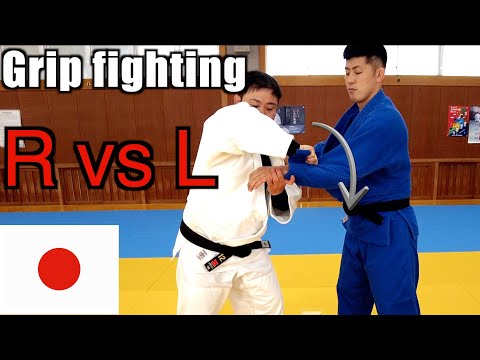
Secret Technique: kenka yotsu Kumite, how to grip right vs left.
0
Opposite-Side Grip — Kenka-Yotsu·FLUID JUDO JAPAN
In this video, you will be learning tried and tested gripping strategies for right vs left grips. these strategies will …
Translation: opposite-side grip
The Opposite-Side Grip (Kenka-Yotsu) subfamily covers the gripping configuration where the two fighters hold opposite-sided stances — one fights right-handed and the other left-handed — creating a mirror-image clinch dynamic. [1] In kenka-yotsu, the fighters' lead hands are on the same side, making it easier to grip the opponent's collar but harder to secure the dominant sleeve grip. [1],[2] Kenka-yotsu dynamics favour different throwing techniques than same-side gripping, with drop techniques (sutemi-waza), foot sweeps, and sacrifice throws being particularly effective from this configuration. [2],[3]
Kenka-yotsu (opposite-side fighting) has been a recognised tactical framework in judo since the early 20th century, when competition rules and grip fighting strategy became more formalised. [1] The kenka-yotsu dynamic creates unique challenges that have driven the development of many specialised techniques and grip-fighting strategies. [2],[3]
Kenka-yotsu (opposite-side grip) creates a diagonal tension that favours rotational throws and unorthodox entries. [1]
Kenka-yotsu is a fundamental grip configuration in judo, extensively studied in competition strategy. [1]
Kenka-yotsu matchups produce different throw selection patterns than ai-yotsu in IJF competition data. [1]
No images yet for this technique.
Sign in to suggest an image.
In this video, you will be learning tried and tested gripping strategies for right vs left grips. these strategies will …
No instructional courses yet for this technique.
Sign in to suggest a course.
Risk of injury to the person this technique is applied to
Grip fighting is primarily positional; finger/wrist strain risk
Skill level needed to execute this technique reliably
Whether this technique is allowed under major competition rule sets
Kodokan Judo (Jigoro Kano, 1986)
Alias sources — [1] Kodokan Judo (Kano, 1986) [2] Judo Formal Techniques (Otaki & Draeger, 1983)
Effectiveness sources — [1] Kodokan Judo (Kano, 1986)
Official Kodokan ground technique classification system
Established Japanese martial arts naming convention — native Japanese term (和語/漢語)
Alias sources — [1] Kodokan Judo (Kano, 1986) [2] Judo Formal Techniques (Otaki & Draeger, 1983)
Effectiveness sources — [1] Kodokan Judo (Kano, 1986)
grip strength, upper body endurance, balance under pressure
strong arms and shoulders, stable base
forearms, deltoids, core, hip muscles
Every move, in any martial art, shares a few universal traits. Mix and match below to pinpoint the right tool — or compare equivalents across styles.
Kenka-yotsu (opposite-side grip) occurs when fighters grip with opposite dominant hands — right vs. left. This asymmetric configuration creates different attacking angles than ai-yotsu and favors different throws. Gripping strategy (kumikata) is considered one of the most important tactical skills in modern judo. (Kano, Kodokan Judo; judo coaching manuals)
Grip below the shoulders rather than above, as positioning above the shoulders reduces your strength and effectiveness. Fluid Judo Japan emphasizes that this lower positioning is critical when your opponent tries to take the grip from the outside.
When your opponent tries to dominate the grip, twist your wrist inward to control their sleeve (surate) and press on their right shoulder to maintain dominance. Fluid Judo Japan stresses the importance of fighting for control of the grip on your side of the line.
Aim for the elbow area rather than the wrist, since if your opponent is moving their hands, targeting the wrist makes it difficult to catch them easily. Fluid Judo Japan recommends aiming for this broader area to ensure solid control.
The Opposite-Side Grip (Kenka-Yotsu) subfamily covers the gripping configuration where the two fighters hold opposite-sided stances — one fights right-handed and the other left-handed — creating a mirror-image clinch dynamic. In kenka-yotsu, the fighters' lead hands are on the same side, making it easier to grip the opponent's collar but harder to secure the dominant sleeve grip.
Kenka-yotsu (opposite-side fighting) has been a recognised tactical framework in judo since the early 20th century, when competition rules and grip fighting strategy became more formalised. The kenka-yotsu dynamic creates unique challenges that have driven the development of many specialised techniques and grip-fighting strategies.
Unified MMA: legal — Legal — clinching is integral to MMA; IJF: legal — Legal — kumi-kata (grip fighting) is fundamental to judo; IBJJF: legal — Legal — standing grip fighting and clinch work permitted; IFMA: legal — Legal — the clinch is a core element of Muay Thai, clinch dominance is highly…; WBC/Boxing: restricted — Holding is technically a foul — referee breaks clinch, excessive holding resu…; K: restricted — 1/GLORY — One attack from clinch allowed, then referee breaks; WAKO: restricted — Clinch generally broken by referee — limited or no clinch fighting in most fo…; UWW: legal — Legal — clinch is fundamental to wrestling, the primary position in Greco-Roman
Danger rating 2/10. Low — grip fighting is primarily positional; finger/wrist strain risk
The standard setup chain: Close Distance → Establish Primary Grip → Position the Hips → Apply Pressure.
Standard counters include: Pummeling — fight for inside position by swimming arms under opponent's grips / Frame and Push — create distance using forearm frames against the chest or neck / Grip Break — systematically strip the opponent's controlling grips / Posture Up — straighten the spine and drive the hips forward to break clinch control.
Common variants: Standard variation (primary clinch configuration from the most common entry); Gi variation (adapted with collar and sleeve grips for gi-based grappling); No-gi / MMA variation (modified for no-gi or cage fighting conditions); Offensive variation (configured to set up strikes, takedowns, or submissions f…).
Kenka-yotsu matchups produce different throw selection patterns than ai-yotsu in IJF competition data.
Top errors to watch for: Using ai yotsu tactics in kenka yotsu — the open angle changes everything about available throws and grip strategies / Not exploiting the open side — kenka yotsu naturally exposes one side of each fighter / Allowing the opponent to dominate the inside position — fight for the closer, deeper grip / Standing square instead of angling to protect the open side.
The Opposite-Side Grip — Kenka-Yotsu is also known as Kenka-yotsu, Kenka-Yotsu, Cross Grip, Opposite Grip, Ai-Hanmi (when mirrored in aikido).