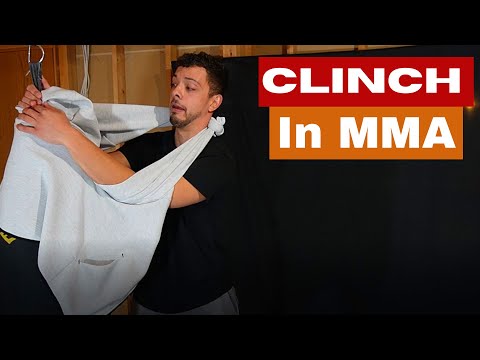
How To CLINCH FIGHT Like A Pro MMA Fighter
0
MMA Clinch·Jesse Enkamp
Basic clinch techniques and tips from Oliver "The Future" Enkamp with his brother Jesse. These fundamental moves apply t…
Translation: MMA clinch
The MMA Clinch family covers clinch techniques adapted specifically for mixed martial arts competition, integrating striking (dirty boxing), takedown attempts, and cage work into a unified clinch system that exists in no traditional martial art. [1] MMA clinch fighting uniquely combines elements from Muay Thai (knees, elbows), wrestling (takedowns, cage control), boxing (short hooks, uppercuts), and judo (throws) into a hybrid system where the fighter must simultaneously manage all of these threats. [1],[2] The cage wall adds a dimension not found in any traditional martial art — fighters pin opponents against the fence for control, deliver strikes from this position, and use the fence as leverage for takedowns in ways impossible on an open mat. [2],[3] Randy Couture pioneered 'dirty boxing' (striking from the clinch in MMA) in the early 2000s, and Khabib Nurmagomedov's cage clinch pressure system (2010s) demonstrated that clinch control could dominate even the most skilled strikers. [3]
MMA clinch fighting evolved as the sport matured from the early UFC era where fighters had limited cross-training. [1] Randy Couture pioneered 'dirty boxing' (clinch striking) and cage clinch work in the early 2000s, demonstrating that the clinch could be used offensively for both striking and wrestling in MMA. [1],[2] The cage wall as a clinch tool was developed through the 2000s-2010s, with fighters discovering that the fence provides unique leverage for takedowns and control. [2],[3] Khabib Nurmagomedov's cage clinch system (2010s-2020) represented the pinnacle of MMA clinch evolution, combining wrestling pressure, cage control, and seamless transition to ground-and-pound. [3]
MMA clinch fighting is one of the most decisive skill sets in professional MMA — fighters who control the clinch control where the fight takes place. [1] Randy Couture won five UFC titles largely through clinch dominance. Khabib Nurmagomedov's undefeated 29-0 record was built significantly on cage clinch pressure and body lock takedowns. [2] Daniel Cormier's Greco-Roman clinch adapted for MMA produced UFC titles at both light heavyweight and heavyweight. [3]
No images yet for this technique.
Sign in to suggest an image.
Basic clinch techniques and tips from Oliver "The Future" Enkamp with his brother Jesse. These fundamental moves apply t…
In this video I show you how to do a clinch mixed martial arts. What is a clinch? It's a form used to be able to have mo…
No instructional courses yet for this technique.
Sign in to suggest a course.
Risk of injury to the person this technique is applied to
MMA clinch exchanges involve knees, elbows, dirty boxing, and takedowns; the close range means both fighters can land powerful strikes; accidental head-butts are common; cage grinding is physically demanding
Skill level needed to execute this technique reliably
Whether this technique is allowed under major competition rule sets
Wrestling for Fighting (Ben Askren, 2019)
Description sources — [1] Randy Couture's dirty boxing innovation [2] Wrestling for Fighting (Askren, 2019) [3] Khabib Nurmagomedov fight analysis
Description sources — [1] Randy Couture's dirty boxing innovation [2] Wrestling for Fighting (Askren, 2019) [3] Khabib Nurmagomedov fight analysis
multi-discipline training (striking + wrestling + clinch-specific skills), cardio endurance (clinch fighting is exhausting), upper body strength (pummeling and cage control)
wrestling background (clinch control foundation), strong hips (takedown power from clinch), good chin (dirty boxing exchanges involve taking punches at close range)
shoulders and chest (pummeling and cage control), forearms (grip fighting), core (integration of striking and wrestling), quadriceps (cage pressing and level changes)
Every move, in any martial art, shares a few universal traits. Mix and match below to pinpoint the right tool — or compare equivalents across styles.
The Body-Lock Takedown to Back combines a body-lock takedown with an immediate back-take, maintaining the body lock throughout the descent and transitioning directly to back control. [1]
Bump the Arm to Back is a clinch transition where the attacker bumps the opponent's arm upward and immediately circles to take the back. [1]
The Dirty Boxing Clinch is an MMA-specific clinch position where one hand controls the opponent's head via a collar tie (cupping the back of the neck) while the other hand delivers short punches, elbows, and uppercuts, creating a devastating inside-fighting position that bridges the gap between wrestling and striking. [1] The term 'dirty boxing' comes from the perception in traditional boxing that clinch-range striking is unsportsmanlike — in boxing, the referee separates clinched fighters, but in MMA the clinch is a contested fighting range where short strikes, knees, elbows, and takedowns are all legal. [1,2] Randy Couture is widely credited with popularising dirty boxing in MMA, using his Greco-Roman wrestling clinch skills to control opponents' heads while delivering devastating short uppercuts, elbows, and knees — a style that neutralised both strikers (by closing distance) and wrestlers (by maintaining upper body control while striking). [2,3] BJ Penn documented the Dirty Boxing Clinch as a core MMA skill in The Book of Knowledge, demonstrating how the collar tie provides head control that enables both strikes AND takedown entries from the same position. [1] The technique's tactical brilliance lies in its dual-threat nature: the opponent cannot defend the short strikes without loosening their takedown defence, and cannot defend the takedowns without absorbing strikes — creating an unresolvable defensive dilemma. [1,2] In UFC competition, the dirty boxing clinch against the cage has become one of the most common and effective fighting positions, with fighters like Khabib Nurmagomedov, Daniel Cormier, and Colby Covington building entire gameplans around cage-clinch dirty boxing. [3]
You need to fight on the inside and punch your hands inside your opponent's arms rather than trying to grab from the outside. According to Jesse Enkamp, you should reach inside, push the opponent's arms out, and keep your hands on the inside with their arms on the outside to establish control.
Keep your shoulders above your hips and hips above your feet in proper alignment, drive forward with your hips rather than leaning on your opponent, and maintain a straight spine. Jesse Enkamp emphasizes that you should push your weight into your opponent instead of leaning on them, keeping your weight centered over your feet.
It's much easier and more effective to move your own body to get your opponent out of position or off balance. Jesse Enkamp explains that with a good grip, moving your own body is more practical than trying to throw your opponent around.
Yes, the clinch is a great defensive tool even if you don't want to grapple. Jesse Enkamp notes that if you're getting outstruck, closing the distance with a clinch can stop your opponent from punching and give you an advantage in the fight.
The likelihood of keeping a clinch for a long time is not really there, as your opponent will work to escape, fight for control, or strike you. Astral Kinetics advises thinking about your next options while in the clinch rather than expecting to maintain it.
The MMA Clinch family covers clinch techniques adapted specifically for mixed martial arts competition, integrating striking (dirty boxing), takedown attempts, and cage work into a unified clinch system that exists in no traditional martial art. MMA clinch fighting uniquely combines elements from Muay Thai (knees, elbows), wrestling (takedowns, cage control), boxing (short hooks, uppercuts), and judo (throws) into a hybrid system where the fighter must simultaneously manage all of these threats.
MMA clinch fighting evolved as the sport matured from the early UFC era where fighters had limited cross-training. Randy Couture pioneered 'dirty boxing' (clinch striking) and cage clinch work in the early 2000s, demonstrating that the clinch could be used offensively for both striking and wrestling in MMA.
Unified MMA: legal — Legal — clinching is integral to MMA; IJF: legal — Legal — kumi-kata (grip fighting) is fundamental to judo; IBJJF: legal — Legal — standing grip fighting and clinch work permitted; IFMA: legal — Legal — the clinch is a core element of Muay Thai, clinch dominance is highly…; WBC/Boxing: restricted — Holding is technically a foul — referee breaks clinch, excessive holding resu…; K: restricted — 1/GLORY — One attack from clinch allowed, then referee breaks; WAKO: restricted — Clinch generally broken by referee — limited or no clinch fighting in most fo…; UWW: legal — Legal — clinch is fundamental to wrestling, the primary position in Greco-Roman
Danger rating 5/10. Moderate — MMA clinch exchanges involve knees, elbows, dirty boxing, and takedowns; the close range means both fighters can land powerful strikes; accidental head-butts are common; cage grinding is physically demanding
The standard setup chain: Close Distance → Establish Grips → Position Against Cage → Choose Offence → Execute → Maintain or Disengage.
Standard counters include: Frame and Circle Off — using forearm frames to create space while circling away from the cage / Underhook Recovery — when the opponent has dominant clinch position, fighting for the underhook to equalise / Level Change — dropping level for a takedown when the opponent is focused on clinch strikes / Clinch Break — disengaging from the clinch entirely to return to striking range.
Common variants: Dirty boxing clinch (single collar tie with one free hand for short punches an…); Cage clinch (wall work) (pinning the opponent against the cage with chest pressure…); Thai clinch in MMA (the plum clinch adapted for MMA, delivering knees while a…); Body lock clinch (arms locked around the torso for body lock takedowns; Kha…); Single collar tie with wrist control (controlling one wrist while holding a collar tie; allows …); Over-under cage position (one underhook, one overhook against the cage; the neutral…); Double underhook cage drive (driving the opponent into the fence with double underhook…).
MMA clinch work is a deciding factor in UFC competition. Randy Couture (5 UFC titles), Khabib (29-0), and Daniel Cormier (2-division champion) all built careers on clinch dominance.
Top errors to watch for: Treating the clinch as rest — in MMA, the clinch must be active; inactive clinch work results in the referee breaking… / Not using the cage — the fence is an MMA-specific tool; ignoring it gives up a significant advantage / Only striking OR grappling in the clinch — MMA clinch is the integration of both; fighters who only dirty box without… / Keeping hands too high for takedown defence — this exposes the chin to dirty boxing; the hand positioning in MMA clin….
The MMA Clinch is also known as MMA Kurinchi, MMA Clinch Fighting, Cage Clinch, Dirty Boxing Clinch.