Bear Hug Under the Arms Defense
0
Under-Arms Bear Hug·Gracie Barra Twin Cities
http://gbtwincities.com/ https://www.facebook.com/pages/Gracie-Barra-Twin-Cities-MN/199007333443329 https://www.facebook…
Translation: under-arms bear hug
The Under-Arms Bear Hug subfamily covers bear hug positions where the attacker's arms encircle the opponent's torso beneath the opponent's arms, leaving the opponent's arms free above the grip. [1] While less controlling than the over-arms variant (the opponent retains arm mobility), the under-arms bear hug provides deeper body contact and a lower centre of control, making it effective for waist-level lifts and body lock takedowns. [1],[2] The opponent's free arms create both a vulnerability (the attacker's head is exposed to crossfaces and frame escapes) and an advantage (deeper grip around the body). [2],[3]
The under-arms bear hug wraps under the opponent's arms, leaving their upper body free but controlling the torso for powerful lifts and throws. [1]
The under-arms bear hug is used in wrestling, judo, and sambo for high-amplitude throws and suplexes. [1]
Under-arms bear hugs are used in Greco-Roman wrestling for gut-wrench and suplex entries at the highest levels of competition. [1]
No images yet for this technique.
Sign in to suggest an image.
http://gbtwincities.com/ https://www.facebook.com/pages/Gracie-Barra-Twin-Cities-MN/199007333443329 https://www.facebook…
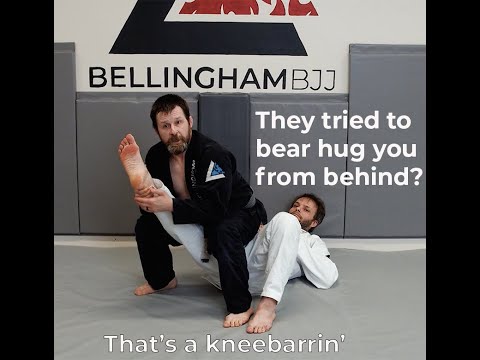
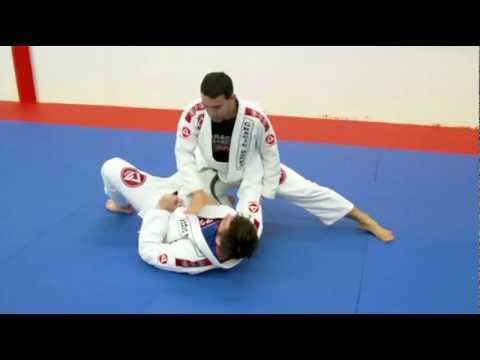
If someone tries to bear hug you, we have to ensure we don't get lifted. After we stabilize position, we can counteratta…
The under-arms bear hug represents a high-threat clinch scenario where an aggressor controls the defender from behind with arms wrapped beneath the ribcage, eliminating hand positioning and creating risk of being lifted and slammed. The unifying principle across this subfamily is rapid positional escape combined with control of the aggressor's structure—either through immediate weight distribution and leg hooks to prevent the lift (Bellingham BJJ), or through overhook and shoulder rotation to create separation and establish dominant positioning (Gracie Barra Twin Cities). Strategic context hinges on defense priority: Bellingham BJJ emphasizes survival-first progression, teaching quad-podding and leg hooks as foundational anti-slam mechanics before introducing counter-attacking options like knee bar finishes. Gracie Barra Twin Cities prioritizes establishing superior control through overhooking and head-to-chest positioning, allowing the defender to transition into takedowns and mounted control rather than purely escaping. The instructors diverge on outcome goals—one frames successful defense as disengagement or optional counter-attack, the other as positional dominance and controlled takedown. Both emphasize immediate reactive squatting or weight-forward positioning to prevent the catastrophic lift, but differ in whether the goal is escape or control establishment.
Synthesized from 2 instructors
No instructional courses yet for this technique.
Sign in to suggest a course.
Risk of injury to the person this technique is applied to
Body clinch positions enable throws and takedowns; rib compression risk
Skill level needed to execute this technique reliably
Whether this technique is allowed under major competition rule sets
Freestyle Wrestling: A Complete Guide for Coaches and Wrestlers (Petrov, 1977)
Alias sources — [1] Wrestling Physical Conditioning Encyclopedia (Welker, 2010) [2] Greco-Roman Wrestling (Petrov, 1987) [3] Clinch Fighting for MMA (Couture, 2011)
Effectiveness sources — [1] Wrestling Physical Conditioning Encyclopedia (Petrov, 1977)
Standard katakana transliteration of Western martial arts terminology (外来語) — used in Japanese MMA, boxing, and BJJ communities
Alias sources — [1] Wrestling Physical Conditioning Encyclopedia (Welker, 2010) [2] Greco-Roman Wrestling (Petrov, 1987) [3] Clinch Fighting for MMA (Couture, 2011)
Effectiveness sources — [1] Wrestling Physical Conditioning Encyclopedia (Petrov, 1977)
arm length to wrap the torso, squeeze strength, hip drive
long arms and strong grip, powerful lower back
biceps, pectorals, forearms, erector spinae, glutes
Every move, in any martial art, shares a few universal traits. Mix and match below to pinpoint the right tool — or compare equivalents across styles.
The under-arms bear hug wraps under both of the opponent's arms — less controlling than over-arms but allows the attacker to lift and throw more easily. The standard setup for belly-to-belly suplexes. (Wrestling manuals; Greco-Roman technique texts)
According to Gracie Barra Twin Cities, your legs are critical because if you don't use them well, you won't be able to keep your opponent down. You need to open a wide base with your legs rather than putting your knee on the ground, which is ineffective even in tournament scoring—the only way to get your point is with a wide, stable base.
Gracie Barra Twin Cities emphasizes grabbing your wrist with all five fingers on the same side, avoiding placing your thumbs underneath the opponent's wrist, as this reduces your power. Your other hand should hold their shoulder while you close your elbows to your body and posture up to create leverage.
According to Bellingham BJJ, the priority is to prevent them from lifting you—if they pick you up, you need to hook their legs and ride them backward into their hips. Prevention is key: don't let them get behind you, and if they do, don't allow them to grab you around the waist in the first place.
The Under-Arms Bear Hug subfamily covers bear hug positions where the attacker's arms encircle the opponent's torso beneath the opponent's arms, leaving the opponent's arms free above the grip. While less controlling than the over-arms variant (the opponent retains arm mobility), the under-arms bear hug provides deeper body contact and a lower centre of control, making it effective for waist-level lifts and body lock takedowns.
The under-arms bear hug is the more common clinch position in practical grappling, as it naturally occurs when a fighter drives into the body from a lower level. It is fundamental to both Greco-Roman and freestyle wrestling clinch work.
Unified MMA: legal — Legal — clinching is integral to MMA; IJF: legal — Legal — kumi-kata (grip fighting) is fundamental to judo; IBJJF: legal — Legal — standing grip fighting and clinch work permitted; IFMA: legal — Legal — the clinch is a core element of Muay Thai, clinch dominance is highly…; WBC/Boxing: restricted — Holding is technically a foul — referee breaks clinch, excessive holding resu…; K: restricted — 1/GLORY — One attack from clinch allowed, then referee breaks; WAKO: restricted — Clinch generally broken by referee — limited or no clinch fighting in most fo…; UWW: legal — Legal — clinch is fundamental to wrestling, the primary position in Greco-Roman
Danger rating 4/10. Moderate — body clinch positions enable throws and takedowns; rib compression risk
The standard setup chain: Close Distance → Establish Primary Grip → Position the Hips → Apply Pressure.
Standard counters include: Pummeling — fight for inside position by swimming arms under opponent's grips / Frame and Push — create distance using forearm frames against the chest or neck / Grip Break — systematically strip the opponent's controlling grips / Posture Up — straighten the spine and drive the hips forward to break clinch control.
Common variants: Front body lock (locked hands around the torso face-to-face); Rear body lock (hands locked around the torso from behind); Side body lock (angled body lock for trips and throws); Over-arms body lock (locking over both arms to pin the opponent's arms to thei…).
Under-arms bear hugs are used in Greco-Roman wrestling for gut-wrench and suplex entries at the highest levels of competition.
Top errors to watch for: Not clasping hands tightly — the deeper wrap makes the lock strong only if the hands are secured / Ignoring the opponent's free arms — they can frame, pummel, crossface, or post to block throws / Not pressing chest-to-chest — the under-arms bear hug requires tight body contact / Standing too upright — bend knees and get hips below the opponent for lifting power.
The Under-Arms Bear Hug is also known as Andā Āmuzu Bea Hagu, Under-Arms Body Squeeze, Low Bear Hug, Free-Arms Bear Hug.