The Bear Hug ATTACK From Behind!
0
Bear Hug·TeachMeGrappling Coach Brian
This video we challenge students to defend from the rear bear hug attack. Check out the details and you are sure to fin…
Translation: bear hug
The Bear Hug family covers clinch positions where the attacker wraps both arms around the opponent's torso and squeezes, using the encircling grip to compress and control the opponent's body. [1] Bear hugs are distinguished from body locks by the emphasis on squeezing force rather than locked grip mechanics — the bear hug uses muscular compression to restrict the opponent's breathing, mobility, and defensive options. [1],[2] Bear hugs can be applied over the arms (pinning the opponent's arms to their sides) or under the arms (allowing the opponent's arms to remain free), each creating different tactical dynamics. [2],[3]
The bear hug is one of the oldest and most instinctive grappling positions, appearing in wrestling traditions worldwide since antiquity. [1] In professional wrestling and catch wrestling, the bear hug was traditionally used as a submission hold through compressive force on the torso. [2] Modern combat sports treat it primarily as a control position for initiating takedowns and throws. [2],[3]
The bear hug is one of the most intuitively powerful clinch positions, using bilateral arm encirclement and torso compression to control and immobilise the opponent. [1] Petrov notes the bear hug is the primary position for lift-based throws and takedowns in Greco-Roman wrestling, where upper-body control determines the outcome of the majority of exchanges. [1] Welker describes it as 'the most direct path to a throwing attack' in clinch wrestling. [2]
The bear hug is among the oldest documented wrestling techniques, depicted in ancient Greek and Roman wrestling art and described in historical wrestling manuals across multiple civilisations. [1] In modern competition, the Greco-Roman wrestling tradition has maintained the bear hug as a primary technique, with Soviet and Eastern European wrestling schools developing systematic approaches to both securing and attacking from the position. [2]
Alexander Karelin built his legendary Greco-Roman wrestling career (3x Olympic gold 1988–1996, 1x silver 2000, 9x World Champion) largely on his ability to secure the over-arms bear hug and execute his signature reverse body lift from the position. [1] Karelin's reverse lift from the bear hug became the most feared single technique in Greco-Roman wrestling history. [1]
No images yet for this technique.
Sign in to suggest an image.
This video we challenge students to defend from the rear bear hug attack. Check out the details and you are sure to fin…
Get more Muay Thai instructionals at http://askchike.com
No instructional courses yet for this technique.
Sign in to suggest a course.
Risk of injury to the person this technique is applied to
Body clinch positions enable throws and takedowns; rib compression risk
Skill level needed to execute this technique reliably
Whether this technique is allowed under major competition rule sets
Freestyle Wrestling: A Complete Guide for Coaches and Wrestlers (Petrov, 1977)
Alias sources — [1] Wrestling Physical Conditioning Encyclopedia (Welker, 2010) [2] Greco-Roman Wrestling (Petrov, 1987) [3] Wrestling for Fighting (Couture, 2007)
Effectiveness sources — [1] Greco-Roman Wrestling (Petrov, 1987) [2] Wrestling Physical Conditioning Encyclopedia (Welker, 2010)
Standard katakana transliteration of Western martial arts terminology (外来語) — used in Japanese MMA, boxing, and BJJ communities
Alias sources — [1] Wrestling Physical Conditioning Encyclopedia (Welker, 2010) [2] Greco-Roman Wrestling (Petrov, 1987) [3] Wrestling for Fighting (Couture, 2007)
Effectiveness sources — [1] Greco-Roman Wrestling (Petrov, 1987) [2] Wrestling Physical Conditioning Encyclopedia (Welker, 2010)
arm length to wrap the torso, squeeze strength, hip drive
long arms and strong grip, powerful lower back
biceps, pectorals, forearms, erector spinae, glutes
Every move, in any martial art, shares a few universal traits. Mix and match below to pinpoint the right tool — or compare equivalents across styles.
The Over-Arms Bear Hug subfamily covers bear hug positions where the attacker's arms encircle the opponent's torso over the top of the opponent's arms, pinning both arms against the body. [1] This is the most controlling variant of the bear hug because it simultaneously immobilises both of the opponent's arms, eliminating their ability to frame, grip fight, or execute defensive techniques. [1,2] The over-arms bear hug is a dominant position used for initiating lifts, throws, and slams in wrestling and MMA. [2,3]
The Under-Arms Bear Hug subfamily covers bear hug positions where the attacker's arms encircle the opponent's torso beneath the opponent's arms, leaving the opponent's arms free above the grip. [1] While less controlling than the over-arms variant (the opponent retains arm mobility), the under-arms bear hug provides deeper body contact and a lower centre of control, making it effective for waist-level lifts and body lock takedowns. [1,2] The opponent's free arms create both a vulnerability (the attacker's head is exposed to crossfaces and frame escapes) and an advantage (deeper grip around the body). [2,3]
The bear hug appears in 256 passages across 74 books. One of the oldest clinch controls — documented in ancient wrestling traditions and appearing in military combatives manuals from 1943 onward. Both over-arms and under-arms variants are used as takedown setups. (74 books; 1943 US Navy H2H Combat manual)
Immediately reverse them on the way down and don't let them gain a dominant control position like mount, back control with hooks, or side control. Coach Brian emphasizes that allowing them to establish a dominant position after the takedown is a critical mistake.
You have three main options: escape, reverse, or submit. The key is to act quickly and not allow your opponent to take you down or establish control.
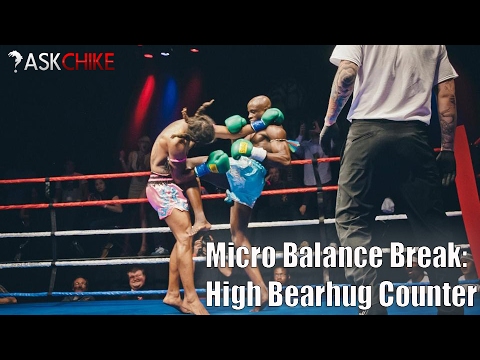
Since you can't create distance with your hips against a high bear hug, use your hand to get to the side and create space there. Swim your hand underneath their arm, come over the top, wrap over their shoulder, and position yourself to shoot a knee or elbow strike. Ask Chike emphasizes that hand position is important—cuff on the back of their shoulder and lift with your shoulder and elbow, not by pulling way up high.
Against a low bear hug at the waist, create space by getting your hips away and back from your opponent. Against a high bear hug, this hip escape won't work as well, so instead create distance to the side using your hands to set up your counter-attack.
The Bear Hug family covers clinch positions where the attacker wraps both arms around the opponent's torso and squeezes, using the encircling grip to compress and control the opponent's body. Bear hugs are distinguished from body locks by the emphasis on squeezing force rather than locked grip mechanics — the bear hug uses muscular compression to restrict the opponent's breathing, mobility, and defensive options.
The bear hug is one of the oldest and most instinctive grappling positions, appearing in wrestling traditions worldwide since antiquity. In professional wrestling and catch wrestling, the bear hug was traditionally used as a submission hold through compressive force on the torso.
Unified MMA: legal — Legal — clinching is integral to MMA; IJF: legal — Legal — kumi-kata (grip fighting) is fundamental to judo; IBJJF: legal — Legal — standing grip fighting and clinch work permitted; IFMA: legal — Legal — the clinch is a core element of Muay Thai, clinch dominance is highly…; WBC/Boxing: restricted — Holding is technically a foul — referee breaks clinch, excessive holding resu…; K: restricted — 1/GLORY — One attack from clinch allowed, then referee breaks; WAKO: restricted — Clinch generally broken by referee — limited or no clinch fighting in most fo…; UWW: legal — Legal — clinch is fundamental to wrestling, the primary position in Greco-Roman
Danger rating 4/10. Moderate — body clinch positions enable throws and takedowns; rib compression risk
The standard setup chain: Close Distance → Establish Primary Grip → Position the Hips → Apply Pressure.
Standard counters include: Pummeling — fight for inside position by swimming arms under opponent's grips / Frame and Push — create distance using forearm frames against the chest or neck / Grip Break — systematically strip the opponent's controlling grips / Posture Up — straighten the spine and drive the hips forward to break clinch control.
Common variants: Front body lock (locked hands around the torso face-to-face); Rear body lock (hands locked around the torso from behind); Side body lock (angled body lock for trips and throws); Over-arms body lock (locking over both arms to pin the opponent's arms to thei…).
Alexander Karelin built his legendary Greco-Roman wrestling career (3x Olympic gold 1988–1996, 1x silver 2000, 9x World Champion) largely on his ability to secure the over-arms bear hug and execute his signature reverse body lift from the position. Karelin's reverse lift from the bear hug became the most feared single technique in Greco-Roman wrestling history.
Top errors to watch for: Squeezing the bear hug as the primary attack — the squeeze tires you faster than it hurts the opponent; use it to set… / Locking hands too high on the back — grip at waist level for maximum throwing leverage / Leaving space between your chest and the opponent — press tight to prevent them from creating frames / Not attacking immediately after securing the bear hug — the longer you hold, the more likely they escape.
The Bear Hug is also known as Bea Hagu, Bear Hug Clinch, Body Squeeze, Torso Wrap.