Strike & defenceLocksClose rangeFighting multiple people
Distance
CloseMiddleLong
Body target
Upper bodyMiddle bodyLower body
Overview
The Standard Under-Arms Bear Hug positions the attacker's arms beneath the opponent's armpits, wrapping around the lower torso with hands locked behind the opponent's back. [1] The attacker presses their head into the opponent's chest or sternum while maintaining a tight grip, using the low centre of control to initiate lifts and takedowns. [1],[2] This position is commonly achieved after a level change or when securing double underhooks and tightening to a body lock. [2],[3]
Also known as
Basic Under-Arms Bear Hug[1]Classic Torso Squeeze[2]Standard Under-Arm Body Clinch[3]
The standard under-arms bear hug has been a core wrestling and grappling position across all styles, occurring naturally when fighters secure double underhooks and close the distance into a tight body grip. [1] It remains one of the most commonly taught clinch positions in wrestling and MMA programmes. [2],[3]
Country of origin· shown in random order
🇬🇷GreeceWrestling, Greco-Roman Wrestling
🇺🇸USAWrestling, MMA
🇫🇷FranceGreco-Roman Wrestling
🇧🇷BrazilMMA
🇷🇺RussiaSambo
🇯🇵JapanJudo
Effectiveness
The under-arms bear hug wraps beneath the opponent's arms, leaving the opponent's arms free but securing torso control at the midsection or waist level. [1] Petrov describes it as less controlling than the over-arms version but easier to achieve against a resisting opponent, since it does not require trapping the arms. [1] It is the more common bear hug variant in MMA, where it frequently serves as a platform for trips and drives. [2]
Lineage
Taught in Greco-Roman and freestyle wrestling from youth through senior competition. [1]
Competition Record
The under-arms bear hug is a powerful clinch grip used in Greco-Roman wrestling and MMA to execute lifts and slams. [1] In MMA, fighters like Fedor Emelianenko and Brock Lesnar used bear hug lifts to devastating effect in PRIDE and UFC competition. [2]
Images
No images yet for this technique.
Sign in to suggest an image.
Biomechanical Mechanism
Primary Action — Establishing body-to-body connection through underhooks, overhooks, or collar ties to control the opponent's movement
Joints Involved — Attacker's shoulders (driving position), hips (base and drive), opponent's upper body (restricted)
Force Vector — Forward pressure and angular positioning — inside position (underhooks) creates offensive advantage
Control Mechanic — Chest-to-chest pressure combined with inside ties limits the opponent's ability to create distance or attack
Position & Entry
From clinch range — Swim the arm under the opponent's arm to secure the underhook, drive the shoulder into their chest for inside position
From hand fighting — During grip exchanges, drop the arm and swim inside to win the underhook battle
Variants
Single underhook — one arm inside for angle and control
Double underhooks — both arms inside for maximum inside position
Underhook with collar tie — combining the underhook with head control
Standard Under-Arms Bear Hug·Kaze Uta Budo Kai / Windsong Dojo
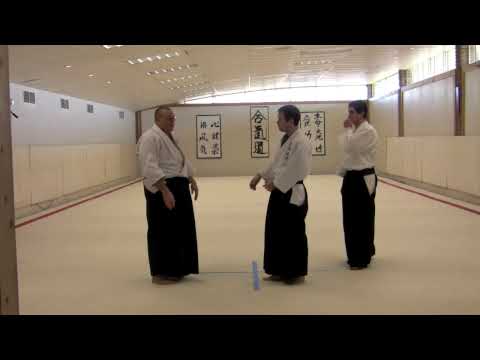
Nick Lowry demonstrates Tomiki aikido principles for facing multipe attackers
1 / 2
3 videos
What Instructors Say
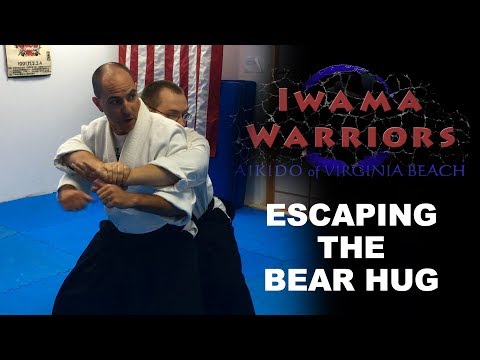
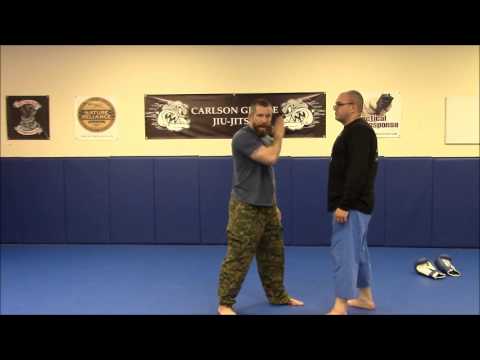
The standard under-arms bear hug is a rear clinch where an attacker wraps their arms around the defender's torso from behind with arms underneath the defender's arms, pinning them close to the body. Instructors agree on fundamental defensive mechanics: the defender should immediately drop their center of gravity to destabilize the attacker and create separation. Iwama Warriors Aikido demonstrates aikido-specific responses, showing how dropping the center, raising up with elbows, and executing a hip/gut check allows transition into joint locks such as Ikyo (first technique) or Sankyo (third technique), which can be followed by pins or throws depending on environmental threat assessment. The instructor emphasizes maintaining situational awareness and using the attacker as a human shield if multiple attackers are present. Valhalla Academy approaches the body lock clinch from a defensive tactics perspective, focusing on the initial threat prevention phase—dropping level, closing distance, and establishing tight hip contact to neutralize striking range and prepare for takedowns. Kaze Uta Budo Kai addresses bear hugs within multiple-attacker randori, stressing the importance of establishing momentary control (particularly through releases 5, 7, and 8) to guide the attacker's body and avoid being locked into a single engagement while remaining aware of subsequent threats. All three instructors converge on the criticality of immediate level drop and maintaining control pressure, though their follow-up applications diverge based on their respective martial arts traditions.
Synthesized from 3 instructors
Iwama Warriors Aikido VA Beach — How to do Aikido - Escaping a Bear Hug #takingaikidoback: Demonstrates rear bear hug escape mechanics using center-drop and gut-check, showing transition into Ikyo and Sankyo joint locks with follow-up pins or throws; emphasizes situational awareness and using attacker as human shield in multi-attacker scenarios.
Valhalla Academy — Defensive Tactics - Body Lock Clinch: Frames body lock clinch as defensive tactic for threat prevention and distance closure; emphasizes dropping level to get under opponent, maintaining hip contact, and positioning for takedown; covers both pre-strike and mid-strike (under punch) scenarios.
Kaze Uta Budo Kai / Windsong Dojo — Aikido: Multiple Attack Randori: Addresses bear hug within multiple-attacker context; emphasizes establishing momentary control through releases to guide attacker's body, prevent being locked into single engagement, and maintain awareness of next threat while continuing to face incoming attackers.
Learn This Technique
No instructional courses yet for this technique.
Sign in to suggest a course.
Ratings
Danger Rating
Risk of injury to the person this technique is applied to
4
Moderate4/10
Body clinch positions enable throws and takedowns; rib compression risk
Difficulty
Skill level needed to execute this technique reliably
Intermediate
Competition Legality
Whether this technique is allowed under major competition rule sets
Restricted
WBC/Boxing — Holding is technically a foul — referee breaks clinch, excessive holding results in point deduction {src— WBC Rules of Boxing}
K-1/GLORY — One attack from clinch allowed, then referee breaks {src— K-1/GLORY Kickboxing Rules}
— WAKO — Clinch generally broken by referee — limited or no...
1Close Distance — bridge the gap using footwork, strikes, or a level change
2Establish Primary Grip — secure the initial controlling grip on the opponent
3Position the Hips — align hips to maximize leverage and control angle
4Apply Pressure — use the grip to control posture and create offensive opportunities
Sources & References
Primary Source
Freestyle Wrestling: A Complete Guide for Coaches and Wrestlers (Petrov, 1977)
1BookMuay Thai: The Art of Fighting (Kraitus, 2002)
Alias sources — [1] Greco-Roman Wrestling (Petrov, 1987) [2] Wrestling Physical Conditioning Encyclopedia (Welker, 2010) [3] UWW Technical Terminology (UWW, 2018)
2BookFreestyle Wrestling (Petrov, 1977)
Effectiveness sources — [1] Greco-Roman Wrestling (Petrov, 1987) [2] Clinch Fighting for MMA (Couture, 2011)
3OtherJapanese Combat Sports Katakana Convention
Standard katakana transliteration of Western martial arts terminology (外来語) — used in Japanese MMA, boxing, and BJJ communities
4CitationMuay Thai: The Art of Fighting (Kraitus, 2002)
Alias sources — [1] Greco-Roman Wrestling (Petrov, 1987) [2] Wrestling Physical Conditioning Encyclopedia (Welker, 2010) [3] UWW Technical Terminology (UWW, 2018)
5CitationFreestyle Wrestling (Petrov, 1977)
Effectiveness sources — [1] Greco-Roman Wrestling (Petrov, 1987) [2] Clinch Fighting for MMA (Couture, 2011)
Community
Athletics
Requires
swimming speed for inside position, shoulder drive, hip pressure
Favours
strong shoulders and low centre of gravity
Key muscles
deltoids, pectorals, core, quadriceps
Frequently Asked Questions
How do I escape from someone squeezing me in a bear hug?
Drop your center to get off-balance, then raise your center with your hands and elbows to create space. You can also kick back with your hips or drop your center and work to get underneath the grip.
What's the key to controlling someone with a body lock or bear hug?
According to Valhalla Academy, eliminate space between you and your opponent, wrap your legs around theirs to prevent knee strikes, and crunch in on their lower back for control.
Should I turn away from my opponent after breaking a bear hug in a multiple-attacker scenario?
No—Kaze Uta Budo Kai emphasizes that you should continue facing your opponent if at all possible, since turning away from incoming attackers can get you into trouble.
How does the Standard Under-Arms Bear Hug work?
The Standard Under-Arms Bear Hug positions the attacker's arms beneath the opponent's armpits, wrapping around the lower torso with hands locked behind the opponent's back. The attacker presses their head into the opponent's chest or sternum while maintaining a tight grip, using the low centre of control to initiate lifts and takedowns.
Where does the Standard Under-Arms Bear Hug come from?
The standard under-arms bear hug has been a core wrestling and grappling position across all styles, occurring naturally when fighters secure double underhooks and close the distance into a tight body grip. It remains one of the most commonly taught clinch positions in wrestling and MMA programmes.
Is the Standard Under-Arms Bear Hug legal in competition?
Unified MMA: legal — Legal — clinching is integral to MMA; IJF: legal — Legal — kumi-kata (grip fighting) is fundamental to judo; IBJJF: legal — Legal — standing grip fighting and clinch work permitted; IFMA: legal — Legal — the clinch is a core element of Muay Thai, clinch dominance is highly…; WBC/Boxing: restricted — Holding is technically a foul — referee breaks clinch, excessive holding resu…; K: restricted — 1/GLORY — One attack from clinch allowed, then referee breaks; WAKO: restricted — Clinch generally broken by referee — limited or no clinch fighting in most fo…; UWW: legal — Legal — clinch is fundamental to wrestling, the primary position in Greco-Roman
How dangerous is the Standard Under-Arms Bear Hug?
Danger rating 4/10. Moderate — body clinch positions enable throws and takedowns; rib compression risk
How do I set up the Standard Under-Arms Bear Hug?
The standard setup chain: Close Distance → Establish Primary Grip → Position the Hips → Apply Pressure.
How do I defend against the Standard Under-Arms Bear Hug?
Standard counters include: Pummeling — fight for inside position by swimming arms under opponent's grips / Frame and Push — create distance using forearm frames against the chest or neck / Grip Break — systematically strip the opponent's controlling grips / Posture Up — straighten the spine and drive the hips forward to break clinch control.
What are the variants of the Standard Under-Arms Bear Hug?
Common variants: Single underhook (one arm inside for angle and control); Double underhooks (both arms inside for maximum inside position); Underhook with collar tie (combining the underhook with head control).
How effective is the Standard Under-Arms Bear Hug in competition?
The under-arms bear hug is a powerful clinch grip used in Greco-Roman wrestling and MMA to execute lifts and slams. In MMA, fighters like Fedor Emelianenko and Brock Lesnar used bear hug lifts to devastating effect in PRIDE and UFC competition.
What are common mistakes when doing the Standard Under-Arms Bear Hug?
Top errors to watch for: Locking hands above the waist — the grip must be at or below the hip bones / Not using the legs for power — the under-arms bear hug throw is leg-driven, not arm-driven / Allowing the opponent to establish frames before you attack — attack before they can set defensive posts / Squeezing the lock and standing still — the lock is the setup, the throw is the payoff.
What are other names for the Standard Under-Arms Bear Hug?
The Standard Under-Arms Bear Hug is also known as Sutandādo Andā Āmuzu Bea Hagu, Basic Under-Arms Bear Hug, Classic Torso Squeeze, Standard Under-Arm Body Clinch.