Strike & defenceLocksClose rangeFighting multiple people
Distance
CloseMiddleLong
Body target
Upper bodyMiddle bodyLower body
Overview
The Standard Over-Arms Bear Hug positions the attacker's arms over and around the opponent's arms and torso, locking the hands behind the opponent's back while squeezing the opponent's arms tight against their body. [1] The grip is secured with a Gable grip, S-grip, or butterfly grip behind the opponent's back, and the attacker maintains chest-to-chest contact with hips low. [1],[2] From this position, the attacker can execute lifts by driving the hips under the opponent, lateral throws by twisting, or takedowns by tripping while maintaining the squeeze. [2],[3]
Also known as
Basic Over-Arms Bear Hug[1]Classic Arms-Pinned Squeeze[2]Standard Over-Arm Body Clinch[3]
The standard over-arms bear hug is a foundational technique in Greco-Roman wrestling and has been taught as a basic clinch control position for over a century. [1] Its effectiveness in immobilising the opponent's arms makes it one of the most direct pathways to throwing or lifting attacks. [2],[3]
Country of origin· shown in random order
🇬🇷GreeceWrestling, Greco-Roman Wrestling
🇺🇸USAWrestling, MMA
🇫🇷FranceGreco-Roman Wrestling
🇧🇷BrazilMMA
🇷🇺RussiaSambo
🇯🇵JapanSumo
Effectiveness
The over-arms bear hug pins the opponent's arms to their body, eliminating their ability to post, frame, or grip fight, making it one of the most controlling clinch positions available. [1] Petrov notes that in Greco-Roman wrestling, the over-arms bear hug is the preferred position for the gut wrench and suplex because it provides maximum control of the opponent's upper body. [1]
Lineage
A fundamental Greco-Roman technique taught at all levels. [1]
Competition Record
Alexander Karelin's reverse body lift — executed from the over-arms bear hug — became the defining technique of his career. [1] He used this position to score five-point throws against the best Greco-Roman wrestlers in the world, compiling a career record of 887 wins to 2 losses. [1]
Images
No images yet for this technique.
Sign in to suggest an image.
Biomechanical Mechanism
Primary Action — Establishing a controlling connection with the opponent at close range
Joints Involved — Upper body contact points — head, arms, and torso used for control and balance disruption
Force Vector — Varies by clinch type — downward (collar tie), lateral (arm drags), or forward (chest pressure)
Control Mechanic — Inside position and head control are the dominant factors in clinch superiority
Position & Entry
From close range — Secure both arms around the opponent's torso (over arms or under arms), clasp hands and squeeze
From clinch transition — Close the distance and wrap both arms around the body from front, side, or rear
Variants
Standard variation — primary clinch configuration from the most common entry
Gi variation — adapted with collar and sleeve grips for gi-based grappling
No-gi / MMA variation — modified for no-gi or cage fighting conditions
Offensive variation — configured to set up strikes, takedowns, or submissions from the clinch
The body lock clinch is a great way to nullify an opponent's striking and get inside for control or a takedown. This tec…
1 / 2
3 videos
What Instructors Say
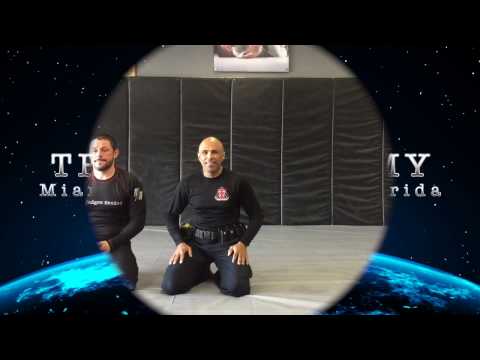
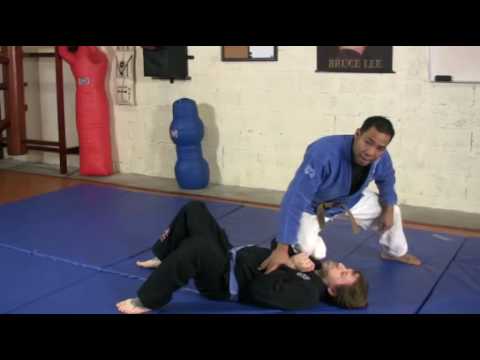
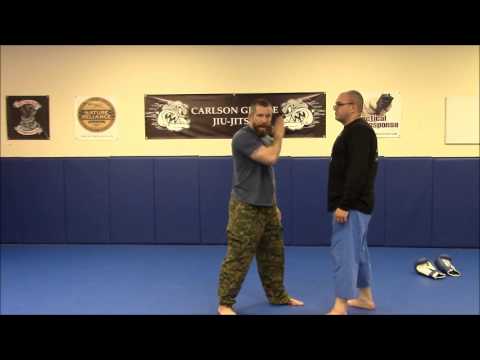
The standard over-arms bear hug is a clinching technique where an opponent wraps their arms around the defender's torso with their hands locked behind the defender's back. According to Trillo Jiujitsu Academy, the primary defensive response involves immediately dropping the base and inserting the hands inside the opponent's grip at the waist to prevent further compression. The defender then shifts weight to one side, extends a leg across the opponent's body, and sits through to initiate a takedown. From the top position, the defender secures a seatbelt grip (one arm around the opponent's torso, the other controlling the neck/head area) and progresses to knee-on-belly control, ultimately positioning themselves to apply restraint or handcuffs. Valhalla Academy emphasizes the offensive mechanics of establishing a body lock clinch by dropping level, placing the chest against the opponent's chest, and generating inward squeeze pressure on the lower back while keeping hips tight—this creates a position of safety from strikes and readiness for takedowns. Both instructors stress that maintaining chest-to-back contact and preventing the opponent from creating distance is essential for control. Leo Sanchez's material on body immobilization supports the trapping concept central to the technique, demonstrating how immobilizing the opponent's body limits their mobility and creates vulnerability for transitions to dominant positions or submissions.
Synthesized from 3 instructors
Trillo Jiujitsu Academy — Police Self Defense Tip of the Week. Front Bear Hug Over Your Arms: Detailed step-by-step defensive response to over-arms bear hug: inserting hands at waist, shifting to side, leg extension across body, seatbelt grip progression, and transition to restraint control. Context provided through law enforcement/SWAT defensive tactics application.
Valhalla Academy — Defensive Tactics - Body Lock Clinch: Explained offensive mechanics of establishing a tight body lock clinch, including level drop, chest-to-chest contact, hip positioning, and inward pressure on lower back. Emphasized maintaining zero distance and using lower base positioning for balance disruption.
Leo Sanchez — Ground HBL- Hand, Leg, Body Immobilization Attack: Contextualized body immobilization principle underlying the bear hug control—demonstrating how trapping and immobilizing the opponent's body limits mobility and creates vulnerability for transitions, submissions, and position advancement.
Learn This Technique
No instructional courses yet for this technique.
Sign in to suggest a course.
Ratings
Danger Rating
Risk of injury to the person this technique is applied to
4
Moderate4/10
Body clinch positions enable throws and takedowns; rib compression risk
Difficulty
Skill level needed to execute this technique reliably
Intermediate
Competition Legality
Whether this technique is allowed under major competition rule sets
Restricted
WBC/Boxing — Holding is technically a foul — referee breaks clinch, excessive holding results in point deduction {src— WBC Rules of Boxing}
K-1/GLORY — One attack from clinch allowed, then referee breaks {src— K-1/GLORY Kickboxing Rules}
— WAKO — Clinch generally broken by referee — limited or no...
1Close Distance — bridge the gap using footwork, strikes, or a level change
2Establish Primary Grip — secure the initial controlling grip on the opponent
3Position the Hips — align hips to maximize leverage and control angle
4Apply Pressure — use the grip to control posture and create offensive opportunities
Sources & References
Primary Source
Freestyle Wrestling: A Complete Guide for Coaches and Wrestlers (Petrov, 1977)
1BookMuay Thai: The Art of Fighting (Kraitus, 2002)
Alias sources — [1] Greco-Roman Wrestling (Petrov, 1987) [2] Wrestling Physical Conditioning Encyclopedia (Welker, 2010) [3] UWW Technical Terminology (UWW, 2018)
2BookFreestyle Wrestling (Petrov, 1977)
Effectiveness sources — [1] Greco-Roman Wrestling (Petrov, 1987)
3OtherJapanese Combat Sports Katakana Convention
Standard katakana transliteration of Western martial arts terminology (外来語) — used in Japanese MMA, boxing, and BJJ communities
4CitationMuay Thai: The Art of Fighting (Kraitus, 2002)
Alias sources — [1] Greco-Roman Wrestling (Petrov, 1987) [2] Wrestling Physical Conditioning Encyclopedia (Welker, 2010) [3] UWW Technical Terminology (UWW, 2018)
5CitationFreestyle Wrestling (Petrov, 1977)
Effectiveness sources — [1] Greco-Roman Wrestling (Petrov, 1987)
Community
Athletics
Requires
grip strength, upper body endurance, balance under pressure
Favours
strong arms and shoulders, stable base
Key muscles
forearms, deltoids, core, hip muscles
Frequently Asked Questions
How do I prevent the person from escaping when I have them in a bear hug?
The key is to eliminate space between you and your opponent. Wrap your legs around their legs so they can't take a knee, and crunch in on their lower back to maintain control (Valhalla Academy).
Should I drop my level when going for the bear hug, and what difference does it make?
Yes, dropping your level is important because it gives you better positioning and feedback. If you don't drop your level sufficiently, you'll end up on the inside of their arms; dropping low gets you more behind the person, which is a stronger control position (Valhalla Academy).
What should I do if my opponent is constantly trying to punch while I'm attempting the bear hug?
When you drop your level and commit to the technique, their arm will typically go over your head rather than land effectively, allowing you to move into position without taking significant strikes (Valhalla Academy).
How does the Standard Over-Arms Bear Hug work?
The Standard Over-Arms Bear Hug positions the attacker's arms over and around the opponent's arms and torso, locking the hands behind the opponent's back while squeezing the opponent's arms tight against their body. The grip is secured with a Gable grip, S-grip, or butterfly grip behind the opponent's back, and the attacker maintains chest-to-chest contact with hips low.
Where does the Standard Over-Arms Bear Hug come from?
The standard over-arms bear hug is a foundational technique in Greco-Roman wrestling and has been taught as a basic clinch control position for over a century. Its effectiveness in immobilising the opponent's arms makes it one of the most direct pathways to throwing or lifting attacks.
Is the Standard Over-Arms Bear Hug legal in competition?
Unified MMA: legal — Legal — clinching is integral to MMA; IJF: legal — Legal — kumi-kata (grip fighting) is fundamental to judo; IBJJF: legal — Legal — standing grip fighting and clinch work permitted; IFMA: legal — Legal — the clinch is a core element of Muay Thai, clinch dominance is highly…; WBC/Boxing: restricted — Holding is technically a foul — referee breaks clinch, excessive holding resu…; K: restricted — 1/GLORY — One attack from clinch allowed, then referee breaks; WAKO: restricted — Clinch generally broken by referee — limited or no clinch fighting in most fo…; UWW: legal — Legal — clinch is fundamental to wrestling, the primary position in Greco-Roman
How dangerous is the Standard Over-Arms Bear Hug?
Danger rating 4/10. Moderate — body clinch positions enable throws and takedowns; rib compression risk
How do I set up the Standard Over-Arms Bear Hug?
The standard setup chain: Close Distance → Establish Primary Grip → Position the Hips → Apply Pressure.
How do I defend against the Standard Over-Arms Bear Hug?
Standard counters include: Pummeling — fight for inside position by swimming arms under opponent's grips / Frame and Push — create distance using forearm frames against the chest or neck / Grip Break — systematically strip the opponent's controlling grips / Posture Up — straighten the spine and drive the hips forward to break clinch control.
What are the variants of the Standard Over-Arms Bear Hug?
Common variants: Standard variation (primary clinch configuration from the most common entry); Gi variation (adapted with collar and sleeve grips for gi-based grappling); No-gi / MMA variation (modified for no-gi or cage fighting conditions); Offensive variation (configured to set up strikes, takedowns, or submissions f…).
How effective is the Standard Over-Arms Bear Hug in competition?
Alexander Karelin's reverse body lift — executed from the over-arms bear hug — became the defining technique of his career. He used this position to score five-point throws against the best Greco-Roman wrestlers in the world, compiling a career record of 887 wins to 2 losses.
What are common mistakes when doing the Standard Over-Arms Bear Hug?
Top errors to watch for: Wrapping over the arms but not squeezing tight enough — the opponent simply pulls their arms free / Locking hands too high on the back — lock at waist level for throw leverage / Not driving your head to the side — head position adds control and prevents headbutt counters / Standing upright — bend the knees and maintain a strong, low base.
What are other names for the Standard Over-Arms Bear Hug?
The Standard Over-Arms Bear Hug is also known as Sutandādo Ōbā Āmuzu Bea Hagu, Basic Over-Arms Bear Hug, Classic Arms-Pinned Squeeze, Standard Over-Arm Body Clinch.