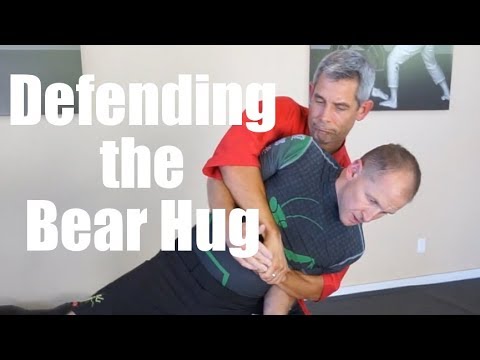
Defending against the Bear Hug- PASS vs FAIL Tips
0
Over-Arms Bear Hug·Randy Brown
Jumped from behind? Your opponent got position on you? No matter how it happened, it's a bad place to be. Join me, and m…
Translation: over-arms bear hug
The Over-Arms Bear Hug subfamily covers bear hug positions where the attacker's arms encircle the opponent's torso over the top of the opponent's arms, pinning both arms against the body. [1] This is the most controlling variant of the bear hug because it simultaneously immobilises both of the opponent's arms, eliminating their ability to frame, grip fight, or execute defensive techniques. [1],[2] The over-arms bear hug is a dominant position used for initiating lifts, throws, and slams in wrestling and MMA. [2],[3]
The over-arms bear hug pins both of the opponent's arms to their sides, eliminating their ability to strike, grip, or defend against throws and takedowns. [1]
The over-arms bear hug is a core Greco-Roman wrestling technique, used to set up suplex throws and lifts. [1]
Over-arms bear hug throws are a primary scoring technique in Greco-Roman wrestling at Olympic and World Championship level. [1]
No images yet for this technique.
Sign in to suggest an image.
Jumped from behind? Your opponent got position on you? No matter how it happened, it's a bad place to be. Join me, and m…
No instructional courses yet for this technique.
Sign in to suggest a course.
Risk of injury to the person this technique is applied to
Body clinch positions enable throws and takedowns; rib compression risk
Skill level needed to execute this technique reliably
Whether this technique is allowed under major competition rule sets
Freestyle Wrestling: A Complete Guide for Coaches and Wrestlers (Petrov, 1977)
Alias sources — [1] Wrestling Physical Conditioning Encyclopedia (Welker, 2010) [2] Greco-Roman Wrestling (Petrov, 1987) [3] Clinch Fighting for MMA (Couture, 2011)
Effectiveness sources — [1] Wrestling Physical Conditioning Encyclopedia (Petrov, 1977)
Standard katakana transliteration of Western martial arts terminology (外来語) — used in Japanese MMA, boxing, and BJJ communities
Alias sources — [1] Wrestling Physical Conditioning Encyclopedia (Welker, 2010) [2] Greco-Roman Wrestling (Petrov, 1987) [3] Clinch Fighting for MMA (Couture, 2011)
Effectiveness sources — [1] Wrestling Physical Conditioning Encyclopedia (Petrov, 1977)
grip strength, upper body endurance, balance under pressure
strong arms and shoulders, stable base
forearms, deltoids, core, hip muscles
Every move, in any martial art, shares a few universal traits. Mix and match below to pinpoint the right tool — or compare equivalents across styles.
The over-arms bear hug traps both of the opponent's arms against their body — the most controlling clinch but also the most difficult to maintain. Used primarily in self-defense and Greco-Roman wrestling. (Wrestling manuals; military combatives)
According to Randy Brown, the arm-split escape fails because timing matters—if your opponent has a high grip on your arms, you can slip out, but if they grab you low (which allows them to pick you up), the escape doesn't work at that moment.
Randy Brown emphasizes that you must stomp with your outside foot and move your inside foot inward to maintain your center balance point; stomping with the inside foot causes you to get tossed easily.
Randy Brown explains that after your initial escape doesn't work, you can follow up with strikes like a groin strike or knee strike, or use a jujitsu-style positional technique once you've broken your opponent's posture.
The Over-Arms Bear Hug subfamily covers bear hug positions where the attacker's arms encircle the opponent's torso over the top of the opponent's arms, pinning both arms against the body. This is the most controlling variant of the bear hug because it simultaneously immobilises both of the opponent's arms, eliminating their ability to frame, grip fight, or execute defensive techniques.
The over-arms bear hug has been a fundamental wrestling technique since ancient times, valued for its ability to completely immobilise the opponent's upper body. It features prominently in Greco-Roman wrestling where upper-body clinch dominance is the primary pathway to scoring.
Unified MMA: legal — Legal — clinching is integral to MMA; IJF: legal — Legal — kumi-kata (grip fighting) is fundamental to judo; IBJJF: legal — Legal — standing grip fighting and clinch work permitted; IFMA: legal — Legal — the clinch is a core element of Muay Thai, clinch dominance is highly…; WBC/Boxing: restricted — Holding is technically a foul — referee breaks clinch, excessive holding resu…; K: restricted — 1/GLORY — One attack from clinch allowed, then referee breaks; WAKO: restricted — Clinch generally broken by referee — limited or no clinch fighting in most fo…; UWW: legal — Legal — clinch is fundamental to wrestling, the primary position in Greco-Roman
Danger rating 4/10. Moderate — body clinch positions enable throws and takedowns; rib compression risk
The standard setup chain: Close Distance → Establish Primary Grip → Position the Hips → Apply Pressure.
Standard counters include: Pummeling — fight for inside position by swimming arms under opponent's grips / Frame and Push — create distance using forearm frames against the chest or neck / Grip Break — systematically strip the opponent's controlling grips / Posture Up — straighten the spine and drive the hips forward to break clinch control.
Common variants: Standard variation (primary clinch configuration from the most common entry); Gi variation (adapted with collar and sleeve grips for gi-based grappling); No-gi / MMA variation (modified for no-gi or cage fighting conditions); Offensive variation (configured to set up strikes, takedowns, or submissions f…).
Over-arms bear hug throws are a primary scoring technique in Greco-Roman wrestling at Olympic and World Championship level.
Top errors to watch for: Locking above the opponent's elbows but not squeezing enough to trap the arms — they swim free / Not pressing chest-to-chest — space allows the opponent to wriggle their arms out / Attempting throws without the hip pop — squeezing and pulling alone won't throw anyone / Standing with narrow feet — maintain a wide base for stability and throwing power.
The Over-Arms Bear Hug is also known as Ōbā Āmuzu Bea Hagu, Over-Arms Body Squeeze, Arms-Pinned Bear Hug, Arm-Trapping Bear Hug.