Sword vs. Polearm - Can You Just CUT it Off?
0
Polearm·Skallagrim
Get Surfshark VPN at https://Surfshark.deals/skall - Enter promo code SKALL for 85% off and 3 extra months for free! T…
Перевод: polearm
The Polearm group encompasses all fighting techniques using long-shafted weapons — typically ranging from five to twelve feet in length — that combine reach advantage with the leverage provided by a long handle to deliver cuts, thrusts, sweeps, and hooking actions. [1] Polearms were the dominant battlefield weapons of virtually every pre-gunpowder civilisation because their superior reach allowed formations of soldiers to engage enemies before shorter weapons could close distance. [1],[2] This group covers the Japanese naginata (curved-blade polearm), sojutsu (spear arts), and European HEMA halberd and pollaxe techniques, representing both Eastern and Western polearm traditions. [2],[3] Polearm combat differs fundamentally from shorter weapon fighting because the long shaft enables lever-based mechanics — the practitioner uses the entire length of the weapon for deflections, sweeps, and strikes, with different grip positions dramatically changing the range and power of each action. [3],[4]
Polearm combat is documented in the oldest military traditions worldwide: Chinese spear (qiang) technique is recorded from the Shang Dynasty (1600-1046 BCE), Greek hoplite spear combat defined classical warfare, and the Japanese yari and naginata became core battlefield weapons by the Kamakura period (1185-1333). [1] European polearm fighting was extensively documented in medieval fight books, with masters such as Fiore dei Liberi (1409) and Hans Talhoffer (1467) devoting substantial sections to pollaxe combat. [2],[3] Modern polearm arts survive as competitive sports (naginata, sojutsu, HEMA tournaments), cultural preservation practices (koryu bujutsu), and academic reconstruction (HEMA). [3],[4]
Polearms (spears, halberds, naginata, guandao) provide the greatest reach of any melee weapon, making them dominant battlefield weapons throughout history. [1]
Polearm competition exists in naginata (International Naginata Federation), HEMA halberd/pollaxe, and Chinese wushu spear (gun-shu) events. [1]
Изображений для этой техники пока нет.
Войдите, чтобы предложить изображение.
Get Surfshark VPN at https://Surfshark.deals/skall - Enter promo code SKALL for 85% off and 3 extra months for free! T…
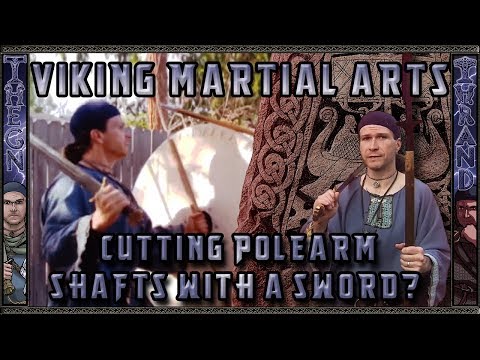
This is old video review of Antony Cummins book The Illustrated Guide to Viking Martial Arts sound was corrupted for yea…
Учебных курсов по этой технике пока нет.
Войдите, чтобы предложить курс.
Риск травмы для человека, к которому применяется техника
Spears, halberds, and naginata; maximum reach with lethal cutting/thrusting capability
Уровень мастерства, необходимый для надёжного выполнения техники
Разрешена ли техника по основным соревновательным правилам
Bubishi: The Classic Manual of Combat (Patrick McCarthy, 2008)
Alias sources — [1] MMA Instruction Manual (UFC, 2008) [2] MMA Instruction Manual (UFC, 2008) [3] MMA Instruction Manual (UFC, 2008)
Effectiveness sources — [1] Comprehensive Asian Fighting Arts (Draeger & Smith, 1969)
Established Japanese martial arts naming convention — native Japanese term (和語/漢語)
Alias sources — [1] MMA Instruction Manual (UFC, 2008) [2] MMA Instruction Manual (UFC, 2008) [3] MMA Instruction Manual (UFC, 2008)
Effectiveness sources — [1] Comprehensive Asian Fighting Arts (Draeger & Smith, 1969)
two-handed coordination, hip rotation for power, distance management
tall reach, strong shoulders for extended weapon handling
shoulders, core rotators, forearms, quadriceps
Каждое движение в любом боевом искусстве обладает рядом универсальных свойств. Комбинируйте параметры ниже, чтобы найти нужный инструмент или сравнить аналоги из разных стилей.
The Halberd-Pollaxe (HEMA) family covers the fighting techniques of European hafted polearms — the pollaxe (a long-handled weapon combining an axe head, hammer, and spike) and the halberd (combining an axe blade, hook, and spike on a longer shaft) — as reconstructed through Historical European Martial Arts research. [1] The pollaxe was the premier weapon of armoured foot combat (Kampf zu Fuss) in late medieval Europe, used extensively in judicial duels, tournaments, and battlefield engagements by fully armoured knights who could not be effectively engaged with swords. [1,2] Pollaxe technique emphasises half-staffing (gripping the weapon at the middle and using both ends offensively), hooking and tripping the opponent, and delivering percussive strikes to vulnerable joints in armour. [2,3]
The Naginata family covers fighting techniques using the naginata — a Japanese polearm consisting of a curved, single-edged blade mounted on a long wooden shaft, typically measuring five to seven feet in total length. [1] The naginata is unique among polearms for its curved cutting blade, which allows sweeping, slashing cuts in addition to thrusts, making it one of the most versatile polearms in any martial tradition. [1,2] Naginata arts include koryu (classical) systems such as Tendo-ryu and Jikishinkage-ryu, and the modern competitive art of atarashii naginata governed by the All Japan Naginata Federation, which features armoured sparring similar to kendo. [2,3] Naginata practice has a strong association with women's martial arts in Japan, as it was traditionally taught to women of the samurai class for home defence. [3]
The Sojutsu (Spear) family covers Japanese spear fighting techniques using the yari, a straight-bladed spear that became the dominant battlefield weapon of the Sengoku period (1467-1615), surpassing the sword and naginata in military importance. [1] Sojutsu emphasises the thrust as the primary attack, exploiting the spear's superior reach and the penetrating power of the straight blade, but also includes sweeping, deflecting, and striking techniques using the shaft. [1,2] The yari comes in numerous blade configurations — su-yari (straight blade), jumonji-yari (cross-shaped blade), and kata-kama-yari (single-hooked blade) — each offering different tactical possibilities. [2,3] Sojutsu is preserved in several koryu bujutsu schools including Hozoin-ryu (founded at Hozoin temple in Nara) and Saburi-ryu, and remains one of the most revered classical Japanese weapon arts. [3]
Polearm techniques cover long-handled weapons — naginata (207 passages/30 books), halberd (181/36), spear, and staff. Polearms were the primary infantry weapons of most historical armies — they provided reach advantage that swords could not match. (36+ books; Draeger, Classical Budo; Clements, Medieval Swordsmanship)
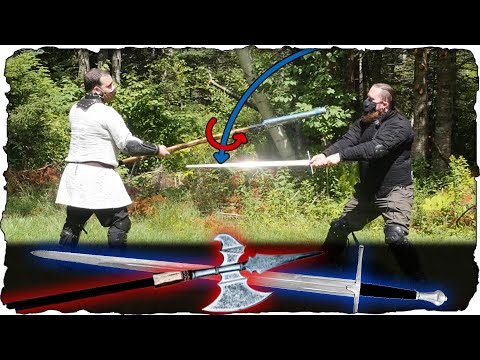
No, a properly made polearm will not be cut through in a single blow. Skallagrim notes that if polearms could be easily destroyed this way, they would never have been used historically. A cut won't simply go through and hit the opponent behind it—that's movie nonsense.
The polearm user can deflect the sword by dipping the shaft under incoming attacks, a common defensive technique also seen in quarterstaff. Additionally, deflecting the flat of the sword blade is generally the best defense strategy against a sword user.
To attempt a cut on the shaft, the sword user must create an opening and close distance significantly, during which the polearm user can thrust directly at them. ThegnThrand explains that a polearm user would have time to attack the sword user's face or body before they could successfully cut the shaft.
Yes, repeated blade-to-blade contact with a polearm can accumulate damage over time, though it won't break in a single strike. ThegnThrand observed that continued striking into an axe or polearm head would eventually cause damage, similar to what can happen against a shield with sufficient force.
The Polearm group encompasses all fighting techniques using long-shafted weapons — typically ranging from five to twelve feet in length — that combine reach advantage with the leverage provided by a long handle to deliver cuts, thrusts, sweeps, and hooking actions. Polearms were the dominant battlefield weapons of virtually every pre-gunpowder civilisation because their superior reach allowed formations of soldiers to engage enemies before shorter weapons could close distance.
Polearm combat is documented in the oldest military traditions worldwide: Chinese spear (qiang) technique is recorded from the Shang Dynasty (1600-1046 BCE), Greek hoplite spear combat defined classical warfare, and the Japanese yari and naginata became core battlefield weapons by the Kamakura period (1185-1333). European polearm fighting was extensively documented in medieval fight books, with masters such as Fiore dei Liberi (1409) and Hans Talhoffer (1467) devoting substantial sections to pollaxe combat.
Traditional martial arts: разрешён — Practiced in traditional kata/forms and weapon-specific competition under var…; IWUF: разрешён — Legal in wushu taolu if applicable; HEMA: разрешён — Legal in applicable historical weapon categories
Оценка опасности 9/10. Extreme — spears, halberds, and naginata; maximum reach with lethal cutting/thrusting capability
Стандартная цепочка подготовки: Ready Position → Distance Control → Execute Technique → Return to Guard.
Стандартные контрприёмы: Parry (Absetzen) — deflect the incoming blade with a counter-displacement / Void (Step Back) — withdraw from measure to avoid the cutting arc / Counter-Cut (Nachreisen) — strike into the opponent's opening during their attack.
Распространённые варианты: Standard technique (primary execution from the most common grip and stance); Competition variation (adapted for sport-specific rules and scoring); Traditional variation (classical execution as taught in the traditional art); Combination variation (chained with preceding or following techniques in a flow).
Polearm competition exists in naginata (International Naginata Federation), HEMA halberd/pollaxe, and Chinese wushu spear (gun-shu) events.
Основные ошибки, на которые стоит обратить внимание: Standing too close to the opponent — polearms are designed for distance; closing range negates their advantage / Using only the blade end — the butt end of polearms is used for strikes, sweeps, and blocks / Holding the polearm too close to the head — the hands should be positioned to maximize reach and leverage / Not using the shaft for blocking — the shaft itself is a defensive tool; blocks and deflections use the shaft.
Polearm также известен как Nagae Buki, Polearm Combat, Long-Hafted Weapons, Reach Weapons.