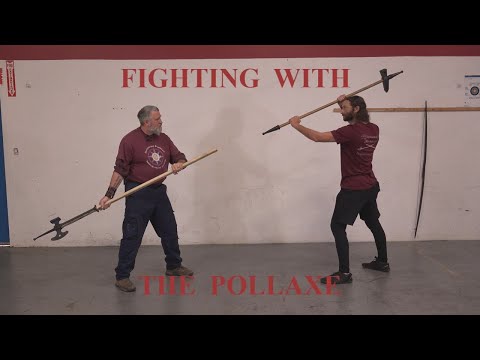
Fighting With the Pollaxe
0
Halberd-Pollaxe — HEMA·swordfightingschool
The pollaxe, or as I like to call it the Medieval Can Opener, is a very versatile weapon that can use either end for sta…
Перевод: halberd-pollaxe — HEMA
The Halberd-Pollaxe (HEMA) family covers the fighting techniques of European hafted polearms — the pollaxe (a long-handled weapon combining an axe head, hammer, and spike) and the halberd (combining an axe blade, hook, and spike on a longer shaft) — as reconstructed through Historical European Martial Arts research. [1] The pollaxe was the premier weapon of armoured foot combat (Kampf zu Fuss) in late medieval Europe, used extensively in judicial duels, tournaments, and battlefield engagements by fully armoured knights who could not be effectively engaged with swords. [1],[2] Pollaxe technique emphasises half-staffing (gripping the weapon at the middle and using both ends offensively), hooking and tripping the opponent, and delivering percussive strikes to vulnerable joints in armour. [2],[3]
Pollaxe combat was one of the most extensively documented weapon arts in medieval European fight books, with detailed instruction in the works of Fiore dei Liberi (Fior di Battaglia, 1409), Hans Talhoffer (1443-1467), and Le Jeu de la Hache (anonymous, c. 1400). [1] Modern reconstruction of these techniques through the HEMA movement has produced competitive pollaxe tournaments and academic study of the medieval texts. [2],[3]
The pollaxe was the preferred weapon for armoured foot combat (pas d'armes and judicial duels) in 15th-century Europe because its combination of axe blade, hammer head, and top spike could deliver devastating blows capable of denting or penetrating plate armour. [1] Fiore dei Liberi devotes a substantial section of Fior di Battaglia to pollaxe combat, demonstrating thrusts, sweeps, disarms, and wrestling techniques specific to this weapon. [2]
Pollaxe combat is documented in multiple European fight books, most importantly Fiore dei Liberi's Fior di Battaglia (1409), Le Jeu de la Hache (anonymous, c. 1400), and the fight books of Hans Talhoffer (1443–1467). [1]
Pollaxe combat is featured at select HEMA tournaments, with techniques reconstructed from 15th-century fighting manuals. [1]
Изображений для этой техники пока нет.
Войдите, чтобы предложить изображение.
The pollaxe, or as I like to call it the Medieval Can Opener, is a very versatile weapon that can use either end for sta…
Учебных курсов по этой технике пока нет.
Войдите, чтобы предложить курс.
Риск травмы для человека, к которому применяется техника
Spears, halberds, and naginata; maximum reach with lethal cutting/thrusting capability
Уровень мастерства, необходимый для надёжного выполнения техники
Разрешена ли техника по основным соревновательным правилам
The Art of Combat (Joachim Meyer, 1570)
Alias sources — [1] MMA Instruction Manual (UFC, 2008) [2] MMA Instruction Manual (UFC, 2008) [3] MMA Instruction Manual (UFC, 2008)
Effectiveness sources — [1] Anglo, S., The Martial Arts of Renaissance Europe (Yale University Press, 2000) [2] Fiore dei Liberi, Fior di Battaglia (1409), Getty MS Ludwig XV 13
Standard katakana transliteration of Western martial arts terminology (外来語) — used in Japanese MMA, boxing, and BJJ communities
Alias sources — [1] MMA Instruction Manual (UFC, 2008) [2] MMA Instruction Manual (UFC, 2008) [3] MMA Instruction Manual (UFC, 2008)
Effectiveness sources — [1] Anglo, S., The Martial Arts of Renaissance Europe (Yale University Press, 2000) [2] Fiore dei Liberi, Fior di Battaglia (1409), Getty MS Ludwig XV 13
wrist control for edge alignment, grip endurance, footwork precision
quick wrists, strong forearms, good posture
forearm extensors/flexors, deltoids, core, calves
Каждое движение в любом боевом искусстве обладает рядом универсальных свойств. Комбинируйте параметры ниже, чтобы найти нужный инструмент или сравнить аналоги из разных стилей.
The halberd/pollaxe appears in 181 passages across 36 books. The pollaxe was the primary weapon for armored foot combat in late medieval Europe — documented extensively in 15th century fight manuals by Fiore dei Liberi and Hans Talhoffer. (36 books; Clements, Medieval Swordsmanship; HEMA texts)
No. Rather than using your leading hand to chop, you pull the cue (rear hand) back to move the axe head forward. This is more like kayaking than traditional axe chopping, allowing you to generate power through proper body mechanics.
Target the joints and armor seams—aim for the clavicle, shoulder lames, or other areas where you can damage tissue or deform armor to slow your opponent's responses. Deformed armor restricts movement and gives you the advantage.
Don't go for a direct head strike because you'll likely get hit in return. Instead, keep your hands in place, step across, and use the cue to snap the axe head into position—this keeps you safer while still controlling the engagement.
Be a 'nice guy'—guide your opponent into the path of your weapon rather than forcing the confrontation. Help them throw their neck under your axe or their face onto your point by reading their movement and responding efficiently.
The Halberd-Pollaxe (HEMA) family covers the fighting techniques of European hafted polearms — the pollaxe (a long-handled weapon combining an axe head, hammer, and spike) and the halberd (combining an axe blade, hook, and spike on a longer shaft) — as reconstructed through Historical European Martial Arts research. The pollaxe was the premier weapon of armoured foot combat (Kampf zu Fuss) in late medieval Europe, used extensively in judicial duels, tournaments, and battlefield engagements by fully armoured knights who could not be effectively engaged with swords.
Pollaxe combat was one of the most extensively documented weapon arts in medieval European fight books, with detailed instruction in the works of Fiore dei Liberi (Fior di Battaglia, 1409), Hans Talhoffer (1443-1467), and Le Jeu de la Hache (anonymous, c. 1400).
Traditional martial arts: разрешён — Practiced in traditional kata/forms and weapon-specific competition under var…; IWUF: разрешён — Legal in wushu taolu if applicable; HEMA: разрешён — Legal in applicable historical weapon categories
Оценка опасности 9/10. Extreme — spears, halberds, and naginata; maximum reach with lethal cutting/thrusting capability
Стандартная цепочка подготовки: Assume Guard (Kamae/Hut) → Measure Distance (Ma-ai) → Initiate Cut/Thrust → Follow Through (Zanshin).
Стандартные контрприёмы: Parry (Absetzen) — deflect the incoming blade with a counter-displacement / Void (Step Back) — withdraw from measure to avoid the cutting arc / Counter-Cut (Nachreisen) — strike into the opponent's opening during their attack.
Распространённые варианты: Standard cut (primary cutting angle from the ready stance); Thrust (tsuki) (straight thrust targeting the throat, chest, or face); Rising cut (kiri-age) (upward diagonal cut from low to high); Diagonal cut (kesa-giri) (downward diagonal cut following the kimono line).
Pollaxe combat is featured at select HEMA tournaments, with techniques reconstructed from 15th-century fighting manuals.
Основные ошибки, на которые стоит обратить внимание: Using the pollaxe like a woodcutter's axe — the fighting pollaxe uses controlled, precise techniques, not logging swings / Ignoring the multiple weapon heads — the pollaxe has a spike, hammer, and blade; using only one wastes the weapon's v… / Standing at sword distance — the pollaxe fights at a closer range than the sword due to its shorter effective length / Not using the butt end — the butt (queue) is a spiked tool used for thrusting and hooking; it is a primary weapon fea….
Halberd-Pollaxe — HEMA также известен как Harubādo / Pōruakkusu, HEMA Pollaxe, European Polearm, Halberd Fighting.