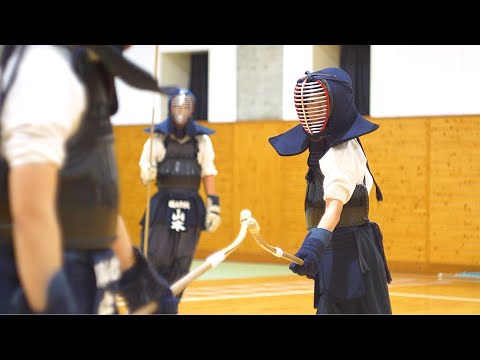
Naginata in Japan
0
Naginata·Q2Japan
Q2 Japan interviews three female martial artists who practice Naginata, here in Okayama. Hear what they have to say and …
Перевод: Mowing Sword
The Naginata family covers fighting techniques using the naginata — a Japanese polearm consisting of a curved, single-edged blade mounted on a long wooden shaft, typically measuring five to seven feet in total length. [1] The naginata is unique among polearms for its curved cutting blade, which allows sweeping, slashing cuts in addition to thrusts, making it one of the most versatile polearms in any martial tradition. [1],[2] Naginata arts include koryu (classical) systems such as Tendo-ryu and Jikishinkage-ryu, and the modern competitive art of atarashii naginata governed by the All Japan Naginata Federation, which features armoured sparring similar to kendo. [2],[3] Naginata practice has a strong association with women's martial arts in Japan, as it was traditionally taught to women of the samurai class for home defence. [3]
The naginata was one of the primary battlefield weapons of the Japanese warrior class from the Heian period (794-1185) through the Kamakura period, used extensively by warrior monks (sohei) and samurai on foot. [1] As the spear (yari) replaced the naginata on the battlefield during the Sengoku period (1467-1615), the naginata became associated with women's martial training — samurai wives were expected to defend the home with the naginata while men were at war. [2],[3] Modern naginata competition under the All Japan Naginata Federation was established in the post-war period and is practiced by approximately 70,000 practitioners in Japan, the majority of whom are women. [3]
The naginata (curved-blade polearm) provides exceptional reach advantage and versatile cutting/thrusting capability, making it one of the most effective battlefield weapons in Japanese martial history. [1] Its combination of blade and shaft allows cuts at extreme range, sweeps to the legs, and butt-end strikes, giving it tactical versatility superior to the sword in open-field combat. [2]
Naginata-jutsu was practised by numerous koryu schools, with Tenshin Shoden Katori Shinto-ryu (c. 1450) including naginata in its curriculum alongside kenjutsu. [1] The Toda-ha Buko-ryu is one of the most important surviving naginata koryu lineages. [2] Modern naginata (atarashii naginata) was standardised as a sport by the All Japan Naginata Federation (AJNF, est. 1955). [3]
Изображений для этой техники пока нет.
Войдите, чтобы предложить изображение.
Q2 Japan interviews three female martial artists who practice Naginata, here in Okayama. Hear what they have to say and …
Учебных курсов по этой технике пока нет.
Войдите, чтобы предложить курс.
Риск травмы для человека, к которому применяется техника
Spears, halberds, and naginata; maximum reach with lethal cutting/thrusting capability
Уровень мастерства, необходимый для надёжного выполнения техники
Разрешена ли техника по основным соревновательным правилам
The Book of Five Rings (Miyamoto Musashi, 1645)
Alias sources — [1] Kodokan Judo (Kano, 1986) [2] Kodokan Judo (Kano, 1986) [3] Kodokan Judo (Kano, 1986)
Effectiveness sources — [1] Draeger, D., Classical Bujutsu (Weatherhill, 1973) [2] Draeger, D. & Smith, R., Comprehensive Asian Fighting Arts (Kodansha, 1969)
Established Japanese martial arts naming convention — native Japanese term (和語/漢語)
Alias sources — [1] Kodokan Judo (Kano, 1986) [2] Kodokan Judo (Kano, 1986) [3] Kodokan Judo (Kano, 1986)
Effectiveness sources — [1] Draeger, D., Classical Bujutsu (Weatherhill, 1973) [2] Draeger, D. & Smith, R., Comprehensive Asian Fighting Arts (Kodansha, 1969)
two-handed coordination, hip rotation for power, distance management
tall reach, strong shoulders for extended weapon handling
shoulders, core rotators, forearms, quadriceps
Каждое движение в любом боевом искусстве обладает рядом универсальных свойств. Комбинируйте параметры ниже, чтобы найти нужный инструмент или сравнить аналоги из разных стилей.
The Naginata Cut subfamily covers all cutting (slashing) techniques with the naginata, exploiting the weapon's curved blade to deliver sweeping cuts to the opponent's body, legs, and head. [1] Naginata cuts are distinguished from straight-bladed polearm techniques by the drawing-cut motion enabled by the curved blade — the naginata's curve allows the edge to slice through the target rather than simply impacting, similar to katana cutting mechanics but at polearm range. [1,2] Standard naginata cuts include men-uchi (strike to the head), kote-uchi (strike to the wrist), sune-uchi (strike to the shin — unique to naginata among Japanese martial arts), and do-uchi (strike to the torso). [2,3]
The Naginata Thrust subfamily covers straight thrusting techniques with the naginata, where the practitioner drives the point of the curved blade directly into the opponent's body. [1] While cutting is the naginata's primary attack mode, the thrust adds a linear dimension to the weapon's offensive repertoire, allowing the practitioner to attack opponents at maximum range and to exploit openings that are too narrow for a sweeping cut. [1,2] Naginata thrusts target the throat (tsuki) in competitive naginata, and the technique requires precise point control despite the weapon's length and the offset angle of the curved blade. [2,3]
The naginata appears in 207 passages across 30 books. Budo Mind and Body (Suino) describes: 'The naginata is a long-handled weapon with a short, curved blade at one end. These days, the art of naginata-do is primarily practiced by women in Japan.' Historically a battlefield weapon of the samurai class. (30 books; Suino, Budo Mind and Body; Draeger, Classical Budo)
The Naginata family covers fighting techniques using the naginata — a Japanese polearm consisting of a curved, single-edged blade mounted on a long wooden shaft, typically measuring five to seven feet in total length. The naginata is unique among polearms for its curved cutting blade, which allows sweeping, slashing cuts in addition to thrusts, making it one of the most versatile polearms in any martial tradition.
The naginata was one of the primary battlefield weapons of the Japanese warrior class from the Heian period (794-1185) through the Kamakura period, used extensively by warrior monks (sohei) and samurai on foot. As the spear (yari) replaced the naginata on the battlefield during the Sengoku period (1467-1615), the naginata became associated with women's martial training — samurai wives were expected to defend the home with the naginata while men were at war.
FIK Kendo: разрешён — Legal, valid strike requires correct form (datotsu-bu), spirit (kiai), and fo…
Оценка опасности 9/10. Extreme — spears, halberds, and naginata; maximum reach with lethal cutting/thrusting capability
Стандартная цепочка подготовки: En Garde → Advance/Lunge Preparation → Attack → Recovery.
Стандартные контрприёмы: Parry (Absetzen) — deflect the incoming blade with a counter-displacement / Void (Step Back) — withdraw from measure to avoid the cutting arc / Counter-Cut (Nachreisen) — strike into the opponent's opening during their attack.
Распространённые варианты: Standard technique (primary execution from the most common grip and stance); Competition variation (adapted for sport-specific rules and scoring); Traditional variation (classical execution as taught in the traditional art); Combination variation (chained with preceding or following techniques in a flow).
The All Japan Naginata Championship is held annually, and naginata is popular as a women's martial art in Japan with thousands of registered competitors. International competition is governed by the International Naginata Federation (INF), which organises World Naginata Championships.
Основные ошибки, на которые стоит обратить внимание: Using the naginata like a sword — the naginata's long handle requires different body mechanics than a sword; both han… / Standing too close to the opponent — the naginata's advantage is reach; closing range negates the weapon's primary st… / Ignoring the butt end (ishizuki) — the non-blade end is used for strikes, blocks, and sweeps; neglecting it wastes ha… / Cutting with only arm power — naginata cuts require hip rotation and the leverage of the long handle to generate prop….
Naginata также известен как Naginata-do, Naginata-jutsu, Japanese Glaive.